What Is a Foundation Model? The Engine Behind AI Agents
What Is a Foundation Model? The Engine Behind AI Agents
A foundation model is a large neural network — trained on massive datasets — that gives AI systems the ability to reason, generate language, and understand context. It is not an AI agent. Think of it as the reasoning engine underneath. The agent is the orchestrated layer on top: the one that plans, acts, uses tools, and remembers. Conflating the two is the most expensive mistake enterprise buyers make when evaluating agentic AI platforms.
---
What Is a Foundation Model, Exactly?
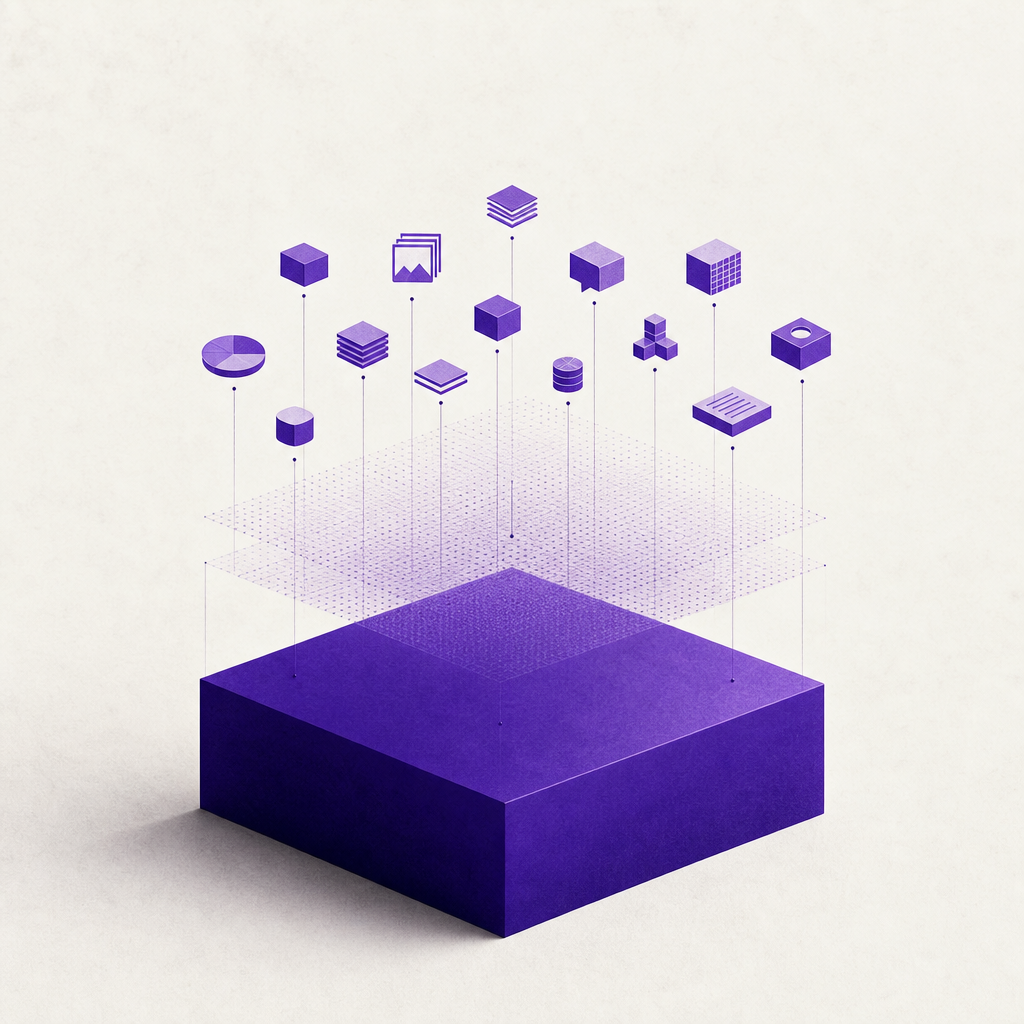
A foundation model is a pre-trained neural network that serves as the cognitive substrate for virtually every modern AI application.
Models like GPT-4, Claude 3, Gemini, and Llama 3 are foundation models. They are trained once — at enormous cost — on text, code, images, and structured data. The result is a system that can reason across domains without task-specific retraining.
The term was coined by Stanford's HAI group in 2021. Their foundational research defined these models by two properties: emergence (unexpected capabilities that arise from scale) and homogenization (one model powering hundreds of downstream applications).
That second property is the one GTM and operations leaders should care about most.
---
How Is a Foundation Model Different from an AI Agent?

A foundation model reasons. An agent acts.
The foundation model has no memory of your last conversation (by default), no access to your CRM, no ability to send an email. It answers one query at a time and stops.
An AI agent wraps that reasoning engine in a loop:
- Perceive — receive a goal or trigger
- Plan — break the goal into steps
- Act — call tools, APIs, or other agents
- Observe — check results
- Iterate — adjust and continue until done
That loop is what makes an agent genuinely useful in an enterprise workflow. The foundation model is the brain. The agent is the worker. Mixing up the two leads to buying decisions based on the wrong criteria — like evaluating a car by its engine specs alone without checking whether it has a steering wheel.
---
Why Does the Foundation Model Choice Actually Matter for Enterprise AI?

The foundation model you run underneath an agent directly determines what that agent can and cannot do.
Different models have different strengths:
- Code generation — models like Claude 3.5 Sonnet and GPT-4o.com/gpt-4o) perform well
- Long-context reasoning — Gemini 1.5 Pro handles 1M+ token windows
- On-premise, air-gapped deployment — open-weight models like Llama 3 are required
- Cost at scale — smaller, distilled models (Mistral, Phi-3) reduce per-call costs significantly
This is why Nagent's Agent Orchestration layer is model-agnostic. Lock yourself into one foundation model and you inherit every one of its weaknesses — permanently. Nagent connects to 25+ leading LLMs (public sources cite this range; internal documentation references 100+ models via Composio integration), so you route each task to the model best suited for it.
---
What Does KARMIC Have to Do with Foundation Models?
KARMIC is Nagent's continuous learning engine — and it operates above the foundation model layer, not inside it.
Foundation models are static after training. They do not learn from your enterprise's usage patterns. KARMIC closes that gap. It captures outcomes from every agent interaction, identifies what worked, and updates agent behavior over time — without retraining the underlying foundation model.
This distinction matters enormously for operations leaders. You are not waiting for OpenAI or Anthropic to release a new model version to get smarter agents. KARMIC learns from your workflows, your data, your edge cases.
> "The foundation model gives the agent language. KARMIC gives it institutional memory."
---
How Does Nagent's Agent Studio Use Foundation Models?
Agent Studio is where foundation models become deployable enterprise agents — in hours, not months.
Here is how the stack works in practice:
- Helix — natural-language system design. Describe the agent you need; Helix translates it into a working architecture.
- Build Craft — execution layer. Connects the agent to your tools, APIs, and data sources.
- Agent Smriti — vector + episodic memory layer. Gives agents context that persists across sessions — something no foundation model provides out of the box.
- KARMIC — continuous improvement so agents get better with use.
The foundation model sits underneath all of this. Nagent's Agent Studio abstracts the complexity of model selection, so your VP of Operations does not need a PhD in ML to deploy a procurement agent that actually works.

---
When Should You Swap the Foundation Model Under an Agent?
Swap the foundation model when the task profile changes — not when results feel slightly off.
Specific triggers:
- Latency is too high → shift to a smaller, faster model for that task
- Accuracy drops on specialized content → route to a domain-fine-tuned model
- Compliance requires on-prem → switch to an open-weight model via Sovereign AI
- Cost per run exceeds budget → replace with a distilled alternative for high-volume, low-complexity tasks
Nagent's multi-model orchestration makes this a configuration change — not a re-architecture project.
---
Related Reading
- How Nagent's Agent Orchestration handles multi-model workflows
- What is Sovereign AI and why regulated industries need it
- Explore pre-built agents in the Nagent Agents Marketplace
- Enterprise AI case studies: real deployments, real outcomes
---
Frequently Asked Questions
What is a foundation model in simple terms? A foundation model is a large AI system trained on broad data — text, code, images — that can reason and generate language across many tasks. It is the cognitive engine that powers AI applications. On its own, it does not take actions; it needs an agent layer on top to connect it to tools, memory, and real-world workflows.
Is ChatGPT a foundation model? ChatGPT is an application built on top of a foundation model — specifically OpenAI's GPT-4 series. The foundation model is the underlying neural network. ChatGPT is the product layer that adds a chat interface, memory features, and tool access. The distinction matters when evaluating enterprise AI platforms, because the product layer is what determines capability — not the model alone.
Can an AI agent work with more than one foundation model? Yes — and for enterprise use cases, it usually should. Different models excel at different tasks. Nagent's Agent Orchestration layer routes each task to the most appropriate model automatically, so a single agent workflow can use GPT-4o for reasoning, a smaller model for classification, and an open-weight model for any on-premise processing requirements.
What is the difference between a foundation model and a large language model? All large language models (LLMs) are foundation models, but not all foundation models are LLMs. Foundation models can also process images, audio, and structured data (multimodal models). In enterprise AI discussions, the terms are often used interchangeably — but the broader category is foundation model, and LLM refers specifically to language-only variants.
How does Nagent prevent vendor lock-in to a single foundation model? Nagent's model-agnostic architecture — built into Agent Orchestration and governed by Sovereign AI for regulated deployments — means you are never tied to one provider. You can swap, mix, or upgrade foundation models without rebuilding your agent workflows.
---
What's Next
If you are evaluating agentic AI platforms and want to see exactly how Nagent's Agent Studio separates the foundation model layer from the orchestration layer — in your industry, with your use cases — book a free 30-minute demo at nagent.ai.