Agentic AI in Banking : Nagent Times Vol 01
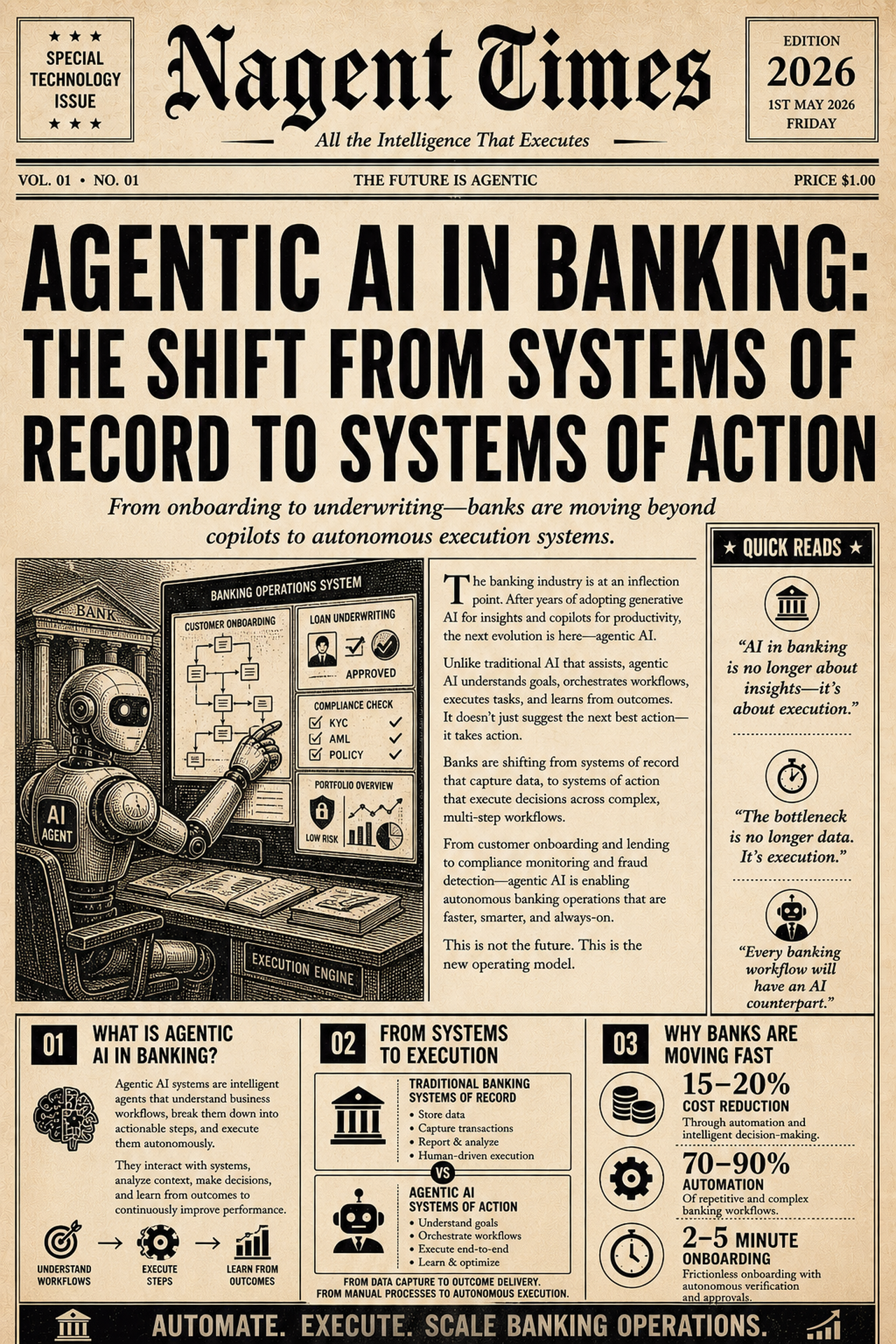
Nagent Times
Editorial Series | Agentic AI in Banking | Vol 01
Click to view The Nagent Times - Vol 01
:quality(80))
:quality(80))
:quality(80))
The Autonomous Bank: From Copilots to Execution Systems
For decades, banking innovation followed a predictable path.
First came digitization.
Then automation.
Then intelligence.
Each wave improved efficiency—but one thing remained constant:
👉 Humans still executed the work.
Even with the rise of generative AI, banks primarily gained:
faster insights
better copilots
improved decision support
But execution—the core of banking operations—remained manual, fragmented, and expensive.
That is now changing.
The Defining Shift
We are entering a new phase:
👉 From AI that assists → to AI that executes
Agentic AI introduces systems that:
understand workflows
plan multi-step actions
execute across systems
improve based on outcomes
This is not an incremental upgrade.
It is a structural shift in how banks operate.
Banking Is Becoming a System of Action
Traditionally, banks have been built as:
👉 Systems of record
👉 Systems of control
But the next generation of banking systems will be:
👉 Systems of action
Where:
onboarding happens autonomously
underwriting becomes continuous
fraud detection acts in real time
customer engagement is proactive
Execution moves from:
👉 human-driven → system-driven
Why This Shift Matters
The economics of banking are being rewritten:
Operational costs reduced by 15–20%
Decision automation reaching 70–90%
Onboarding cycles shrinking from days to minutes
ROI expanding 3–5x per AI investment
This is not about optimization.
👉 It is about redefining the cost structure of the bank
Where the Change Is Happening
Retail Banking → Invisible Banking
Agents predict customer needs, trigger actions, and manage financial journeys proactively.
Credit & Risk → Continuous Underwriting
Loan decisions are no longer one-time events—they evolve continuously based on real-time data.
Operations → Autonomous Workflows
Reconciliation, servicing, and exception handling move toward full automation.
Corporate Banking → Real-Time Capital Intelligence
Liquidity, hedging, and financial decisions are managed dynamically by intelligent agents.
The Rise of the Agentic AI Lab
Forward-looking banks are not waiting.
They are building:
👉 Agentic AI Labs
These labs serve as:
experimentation environments
deployment engines
continuous improvement systems
This is where:
workflows are redesigned
agents are tested
systems are deployed at scale
👉 The lab becomes the innovation core of the bank
Regulation: The New Design Constraint
Agentic systems operate differently.
They are:
probabilistic
adaptive
continuously evolving
This introduces new requirements:
auditability
explainability
governance
Banks are responding with:
AI control layers
human-in-the-loop systems
programmable compliance frameworks
👉 Compliance is no longer a barrier.
👉 It becomes part of the system architecture.
From Tools to Systems
The biggest misconception today:
👉 That AI is a tool layer.
In reality, AI is becoming:
👉 An operating layer
The shift is clear:
Old Model
New Model
Tools
Systems
Copilots
Agents
Workflows
Autonomous execution
Decisions
Outcomes
This Week in Nagent Times
In this edition, we break down:
The rise of the Autonomous Bank
Real-world agentic use cases
Department-level transformation
The Agentic AI Lab model
Regulatory implications
Download the Full Edition
Nagent Times — Agentic AI in Banking
A newspaper-style deep dive into the future of banking.
link: https://canva.link/fh9q112nlf3qwlb
👉 Includes:
use cases
Architecture breakdown
Implementation insights
Download the full PDF below
Closing Note
The shift has already begun.
Not slowly. Not experimentally.
But structurally.
The question is no longer:
👉 Will banks adopt AI?
The real question is:
👉 Which workflows will they give to AI first?