AI Agents for Localized Store Marketing
AI Agents for Localized Store Marketing
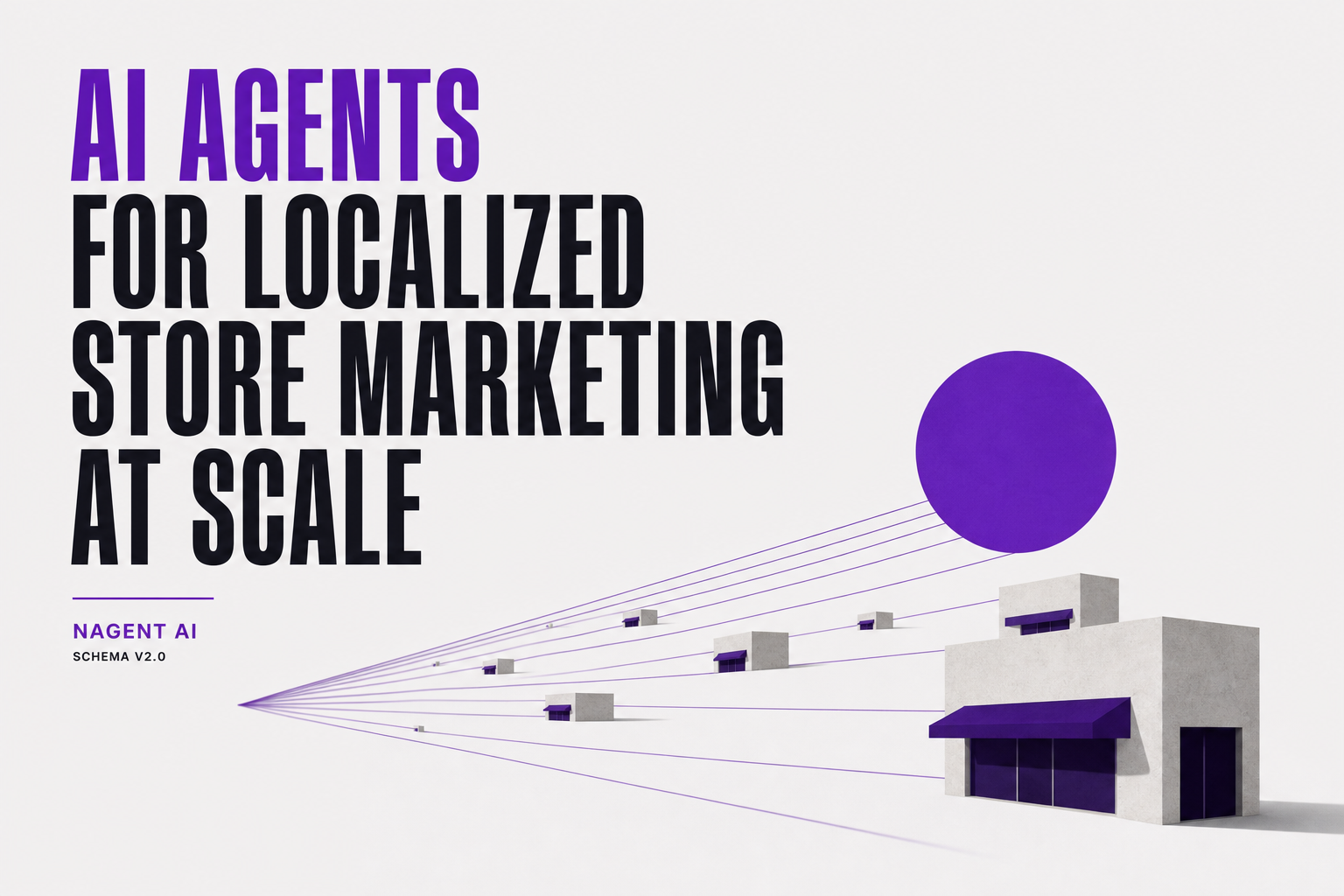
AI agents for localized store marketing solve the operational gap between centralized teams and hundreds of store locations by reading store-level signals—foot traffic, inventory, local events—and deploying campaigns autonomously. No field marketer required per location. Agents generate store-specific promotions, adapt signage copy, and publish local social posts in real time, cutting campaign turnaround from weeks to hours.
Why does localized store marketing fail at scale?
Most retail marketing teams hit the same wall: the strategy is solid, but execution collapses beyond 20-30 locations.
Centralized teams cannot realistically adapt creative for 200 stores. Regional managers lack the tools and time. The result? Every location runs the same campaign — regardless of whether Store 147 in Austin is sitting on excess winter inventory during a heat wave, or Store 23 in Chicago has a major local festival driving foot traffic this weekend.
That is the operational gap. And it is costing retailers revenue every day.
Consider the math. A chain with 300 locations, each missing 2-3 conversion opportunities per month from misaligned promotions, compounds into a significant bottom-line drag. Teams in this position typically see 15-25% lift in store-level conversion when campaigns match local context — but achieving that without AI has required a dedicated field marketer per region, which most brands cannot afford.
What do AI agents for localized store marketing actually do?
AI agents for localized store marketing read live store-level data, generate campaign assets, and deploy them — without a human approving every output.
This is not automation in the traditional sense. Traditional automation runs predefined rules: "if inventory > X, send discount." Agents reason. They weigh multiple signals simultaneously — regional weather forecast, local competitor activity, foot traffic trend from the last 14 days, and current inventory position — then decide what campaign to run, write the copy, and push it to the right channel.
Nagent's Agent Orchestration layer coordinates this across multiple agents handling different tasks:
A data agent pulls store-level signals from your POS, foot traffic sensors, and local event APIs
A content agent generates localized copy — promotional SMS, signage headlines, local social captions
A deployment agent pushes assets to the correct channels: in-store digital signage, Google Business Profile posts, local social accounts
A learning agent tracks engagement and feeds results back into KARMIC, Nagent's continuous learning engine
Each agent handles its lane. The orchestration layer ensures they work in sequence — not in silos.

Which store-level signals should agents read?
The quality of localized campaigns depends entirely on the signals feeding the agents.
Weak inputs produce generic outputs. Strong, store-specific inputs produce campaigns that feel hand-crafted — at machine speed.
The signals that matter most:
Real-time inventory by SKU — overstocked items become local promotions; understocked items get suppressed from campaigns
Foot traffic patterns — day-of-week and hour-of-day data shapes offer timing and channel selection
Local event calendars — sports fixtures, festivals, school holidays create predictable demand spikes
Regional weather — affects product relevance in apparel, F&B, and home goods categories
Competitive proximity data — nearby competitor openings or promotions shift the urgency of local offers
Nagent's Agent Smriti memory layer retains historical context for each store — so agents do not start from zero every campaign cycle. They remember that Store 147 underperformed last November's winter push and weight that into this season's timing decisions.
How does campaign content get generated at store level?
Agents generate store-specific content by combining a brand-controlled template layer with dynamic local variables — keeping brand consistency intact while personalizing the message.
This addresses the biggest fear retail marketing directors have: "If agents are writing copy, will it sound off-brand?"
The answer is no — if the architecture is right.
Nagent's Build Craft execution layer separates brand guardrails (tone, terminology, visual rules) from dynamic content slots (store name, offer details, local reference). Agents fill the dynamic slots. They never touch the brand guardrails.
A practical example:
Brand template: "[Store name] has something special for [local reference] — [offer headline]. Valid [dates] at [address]." Agent output for Store 23, Chicago: "Lincoln Park has something special for Cubs Opening Week — 20% off all team gear. Valid April 4-6 at 2145 N. Halsted."
That output required zero human intervention. It used real inventory data (team gear is in stock), a real local event (Cubs Opening Day), and the correct store address — all pulled and assembled in under 3 seconds.
Multiply that by 300 stores, across weekly campaign cycles, and you begin to see why ai agents for localized store marketing represent a structural shift — not just a productivity tool.
What channels can agents deploy to autonomously?
Agents deploy across every channel where your store has a local presence.
The channels most retail chains activate first:
In-store digital signage — agents update display content based on time-of-day foot traffic and current inventory
Google Business Profile posts — weekly local posts generated and published without manual login per location
Local social accounts — Instagram and Facebook posts tailored per store, scheduled based on peak engagement windows
SMS and push notifications — triggered by foot traffic drops or inventory thresholds, not just calendar scheduling
The deployment layer in Nagent connects to these channels via standard integrations. Helix, Nagent's natural-language system design interface, lets your marketing team configure which channels activate under which signal conditions — without writing code.
How do agents learn and improve campaign performance over time?
KARMIC, Nagent's continuous learning engine, ingests campaign performance data and adjusts agent behavior for subsequent cycles — so agents improve with every store, every campaign.
This is where AI agents create compounding value that rules-based automation never achieves.
After each campaign cycle, KARMIC captures:
Open and redemption rates by store
Which signals most accurately predicted high-converting periods
Which content variants performed above the baseline
Agents in the next cycle weight their decisions accordingly. Store 23 responded strongly to event-tied promotions — agents prioritize event-signal weighting for that location going forward. Store 147 showed higher conversion on inventory-clearance urgency copy — agents adjust tone accordingly.
Over 6-12 months of deployment, ai agents for localized store marketing built on KARMIC become materially more accurate for each specific store — a competitive moat that compounds with time.
Is this a build or buy decision?
For most multi-location retailers, buying a pre-built agent stack and configuring it to your data sources is faster than building from scratch.
Nagent's Agent Studio offers a "Build on Me" engagement model — pre-built agents for retail marketing workflows that your team configures and owns. For brands with more complex orchestration needs, the "With Me" model brings Nagent's solution team in to co-develop the agent logic alongside your marketing operations team.
A retailer with 100+ locations can typically deploy their first localized campaign agent in under 2 weeks using the Build on Me path — versus a 3-6 month custom build timeline.
The build-vs-buy calculus shifts further toward buying when you factor in the ongoing model maintenance that KARMIC handles automatically. Your team is not managing prompt updates or retraining cycles — that infrastructure is built in.
Explore Nagent's retail marketing solutions to see which engagement model fits your current operations.
Related reading
Frequently Asked Questions
What are AI agents for localized store marketing?
AI agents for localized store marketing are autonomous software agents that read store-level signals — inventory, foot traffic, local events — and generate and deploy location-specific campaigns without requiring human input for each store. They handle content generation, channel deployment, and performance learning in a continuous loop. Nagent's Agent Orchestration layer coordinates multiple specialist agents handling each part of this workflow.
How do AI agents maintain brand consistency across hundreds of store locations?
Agents work within a structured template system where brand guardrails — tone, terminology, visual rules — are locked and managed centrally. Dynamic content slots (store name, local reference, offer details) are filled by agents using live data. Nagent's Build Craft execution layer enforces this separation, so agents personalize within brand boundaries rather than generating free-form copy.
Do I need a data engineering team to connect store-level signals to agents?
Not for standard data sources. Nagent's pre-built integrations cover common POS systems, foot traffic platforms, and event data APIs. For custom or proprietary data sources, Nagent's "With Me" co-development model includes integration setup as part of the engagement. Most retailers activate their first agent on live store data within 2 weeks.
How long does it take to see performance improvement from AI-driven localized campaigns?
Initial campaigns can go live within 2 weeks of deployment. Performance improvement compounds over time as KARMIC ingests results and adjusts agent behavior per store. Teams typically observe measurable lift in store-level conversion within the first 60-90 days, with continued improvement through 6-12 months as the learning layer accumulates store-specific context.
What happens if an agent generates content that does not fit a specific store's context?
Brand guardrails prevent off-brand outputs by design. For edge cases — a store temporarily closed, a local situation requiring sensitivity — agents can be configured with override rules or human-in-the-loop review gates for flagged scenarios. Nagent's Sovereign AI governance layer provides audit trails for every piece of agent-generated content, giving marketing directors full visibility and control.
What's next
See how Nagent's ai agents for localized store marketing perform against your specific store network — book a free 30-minute demo at nagent.ai and walk through a live agent deployment scoped to your location count and channel mix.