AI Chatbot vs. Agentic CX: What Resolves Fintech Disputes
AI Chatbot vs. Agentic CX: What Resolves Fintech Disputes
A chatbot answers questions. An agentic CX layer resolves disputes. That distinction — not feature parity — is what separates a 40% containment rate from a closed case. In fintech, where a dispute touches transaction records, fraud flags, policy thresholds, and regulatory timelines simultaneously, only an architecture that acts across all four closes the loop without a human relay.
---
Why does the chatbot vs. agentic AI debate matter for fintech CX?

Fintech CX teams comparing vendors on the wrong axis — features, pricing, integrations — consistently end up with the same problem: a bot that handles FAQs while humans still close disputes.
The traditional chatbot was built for deflection. It answers "What's my balance?" and "Where's my card?" It cannot pull a transaction record, cross-reference a chargeback policy, and file a resolution — because it has no memory, no tools, and no authority to act.
Agentic AI operates differently. It perceives a situation, retrieves relevant data, reasons across policy, and takes action — all within a single session. That's not an incremental upgrade. It's a different architecture altogether.
The fintech CX teams winning on resolution rate aren't asking "Which chatbot has better NLP?" They're asking: "Which system can own a dispute end-to-end?"
---
What actually separates a chatbot from an agentic CX layer?

A chatbot generates text. An agentic CX layer executes workflows.
Here's the operational difference:
| Capability | AI Chatbot | Agentic CX Layer |
|---|---|---|
| Reads transaction records | ✗ (surface display only) | ✓ (live API pull) |
| Cross-references policy | ✗ | ✓ (policy as agent memory) |
| Files dispute autonomously | ✗ | ✓ (tool-use + action) |
| Escalates with context | Partial | ✓ (full session handoff) |
| Learns from outcomes | ✗ | ✓ (via continuous learning) |
The gap isn't philosophical — it's architectural. A chatbot is stateless. Each message is fresh. An agentic layer carries memory, tools, and goals across an entire interaction.
Nagent's Agent Smriti handles exactly this: vector and episodic memory that retains context from the moment a customer opens a dispute to the moment it closes. No repeat questions. No dropped context on handoff.
---
How does multi-agent orchestration resolve a fintech dispute faster?
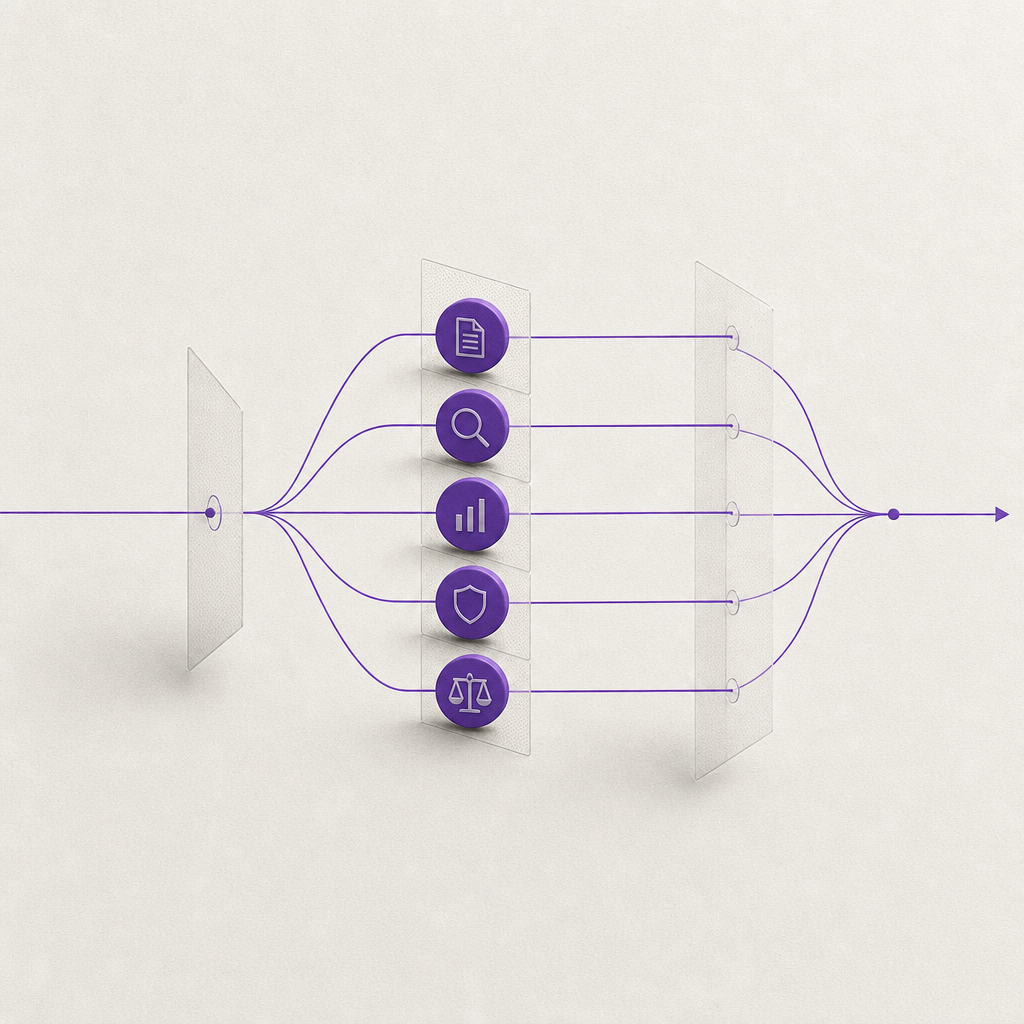
A single agent handles one function. Agent Orchestration coordinates multiple specialists working in parallel — cutting resolution time from hours to minutes.
In a typical dispute workflow, this looks like:
- Intake agent captures and classifies the dispute type
- Data retrieval agent pulls transaction records from core banking APIs
- Policy agent cross-references chargeback rules and regulatory timelines
- Decision agent determines eligibility and resolution path
- Action agent files the resolution or escalates with a full brief
No human relay between steps. No ticket bouncing. The Nagent KARMIC continuous learning engine monitors each resolved case and refines decision thresholds — so the system gets more accurate over time, not just faster.[^2]
> "The autonomous bank is not a distant vision — it is a near-term operational imperative." — The Autonomous Bank: A Strategic Blueprint for Agentic AI in Wholesale & Corporate Banking, Nagent AI[^2]
That framing applies directly to CX. Dispute resolution is one of the highest-cost, highest-friction moments in any fintech customer relationship. Automating it fully — not partially — is now table stakes.
---
What decision criteria actually predict dispute resolution rate?
When evaluating ai chatbot vs agentic ai fintech cx, resolution rate tracks four variables — not the ones on most vendor scorecards.
1. Tool access depth Can the system read and write to your core systems — banking APIs, CRM, fraud platforms? Read-only access produces summaries, not resolutions.
2. Memory persistence Does the system remember what happened three messages ago? Three sessions ago? Agent Smriti's episodic memory layer retains context across sessions, eliminating the "please repeat your issue" failure mode.
3. Policy as agent knowledge Policy documents locked in a PDF are useless to a chatbot. An agentic system ingests policy as structured knowledge — and reasons against it in real time. Nagent's Build Craft executes this at the workflow level, connecting policy logic to action triggers.
4. Ethical constraint handling Fintech disputes carry regulatory weight. Agents making autonomous decisions need guardrails. The multi-source reinforcement learning framework underlying Nagent's architecture trains agents against ethical and compliance constraints — not just task completion.[^3]
Score vendors on these four axes. Feature parity on NLP quality or UI polish won't predict whether your dispute queue shrinks.
---
When should a fintech team build vs. buy an agentic CX layer?
Buy — unless you have 12+ months, an ML team, and a compliance infrastructure already integrated.
Nagent's Agent Studio lets CX and product ops teams design and deploy dispute-resolution agents in natural language — no engineering bottleneck. Helix handles system design from a plain-English description of your workflow. Teams in this position typically go live in days, not quarters.
The "build" path makes sense only if your dispute logic is proprietary enough to be a competitive moat. For most fintechs, it isn't. The moat is resolution speed and customer retention — both of which compound faster when you deploy, not develop.
For CX Directors evaluating vendors right now, the BFSI solutions page maps Nagent's fintech-specific deployment patterns to dispute, onboarding, and fraud workflows.
---
Related reading
- How agentic AI is rewriting financial services workflows
- Agent Orchestration: coordinating multi-step workflows without human relay
- KARMIC: the continuous learning engine behind improving resolution accuracy
- Fintech and BFSI agentic AI solutions
---
Frequently Asked Questions
What is the main difference between an AI chatbot and an agentic AI system in fintech CX?
An AI chatbot generates text responses based on a user's message. An agentic AI system perceives the full context of a dispute, retrieves live data from connected systems, reasons against policy, and takes action — such as filing a chargeback resolution — without a human relay. The difference is not capability depth; it is architectural authority to act.
Can an agentic CX layer handle regulatory compliance during dispute resolution?
Yes. Nagent's agentic architecture trains agents against ethical and compliance constraints using multi-source reinforcement learning, not just task-completion metrics.[^3] Policy documents are ingested as structured knowledge, so the agent reasons against regulatory timelines and chargeback thresholds in real time — rather than surfacing a document for a human to interpret.
How long does it take to deploy an agentic dispute-resolution workflow with Nagent?
Teams using Nagent's Agent Studio and Helix natural-language design tool typically deploy their first dispute-resolution agent within days. The "Build on Me" engagement tier provides pre-built fintech agents that can be configured to your policy and API environment without writing code.
How does Nagent's KARMIC engine improve dispute resolution over time?
KARMIC monitors the outcome of every resolved case and updates agent decision thresholds based on real results. This means the system's accuracy on eligibility determinations improves with each dispute closed — reducing false escalations and misrouted cases the longer it runs.[^2]
What should fintech CX directors ask vendors before signing a support-automation contract?
Ask four questions: Does the system have read-and-write access to your core banking APIs? How does it retain context across sessions and escalations? How is policy logic encoded and updated? And what compliance guardrails govern autonomous decisions? A vendor who cannot answer all four clearly is selling a chatbot dressed as an agent.
---
What's next
See how Nagent's agentic CX layer closes disputes end-to-end — without a human relay. Book a free 30-minute demo at nagent.ai.
Sources
- The Agentic FMCG Playbook _(pdf)_
- The autonomous bank in Agentic Era _(pdf)_
- Agentic AI SYSTEM _(pdf)_