AI-Generated UGC Ads vs. Influencer Creative: Cost & Speed
AI-Generated UGC Ads vs. Influencer Creative: Cost & Speed
AI-generated UGC ads cost 85–95% less per creative than influencer-sourced content and launch in hours instead of weeks. For D2C and FMCG brands running paid social at scale, that math doesn't just change the budget conversation — it changes how many hypotheses you can test, how fast you can iterate, and ultimately, how much of your ad spend actually converts.
What Does Influencer-Sourced Creative Actually Cost?
The real number is 3–5× what most CMOs budget for.
Most teams account for the creator fee. Few account for everything around it.
Here's a realistic line-item breakdown for a single influencer UGC creative:
| Cost Item | Typical Range |
|---|---|
| Creator fee (mid-tier, 50K–200K followers) | $800 – $2,500 |
| Briefing, negotiation, contracting | $200 – $600 (internal hours) |
| Revisions (avg. 2–3 rounds) | $300 – $900 |
| Usage rights (paid social, 90 days) | $500 – $1,500 |
| Gifting / product send | $50 – $300 |
| Creative director oversight | $150 – $400 |
| Total per creative | $2,000 – $6,200 |
And that's before the 3–6 week production timeline.
At $50K/month in paid social spend, most performance teams need 20–40 fresh creatives per month to maintain test velocity. Run that math: you're looking at $40K–$250K in production costs alone — before a single dollar hits the ad auction.
How Does AI-Generated UGC Compare on Cost Per Creative?
AI-generated UGC ads drop per-creative costs to $15–$80, including iteration.
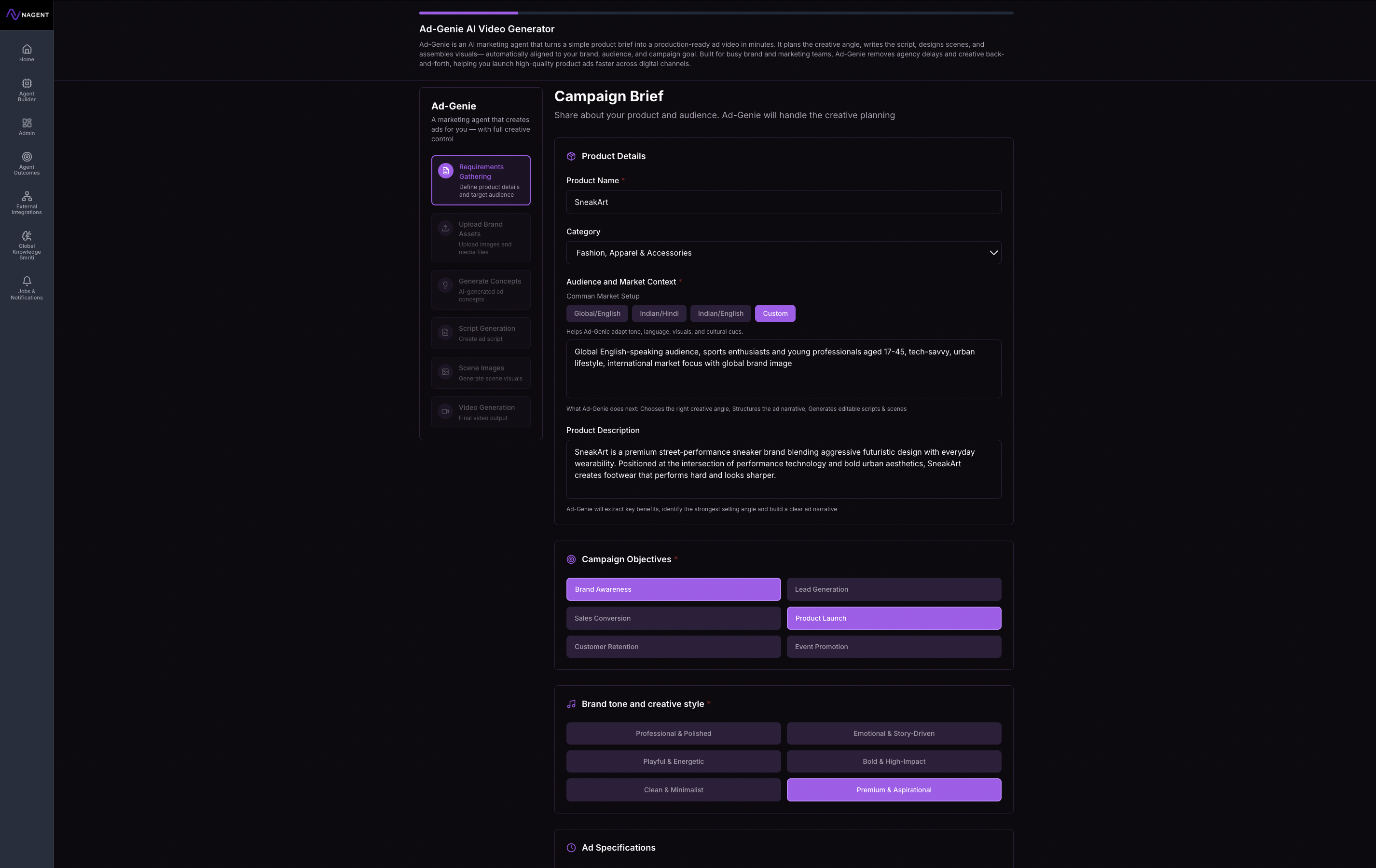
This isn't a theoretical estimate. It's the operational reality teams using tools like Ad-Genie and UGC Muse are reporting.
Here's the AI-generated line-item breakdown for one creative:
| Cost Item | Typical Range |
|---|---|
| AI generation (script + visual + format) | $10 – $40 |
| Internal review (1 round, 15–20 min) | $5 – $20 (internal hours) |
| Format adaptation (9:16, 1:1, 16:9) | $2 – $10 |
| Total per creative | $17 – $70 |
The difference isn't incremental. It's structural.
At the same $50K/month ad spend, you can produce 400–600 AI-generated creatives for what you'd spend on 15–20 influencer clips. That's not a marginal improvement in test capacity — it's a different operating model.
What Does the Speed Gap Look Like in Practice?
Influencer UGC takes 21–42 days from brief to live. AI-generated UGC takes 20 minutes to 4 hours.
That speed gap has compounding consequences.
With influencer sourcing, a typical production calendar looks like this:
- Brief creation and internal approval — 3–5 days
- Creator shortlisting and outreach — 5–7 days
- Contract and negotiation — 3–7 days
- Content creation by creator — 5–10 days
- Review, revision, approval — 5–10 days
- Usage rights clearance — 2–5 days
Total: 23–44 days before the creative is live.
With Ad-Genie, the same workflow compresses to:
- Brief input — 5 minutes
- Script + scene generation — 8–15 minutes
- Format adaptation across platforms — automated
- Internal review — 15–20 minutes
Total: Under 1 hour for a campaign-ready video ad.
When a trend breaks on TikTok or a competitor drops a flash sale, that speed gap is the difference between capturing the moment and missing it entirely.
How Does Iteration Velocity Change the Performance Equation?
Faster iteration means more data, faster — and that compounds into measurably better ROAS over time.
This is the part of the ai ugc ads vs influencer creative cost debate that most CMOs underweight.
Creative iteration isn't just about speed. It's about the number of hypotheses you can test per dollar. Every creative is a hypothesis: this hook, this offer, this visual treatment, this CTA. The team that tests more hypotheses per month learns faster and wins more auctions.
With influencer sourcing:
- Avg. creatives tested per month: 8–15
- Avg. iterations per winning creative: 1–2
- Time to identify a winner: 3–5 weeks
With AI-generated UGC:
- Avg. creatives tested per month: 80–200
- Avg. iterations per winning creative: 6–12
- Time to identify a winner: 3–7 days
Ad-Genie generates 9 creative variations from a single brief. That means every hypothesis gets 9 shots at the data before you decide what to scale. Most influencer-sourced workflows give you 1.
Is AI-Generated UGC Authentic Enough to Convert?
Authenticity in performance creative isn't about the source — it's about the signal.
This is the objection every creative director raises. And it's worth taking seriously.
The assumption is that human creators produce more authentic content, and authenticity drives conversion. That's partially true — but it conflates two different things: perceived authenticity and creative authenticity.
Perceived authenticity (the "real person" feel) matters for brand campaigns targeting cold audiences. Creative authenticity (the right hook, the right emotional trigger, the right social proof framing) matters for performance creative driving ROAS.
For performance-focused paid social — the $50K+/month context this post is written for — creative authenticity wins. And AI-generated UGC, when briefed well, produces hooks, scripts, and visual treatments that are indistinguishable from creator content in a feed environment.
Tools like UGC Muse are specifically designed for this: retention-focused scripts, platform-native hooks, engagement pacing built for the first 3 seconds. The output isn't generic — it's engineered for scroll-stop performance.
For top-of-funnel brand building with macro influencers? Human creators still have an edge. But that's a different budget line.
What Does a Hybrid Model Look Like at Scale?
The smartest teams use influencer creative for brand equity and AI-generated UGC for performance volume.
This isn't an either/or decision. The highest-performing D2C brands at scale are running both — but they're allocating them differently.
Influencer-sourced creative: 3–5 hero assets per quarter. Used for brand campaigns, retargeting anchors, and social proof. Budget: $15K–$30K/quarter.
AI-generated UGC: 150–300 creatives per month. Used for prospecting, A/B testing, offer variation, and format adaptation. Budget: $3K–$8K/month.
The ratio shift is significant: instead of spending 60–70% of creative budget on production, teams in this model spend 15–20% — and redirect the rest into media spend.
Nagent's Campaign Hub handles the brief-to-creative pipeline end-to-end: brief input, brand-aligned copy, CTAs, and static creatives at scale, without requiring a detailed prompt for every asset. For teams managing multi-SKU campaigns across platforms, that's the operational unlock.
CREA — the Creative Content Execution Agent acts as the entry point for content teams building this model on Nagent's platform, routing to the right agents based on the campaign type, format, and objective.
What's the Total Cost of Ownership Comparison Over 90 Days?
Over a 90-day period, AI-generated UGC delivers 10–20× more test volume at 15–25% of the production cost.
Here's the 90-day math for a brand spending $50K/month on paid social:
| Metric | Influencer-Sourced | AI-Generated UGC |
|---|---|---|
| Creatives produced | 25–45 | 400–700 |
| Production cost | $75K – $200K | $8K – $20K |
| Avg. time to first live creative | 21–42 days | < 4 hours |
| Winning creative identification time | 3–5 weeks | 3–7 days |
| Iteration rounds per creative | 1–2 | 6–12 |
| Cost per creative | $2,000 – $6,200 | $17 – $70 |
The ai ugc ads vs influencer creative cost comparison isn't close at this scale. The question isn't whether AI-generated UGC is cheaper — it is. The question is whether your team is structured to act on 10× more creative data than you're generating today.
That's the real strategic shift.
Related Reading
- How AI Agents Are Rewriting Social Media Content for E-Commerce CMOs
- Product Ad Creative Generator: Scaling Ads from a Few Winners to Infinite Performers
- AI Restructuring Marketing Content Operations
- Why Fashion Marketers Are Ditching Studios for AI Visual Agents
Frequently Asked Questions
What is the average cost difference between AI UGC ads and influencer-sourced creative?
Influencer-sourced UGC typically costs $2,000–$6,200 per creative when you include creator fees, usage rights, revisions, and internal overhead. AI-generated UGC ads typically cost $17–$70 per creative, including generation, review, and format adaptation. That's an 85–95% cost reduction per asset.
How long does it take to produce an AI-generated UGC ad compared to influencer content?
Influencer-sourced UGC takes 21–44 days from brief to live creative. AI-generated UGC — using tools like Ad-Genie or UGC Muse on the Nagent platform — takes under 1 hour from brief input to a campaign-ready video ad. For time-sensitive campaigns, that speed gap is decisive.
Does AI-generated UGC perform as well as human creator content in paid social?
For performance-focused paid social targeting ROAS, AI-generated UGC performs comparably to human creator content — and often outperforms it due to higher iteration velocity. Human influencer content retains an edge in brand-building campaigns targeting cold audiences at the top of the funnel, where perceived authenticity carries more weight.
How many creatives should a $50K/month paid social brand be testing?
Performance marketing benchmarks suggest testing 20–40 new creatives per month at $50K/month in ad spend to maintain healthy creative refresh rates and avoid audience fatigue. Most influencer-sourced workflows produce 8–15 per month. AI-generated UGC workflows routinely produce 150–300 per month at the same budget allocation.
Can AI-generated UGC and influencer content work together in the same paid social strategy?
Yes — and the highest-performing D2C brands use both. The recommended model: 3–5 influencer hero assets per quarter for brand equity and retargeting anchors, plus 150–300 AI-generated creatives per month for prospecting, offer testing, and format variation. This hybrid approach typically reduces total creative production costs by 60–75% while increasing test volume by 10–15×.
What's Next
If your team is spending more than $20K/month producing creative that your media budget outpaces, it's time to see what an AI-generated UGC workflow looks like in practice. Book a free 30-minute demo at nagent.ai — we'll show you exactly how fast your first campaign-ready creative can go live.