
Dust vs Claude Tag
Dust and Claude Tag compared on the same dimensions, with Nagent beside them: role, pricing, governance evidence, screenshots and the demonstration to ask for.
Dust is a reusable workspace and orchestration layer at €30 / seat / month; Claude Tag is a reusable workspace and orchestration layer at Pricing not published. Nagent is multiplayer AI for growth teams: agent teams for marketing, sales and CX in one shared workspace, from $29.99 a month, with autonomy earned on approved work.
At a glance
| Dimension | Nagent ↗ | Dust ↗ | Claude Tag ↗ |
|---|---|---|---|
| Stack role | Control plane / Horizontal AI | Control plane / Horizontal AI | Control plane / Horizontal AI |
| Maturity | scaling | scaling | emerging |
| Growth scope | Marketing, Sales, CX | Marketing, Sales, CX | Marketing, Sales, CX |
| Price | From $29.99 per month | €30 / seat / month | Pricing not published |
| Billing basis | Published plans with seats and monthly credits; annual billing saves 33%. Enterprise adds VPC deployment, BYO model and BYO key. | Pro monthly: 8,000 credits. Annual: €24/seat/month equivalent. Excludes VAT; Enterprise custom. | Available in beta on Claude Team and Enterprise plans. Channel, thread and group DM work bills by usage to an organisation usage balance in its billing currency, capped by a monthly spend limit an Owner sets; adding Claude to Slack adds no per-seat charge, and the documentation states there is no published per-task cost guidance. One-to-one DMs from members with a connected Claude account bill to that member's seat. Team plans must fund the usage balance before Claude responds in channels. A one-time launch credit of USD 25,000 per Enterprise and USD 2,500 per Team organisation expired on 1 October 2026. |
| Documented statements | Nagent runs a shared workspace for people and agents, Smriti memory that every agent reads, Karma performance records built from each agent's KPIs and governance history, and composable skills, tools, agents and workflows. 17 ready-to-install agents ship today: one super agent, 8 function specialists and 8 industry strategists. Agents run on 19 model providers and 61 models and connect to 998 tools. The marketplace lists 58 published agents in all. 4 patents filed, 3 published. | Dust explicitly markets multiplayer human–agent collaboration. Pro and Max differ in included credits; Max is €150 monthly or €120 on annual billing, with 40,000 credits per seat monthly. Enterprise adds pooled credits, SCIM and audit-log features. | Anthropic announced Claude Tag on 23 June 2026 as a beta for Claude Enterprise and Team customers, starting on Slack, where one Claude identity per channel can be tagged by anyone in that channel. Claude builds channel memory, can learn from other channels and data sources when granted permission, and can schedule tasks and pursue a project over hours or days. Tasks run in an ephemeral sandbox, and admins extend what Claude can reach through connections, plugins and skills configured per channel, workspace or organisation. With the Respond automatically setting on, Claude may reply to untagged channel messages it judges warrant a reply. Claude Tag replaced the earlier Claude in Slack app, and the product page lists Microsoft Teams as coming soon, with a waitlist. |
| Governance evidence | Every action is fired, queued for approval or refused. Approval sits before the irreversible step, destructive changes always ask first, and each agent carries a budget cap and a kill switch. 6 workspace roles (Admin, Sales, Approver, Editor, Writer, Viewer), tenant isolation and an append-only audit trail. Autonomy runs L0 Locked to L4 Fully autonomous and is promoted on approved work, never automatically. SOC 2 Type II and ISO 27001 programmes underway; tenant isolation, RBAC, append-only audit and private VPC available today. | Dust describes separate permissions for agent data access and agent use, plus enterprise retention and deployment options. Validate the selected plan and connector behaviour. | The documentation describes Claude acting under its own service accounts, with admin-provisioned Access bundles scoped to channels or workspaces, organisation and per-channel spend limits, and an admin Activity page listing scheduled work, memory files (which Owners can edit or delete) and an hourly export of outbound network events. Use of a member's personal connectors in a channel requires that member's approval, with an option to review results before they post. During the beta there is no automatic retention period for Claude Tag data, and the healthcare guide states that Claude Tag is not covered by Anthropic's Business Associate Agreement. The launch post says admins can view a log of everything Claude has done and who requested each task, while the audit documentation states there is no per-action log of every task and who asked; confirm which applies to your plan and how actions are traced through each connected tool's audit log. |
| Promoted use cases | Run marketing, sales and CX agent teams with the people who own the number; Give every agent one shared memory and one ledger of decisions; Raise each agent from locked to fully autonomous on approved work, with approval before anything irreversible; Bring in forward deployed engineers and Growth Pods for custom delivery | Research accounts and prepare proposals; Create campaign briefs and performance narratives; Triage support and synthesize company knowledge | Triage requests in an intake channel and route what the docs do not cover; Answer data questions with warehouse queries and charts in the thread; Recap campaign channels, draft announcements and post a weekly campaign metrics digest |
| Review status | Figures from live client campaigns, 2025 to 2026, are published on nagent.ai: Emami Navratna: 24.5M+ reach on a single agent-run campaign; Madmonk AI: 5x more qualified leads; Bigbasket: 70% lower video ad production cost; Sophoz: 3x trial user growth after relaunch. Thirteen brands are named, with four customers quoted by name. These are vendor-published results; ask for a reference in your function and the baseline behind each figure. | G2’s September 2026 seller-invited review by Thibault G. praises model choice, connected knowledge and scheduled automation. A separate 2025 review sample praises reusable agents and support while raising onboarding, documentation and editing concerns. Those historical complaints require re-testing against today’s product. These are attributed experiences, not a representative benchmark or a verified guarantee of results. | No independent review sample was verified in this research pass. Vendor-hosted testimonials are selection-biased customer evidence, not an aggregate rating. |
| Editorial fit | Nagent is the option for teams that want agents and people in one workspace rather than a tool beside the work: shared memory, autonomy that is earned and enforced, published pricing from $29.99 per month, and a delivery team that owns the outcome with you. Evaluate it on the same evidence you would ask of any vendor: shared context, human control and a safe improvement loop. | Dust is a direct horizontal workspace comparator. Its self-service, published seat economics are easier to inspect than a custom managed engagement. Whether that workspace covers a particular end-to-end growth process still depends on configuration, connectors and accountable operators. | Claude Tag places one shared, general-purpose Claude teammate in Slack channels, and its documentation presents marketing, deal and support work as recipes that run on the connections an organisation configures. Beside an end-to-end growth team, it sits as a horizontal collaboration layer whose growth reach depends on those connections, skills and channel instructions. |
| Priority question | Can two colleagues join the same live agent task, change its direction, inspect the memory it used, approve or reject an action and export the audit trail? Nagent demonstrates this in a team room. | Show permission propagation and revocation across a shared conversation, a connected source and a scheduled agent. | For a task that changes a CRM record or sends a customer-facing message, which approval step can an admin require before Claude acts, and how is that action traced back to the person who asked? |
| Facts checked | 4 October 2026 | 23 September 2026 | 4 October 2026 |
| Detailed guide | All Nagent comparisons ↗ | Nagent vs Dust ↗ | Nagent vs Claude Tag ↗ |
Screenshots and source context
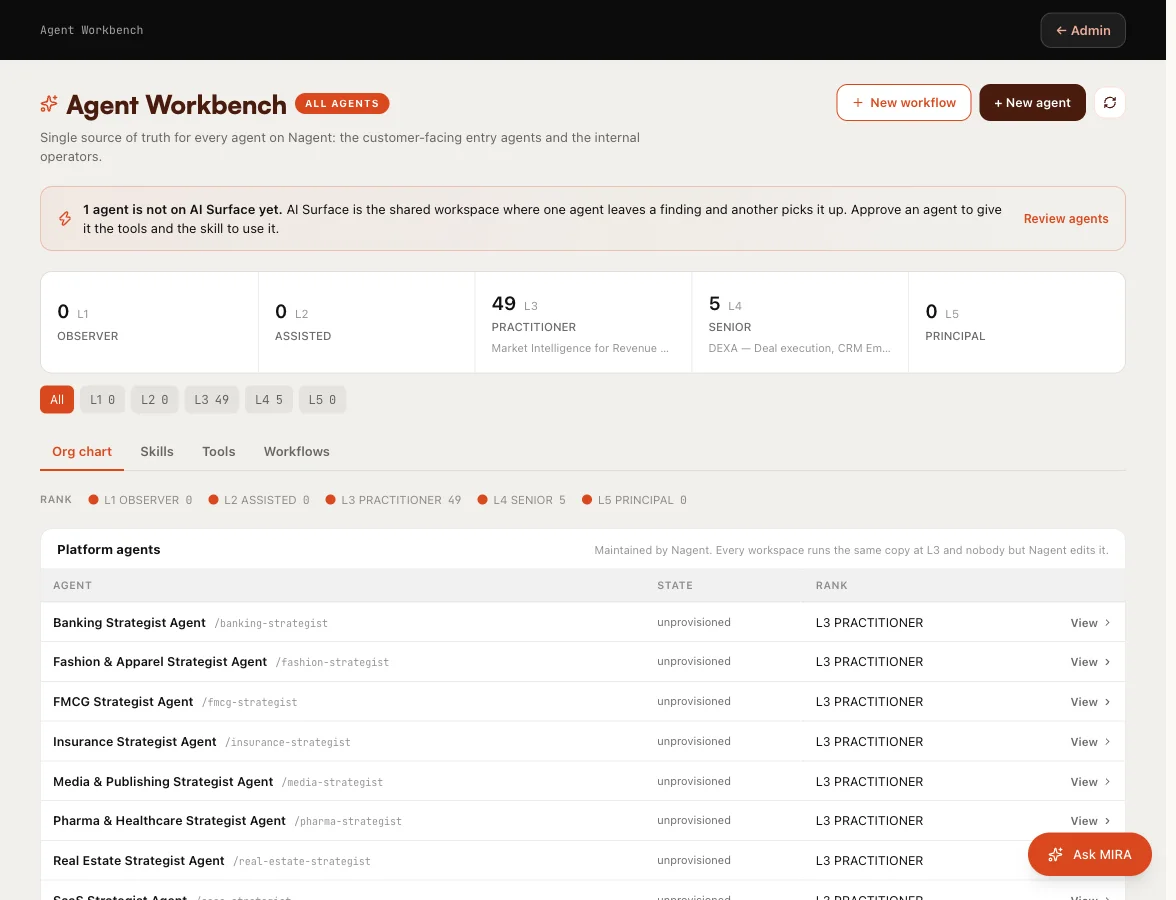
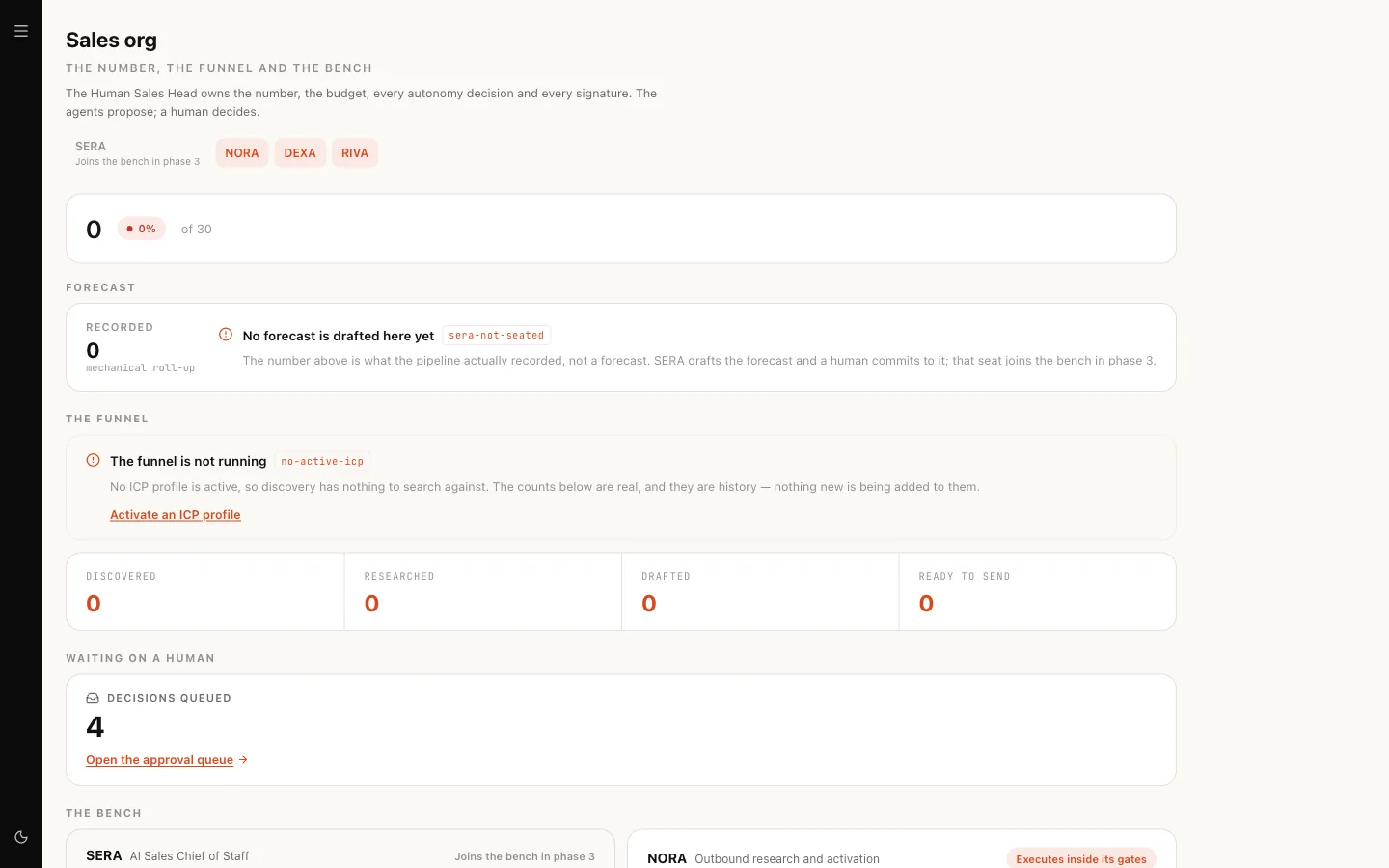
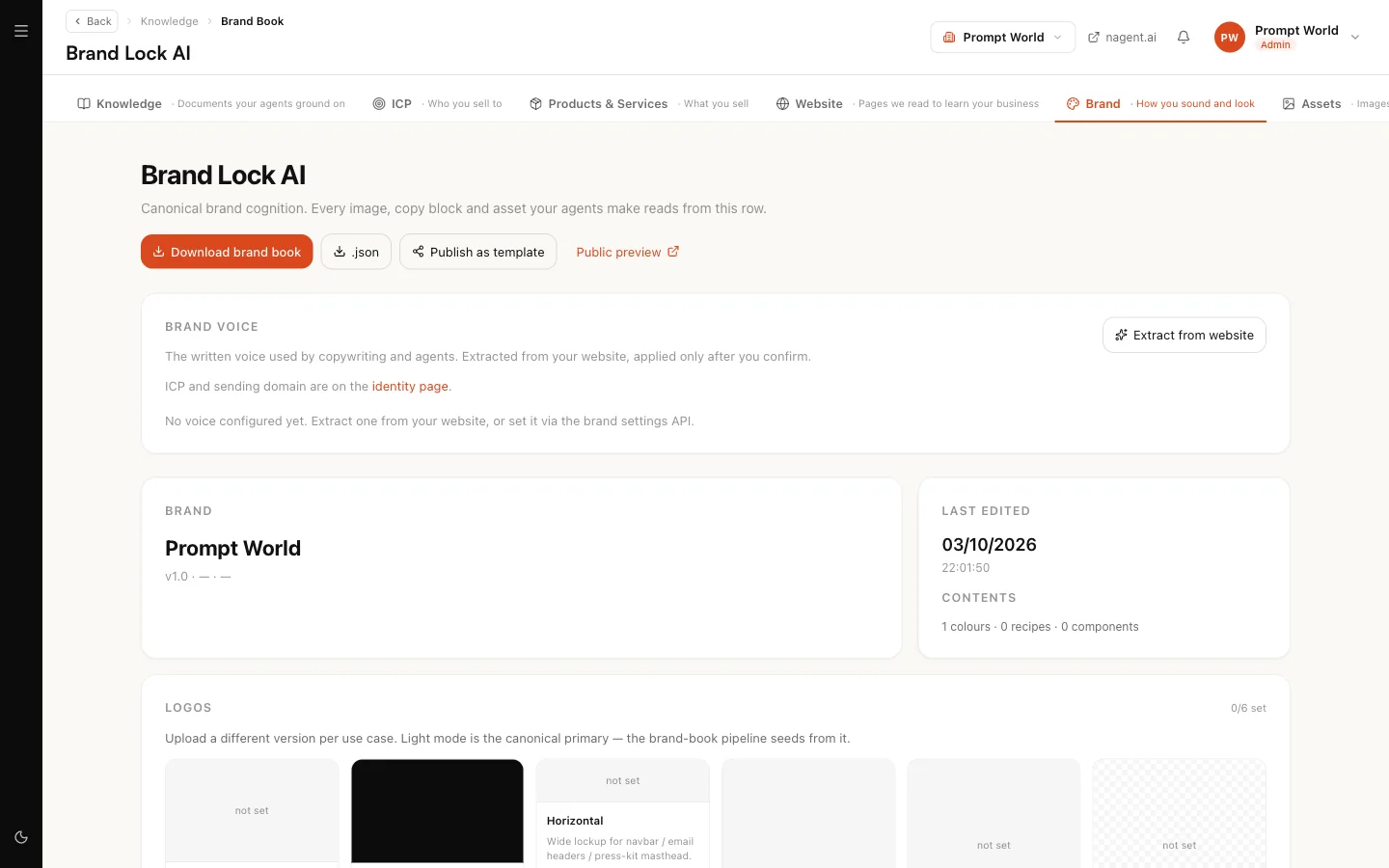
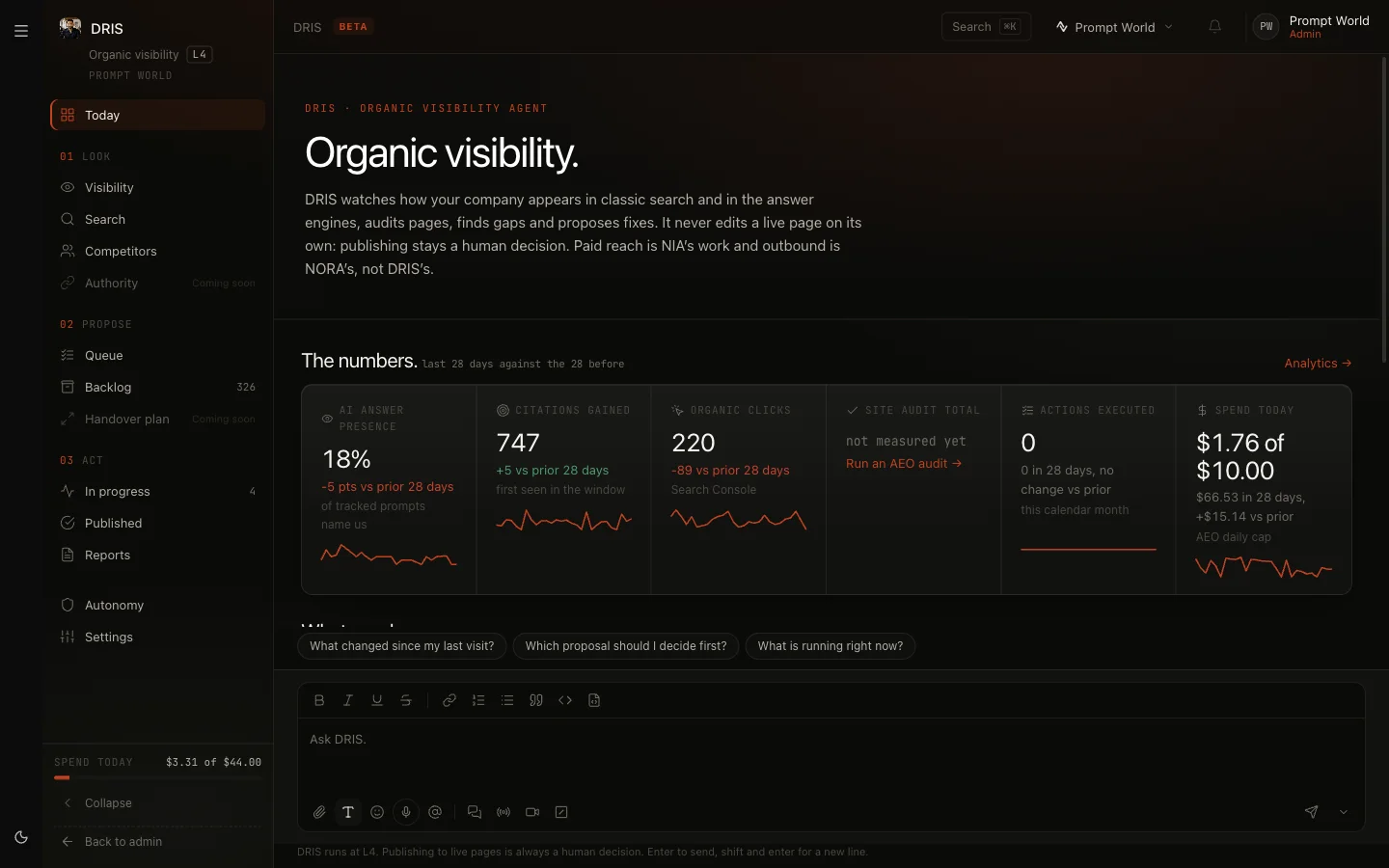
Nagent in detail
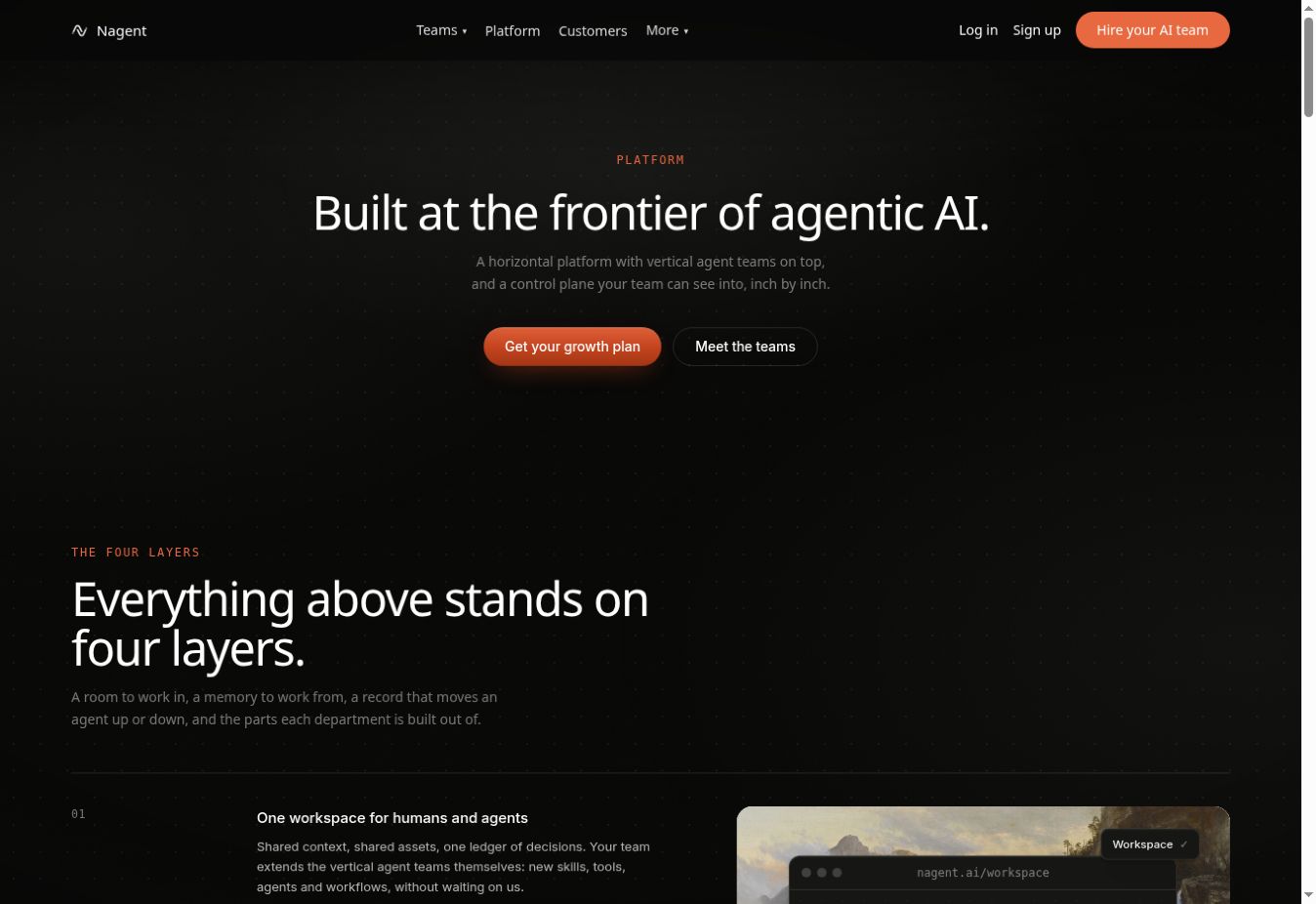
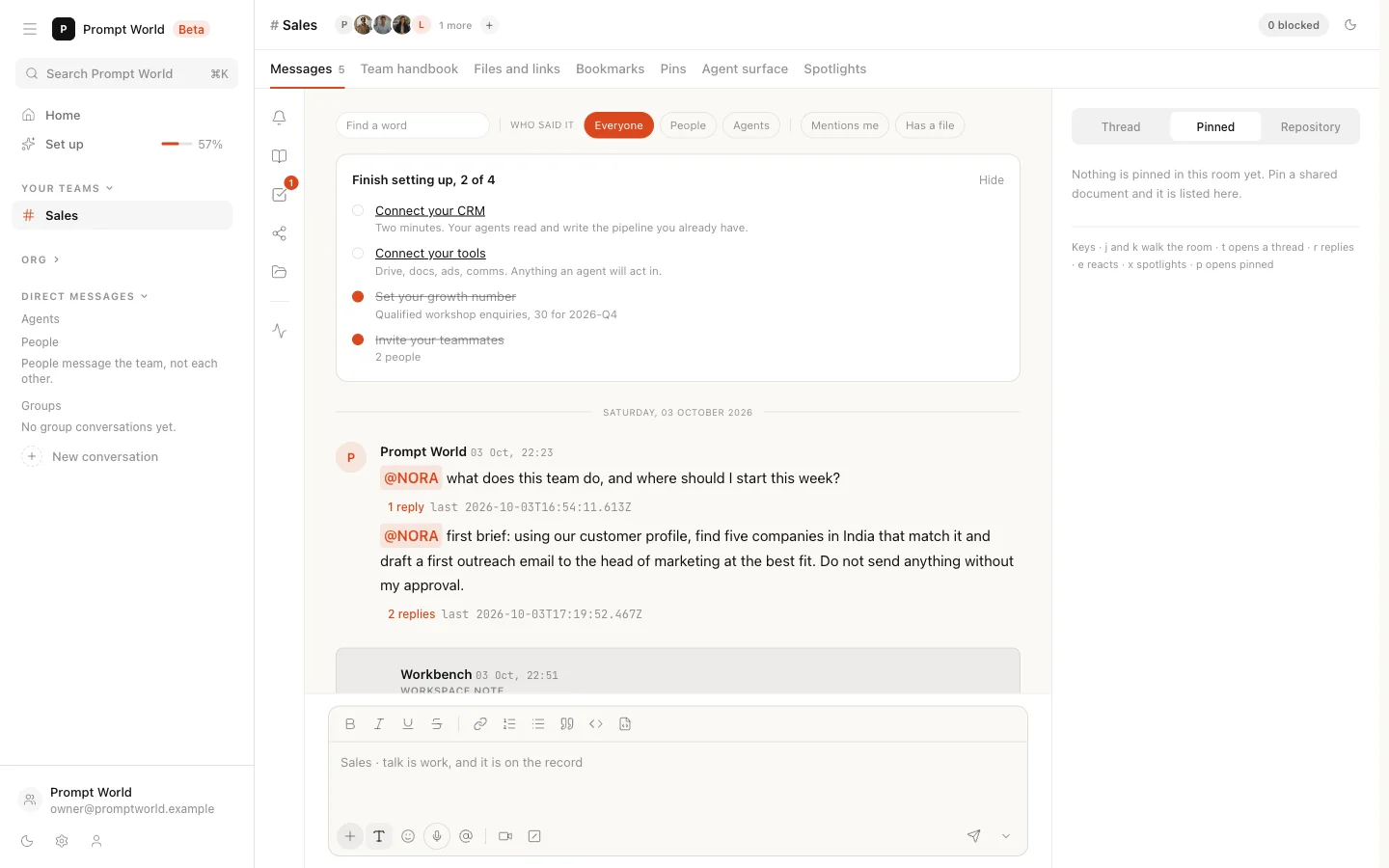
Multiplayer AI platform for growth teams: AI agent teams for marketing, sales and CX work with people in one shared workspace, with Smriti memory, Karma scoring and autonomy that is earned, not deployed.
What the vendor documents
Nagent runs a shared workspace for people and agents, Smriti memory that every agent reads, Karma performance records built from each agent's KPIs and governance history, and composable skills, tools, agents and workflows. 17 ready-to-install agents ship today: one super agent, 8 function specialists and 8 industry strategists. Agents run on 19 model providers and 61 models and connect to 998 tools. The marketplace lists 58 published agents in all. 4 patents filed, 3 published.
From $29.99 per month
Published plans with seats and monthly credits; annual billing saves 33%. Enterprise adds VPC deployment, BYO model and BYO key.
Check current commercial source ↗Collaboration and governance
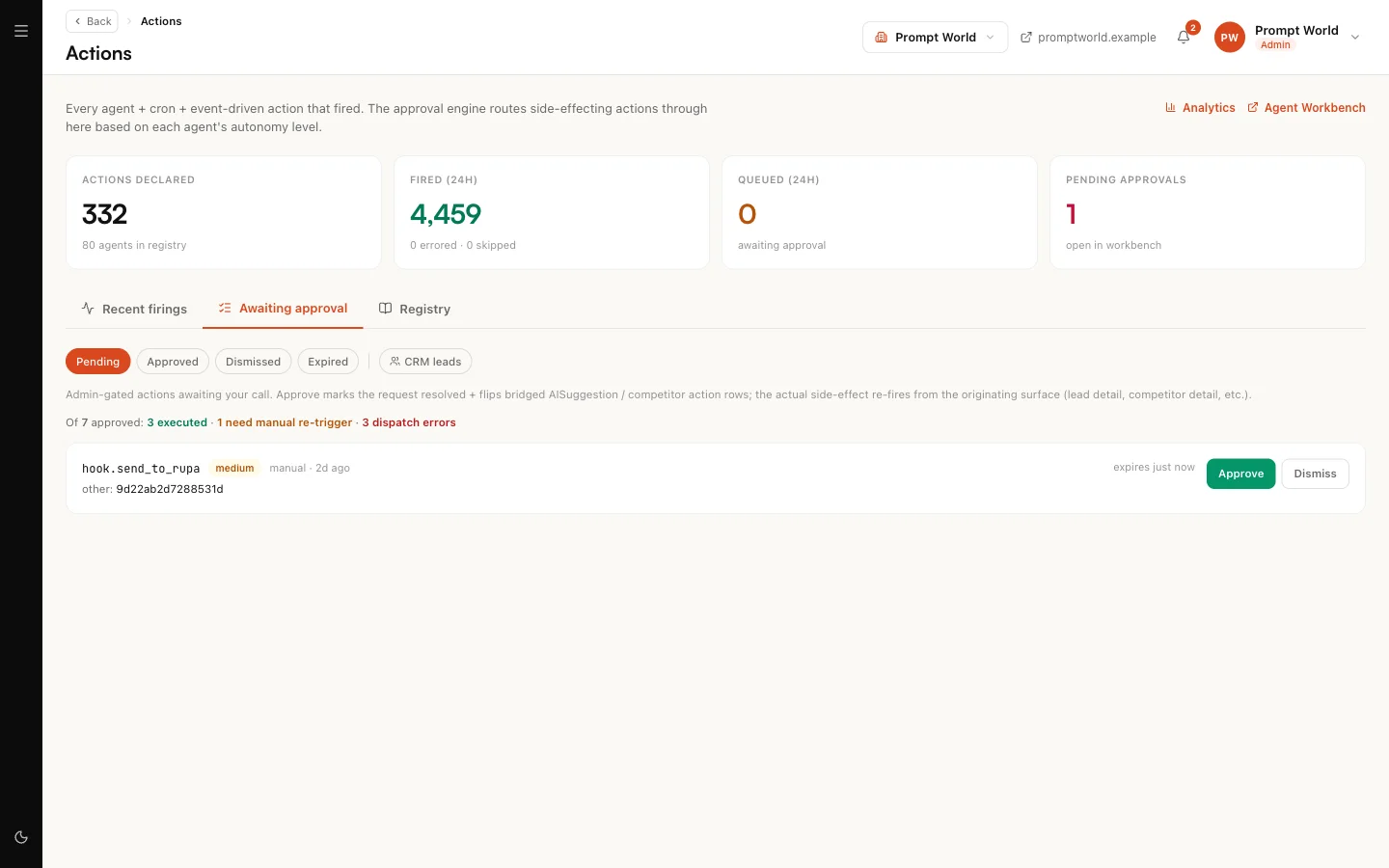
Every action is fired, queued for approval or refused. Approval sits before the irreversible step, destructive changes always ask first, and each agent carries a budget cap and a kill switch. 6 workspace roles (Admin, Sales, Approver, Editor, Writer, Viewer), tenant isolation and an append-only audit trail. Autonomy runs L0 Locked to L4 Fully autonomous and is promoted on approved work, never automatically. SOC 2 Type II and ISO 27001 programmes underway; tenant isolation, RBAC, append-only audit and private VPC available today.
Promoted use cases
- Run marketing, sales and CX agent teams with the people who own the number
- Give every agent one shared memory and one ledger of decisions
- Raise each agent from locked to fully autonomous on approved work, with approval before anything irreversible
- Bring in forward deployed engineers and Growth Pods for custom delivery
Review and customer evidence
Figures from live client campaigns, 2025 to 2026, are published on nagent.ai: Emami Navratna: 24.5M+ reach on a single agent-run campaign; Madmonk AI: 5x more qualified leads; Bigbasket: 70% lower video ad production cost; Sophoz: 3x trial user growth after relaunch. Thirteen brands are named, with four customers quoted by name. These are vendor-published results; ask for a reference in your function and the baseline behind each figure.
Editorial fit
Nagent is the option for teams that want agents and people in one workspace rather than a tool beside the work: shared memory, autonomy that is earned and enforced, published pricing from $29.99 per month, and a delivery team that owns the outcome with you. Evaluate it on the same evidence you would ask of any vendor: shared context, human control and a safe improvement loop.
Priority question for the demo: Can two colleagues join the same live agent task, change its direction, inspect the memory it used, approve or reject an action and export the audit trail? Nagent demonstrates this in a team room.
Dust in detail
Collaborative enterprise AI workspace for teams to build and use connected agents.
What the vendor documents
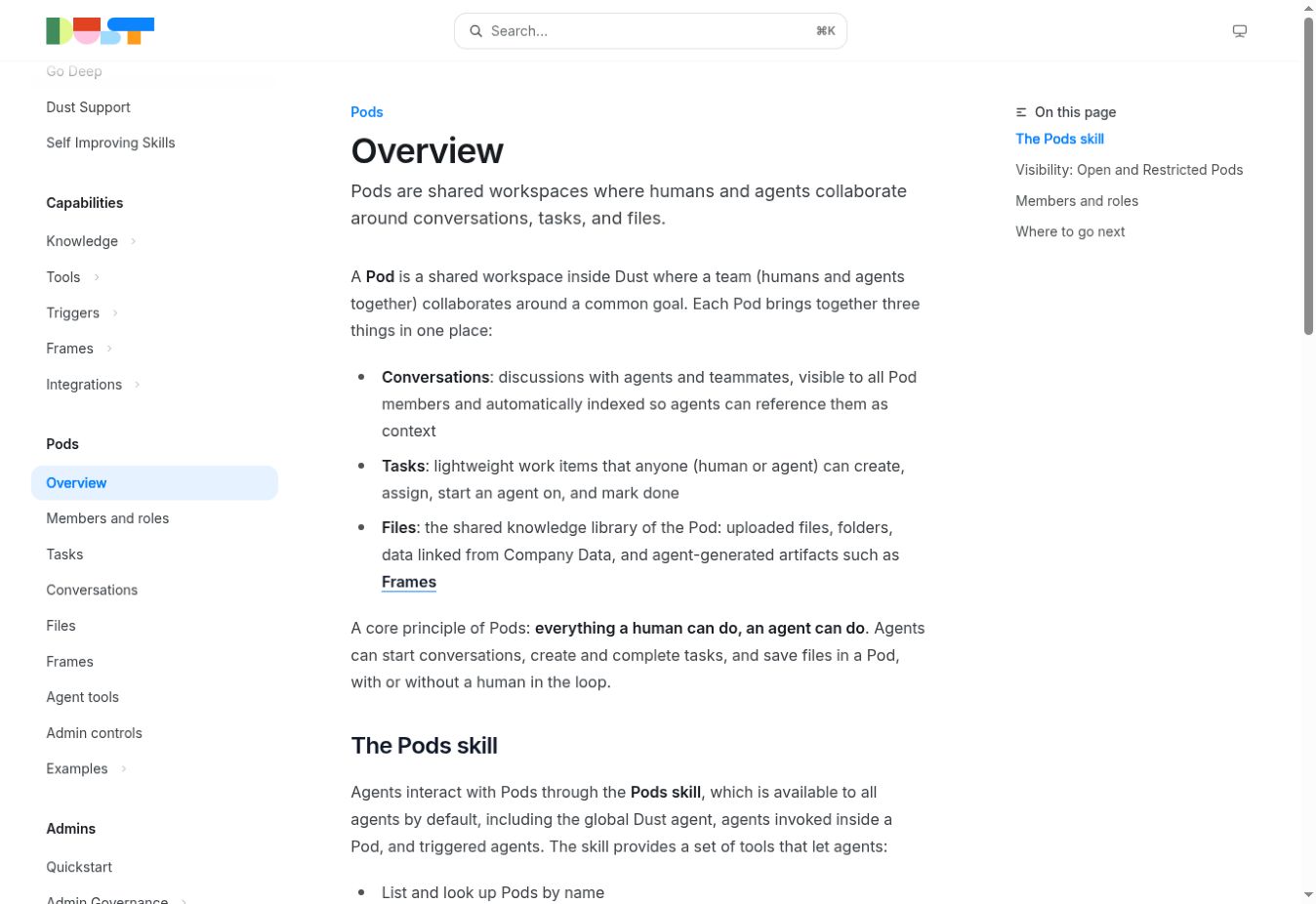
Dust explicitly markets multiplayer human–agent collaboration. Pro and Max differ in included credits; Max is €150 monthly or €120 on annual billing, with 40,000 credits per seat monthly. Enterprise adds pooled credits, SCIM and audit-log features.
€30 / seat / month
Pro monthly: 8,000 credits. Annual: €24/seat/month equivalent. Excludes VAT; Enterprise custom.
Check current commercial source ↗Collaboration and governance
Dust describes separate permissions for agent data access and agent use, plus enterprise retention and deployment options. Validate the selected plan and connector behaviour.
Promoted use cases
- Research accounts and prepare proposals
- Create campaign briefs and performance narratives
- Triage support and synthesize company knowledge
Review and customer evidence
G2’s September 2026 seller-invited review by Thibault G. praises model choice, connected knowledge and scheduled automation. A separate 2025 review sample praises reusable agents and support while raising onboarding, documentation and editing concerns. Those historical complaints require re-testing against today’s product. These are attributed experiences, not a representative benchmark or a verified guarantee of results.
Editorial fit
Dust is a direct horizontal workspace comparator. Its self-service, published seat economics are easier to inspect than a custom managed engagement. Whether that workspace covers a particular end-to-end growth process still depends on configuration, connectors and accountable operators.
Priority question for the demo: Show permission propagation and revocation across a shared conversation, a connected source and a scheduled agent.
Claude Tag in detail
Shared Claude teammate that works in Slack channels, with admin-scoped tools, memory and spend limits.
What the vendor documents
Anthropic announced Claude Tag on 23 June 2026 as a beta for Claude Enterprise and Team customers, starting on Slack, where one Claude identity per channel can be tagged by anyone in that channel. Claude builds channel memory, can learn from other channels and data sources when granted permission, and can schedule tasks and pursue a project over hours or days. Tasks run in an ephemeral sandbox, and admins extend what Claude can reach through connections, plugins and skills configured per channel, workspace or organisation. With the Respond automatically setting on, Claude may reply to untagged channel messages it judges warrant a reply. Claude Tag replaced the earlier Claude in Slack app, and the product page lists Microsoft Teams as coming soon, with a waitlist.
Pricing not published
Available in beta on Claude Team and Enterprise plans. Channel, thread and group DM work bills by usage to an organisation usage balance in its billing currency, capped by a monthly spend limit an Owner sets; adding Claude to Slack adds no per-seat charge, and the documentation states there is no published per-task cost guidance. One-to-one DMs from members with a connected Claude account bill to that member's seat. Team plans must fund the usage balance before Claude responds in channels. A one-time launch credit of USD 25,000 per Enterprise and USD 2,500 per Team organisation expired on 1 October 2026.
Check current commercial source ↗Collaboration and governance
The documentation describes Claude acting under its own service accounts, with admin-provisioned Access bundles scoped to channels or workspaces, organisation and per-channel spend limits, and an admin Activity page listing scheduled work, memory files (which Owners can edit or delete) and an hourly export of outbound network events. Use of a member's personal connectors in a channel requires that member's approval, with an option to review results before they post. During the beta there is no automatic retention period for Claude Tag data, and the healthcare guide states that Claude Tag is not covered by Anthropic's Business Associate Agreement. The launch post says admins can view a log of everything Claude has done and who requested each task, while the audit documentation states there is no per-action log of every task and who asked; confirm which applies to your plan and how actions are traced through each connected tool's audit log.
Promoted use cases
- Triage requests in an intake channel and route what the docs do not cover
- Answer data questions with warehouse queries and charts in the thread
- Recap campaign channels, draft announcements and post a weekly campaign metrics digest
Review and customer evidence
No independent review sample was verified in this research pass. Vendor-hosted testimonials are selection-biased customer evidence, not an aggregate rating.
Editorial fit
Claude Tag places one shared, general-purpose Claude teammate in Slack channels, and its documentation presents marketing, deal and support work as recipes that run on the connections an organisation configures. Beside an end-to-end growth team, it sits as a horizontal collaboration layer whose growth reach depends on those connections, skills and channel instructions.
Priority question for the demo: For a task that changes a CRM record or sends a customer-facing message, which approval step can an admin require before Claude acts, and how is that action traced back to the person who asked?
How to run the evaluation
Run the same bounded pilot on Dust and Claude Tag and on Nagent, with the inputs, the required output and the measure fixed before the first demo. Ask each vendor to show who can propose, approve, execute, interrupt and audit the action, and keep the evidence.
Account research to approved follow-up
Give the team an account record, a current product brief and a small set of approved customer references. Ask it to identify a relevant problem, distinguish observed facts from inferred needs, and prepare a follow-up for review. Then change one source and require a second person to correct the draft without restarting the research.
Measure: source accuracy, reviewer minutes, approved follow-ups and CRM consistency.
Campaign brief to coordinated delivery
Start with one campaign objective, audience, budget constraint and brand guide. Require research, a brief, assets and a release checklist with distinct human owners. Introduce an unresolved claim midway through the process. The system should retain useful work while preventing that claim from silently propagating into every asset.
Measure: accepted assets, revision burden, approval latency and missing handoffs.
Customer insight to shared learning
Provide anonymized support themes and sales objections. Ask for a synthesized insight, a proposed campaign adjustment and a knowledge update. A marketing owner and a CX owner should review the same underlying evidence. The exercise tests cross-functional context and accountability, not merely summarization quality.
Measure: evidence coverage, disagreement resolution and reuse of approved learning.
The evaluation owner should be a growth operations lead. Use accepted work completed across tools as the business target.
Frequently asked questions
Dust vs Claude Tag: what is the difference?
Dust is a reusable workspace and orchestration layer; Collaborative enterprise AI workspace for teams to build and use connected agents. Claude Tag is a reusable workspace and orchestration layer; Shared Claude teammate that works in Slack channels, with admin-scoped tools, memory and spend limits. Both sit in the same stack role, so delivery scope, commercial basis and governance decide.
How do Dust and Claude Tag compare on price?
Dust: €30 / seat / month. Pro monthly: 8,000 credits. Annual: €24/seat/month equivalent. Excludes VAT; Enterprise custom. Claude Tag: Pricing not published. Available in beta on Claude Team and Enterprise plans. Channel, thread and group DM work bills by usage to an organisation usage balance in its billing currency, capped by a monthly spend limit an Owner sets; adding Claude to Slack adds no per-seat charge, and the documentation states there is no published per-task cost guidance. One-to-one DMs from members with a connected Claude account bill to that member's seat. Team plans must fund the usage balance before Claude responds in channels. A one-time launch credit of USD 25,000 per Enterprise and USD 2,500 per Team organisation expired on 1 October 2026. Nagent publishes 4 plans, from $29.99 a month, with monthly credits as the unit of agent work.
Which has stronger governance: Dust or Claude Tag?
Dust: Dust describes separate permissions for agent data access and agent use, plus enterprise retention and deployment options. Validate the selected plan and connector behaviour. Claude Tag: The documentation describes Claude acting under its own service accounts, with admin-provisioned Access bundles scoped to channels or workspaces, organisation and per-channel spend limits, and an admin Activity page listing scheduled work, memory files (which Owners can edit or delete) and an hourly export of outbound network events. Use of a member's personal connectors in a channel requires that member's approval, with an option to review results before they post. During the beta there is no automatic retention period for Claude Tag data, and the healthcare guide states that Claude Tag is not covered by Anthropic's Business Associate Agreement. The launch post says admins can view a log of everything Claude has done and who requested each task, while the audit documentation states there is no per-action log of every task and who asked; confirm which applies to your plan and how actions are traced through each connected tool's audit log. Nagent puts approval before any irreversible action, gives each agent a budget cap and a kill switch, and keeps an append-only audit trail.
Is Nagent an alternative to Dust or Claude Tag?
Nagent is a multiplayer AI platform where agent teams for marketing, sales and CX work with people in one shared workspace. It overlaps with Dust and Claude Tag where a growth team wants agents to do the work, and differs in operating model, governance and delivery; many teams run it beside a a reusable workspace and orchestration layer.
What should I ask Dust and Claude Tag in a demo?
Dust: Show permission propagation and revocation across a shared conversation, a connected source and a scheduled agent. Claude Tag: For a task that changes a CRM record or sends a customer-facing message, which approval step can an admin require before Claude acts, and how is that action traced back to the person who asked? For Nagent, ask to see a team room with several people, an approval taken in the Inbox and the audit entry it leaves.
Sources and research notes
- Nagent · product ↗
- Nagent · commercial / feature reference ↗
- Nagent · platform, workspace and security ↗
- Nagent · customer results ↗
- Dust · product ↗
- Dust · commercial / feature reference ↗
- Pods overview · shared conversations, tasks and files ↗
- Pod conversations · participation and search ↗
- Independent reviews · G2, current reviewer index ↗
- Independent reviews · G2, historical pros and cons ↗
- Claude Tag · product ↗
- Claude Tag · commercial / feature reference ↗
- Introducing Claude Tag, 23 June 2026 · official launch post ↗
- Work with Claude Tag · official documentation ↗
- Review what Claude Tag has done · official documentation ↗
- Control when Claude Tag responds · official documentation ↗
- Personal connectors in channels · official documentation ↗
- Data lifecycle and deletion · official documentation ↗
- Use Claude Tag at a healthcare organization · official documentation ↗
- Claude Tag for marketing teams · official documentation ↗
- Set up a skills repository Claude can update · official documentation ↗
- Claude Tag launch promo · official help centre ↗
- Nagent · security and compliance ↗