
Artisan
AI BDR platform combining prospect research, enrichment, personalized outreach and meeting booking.
What it is
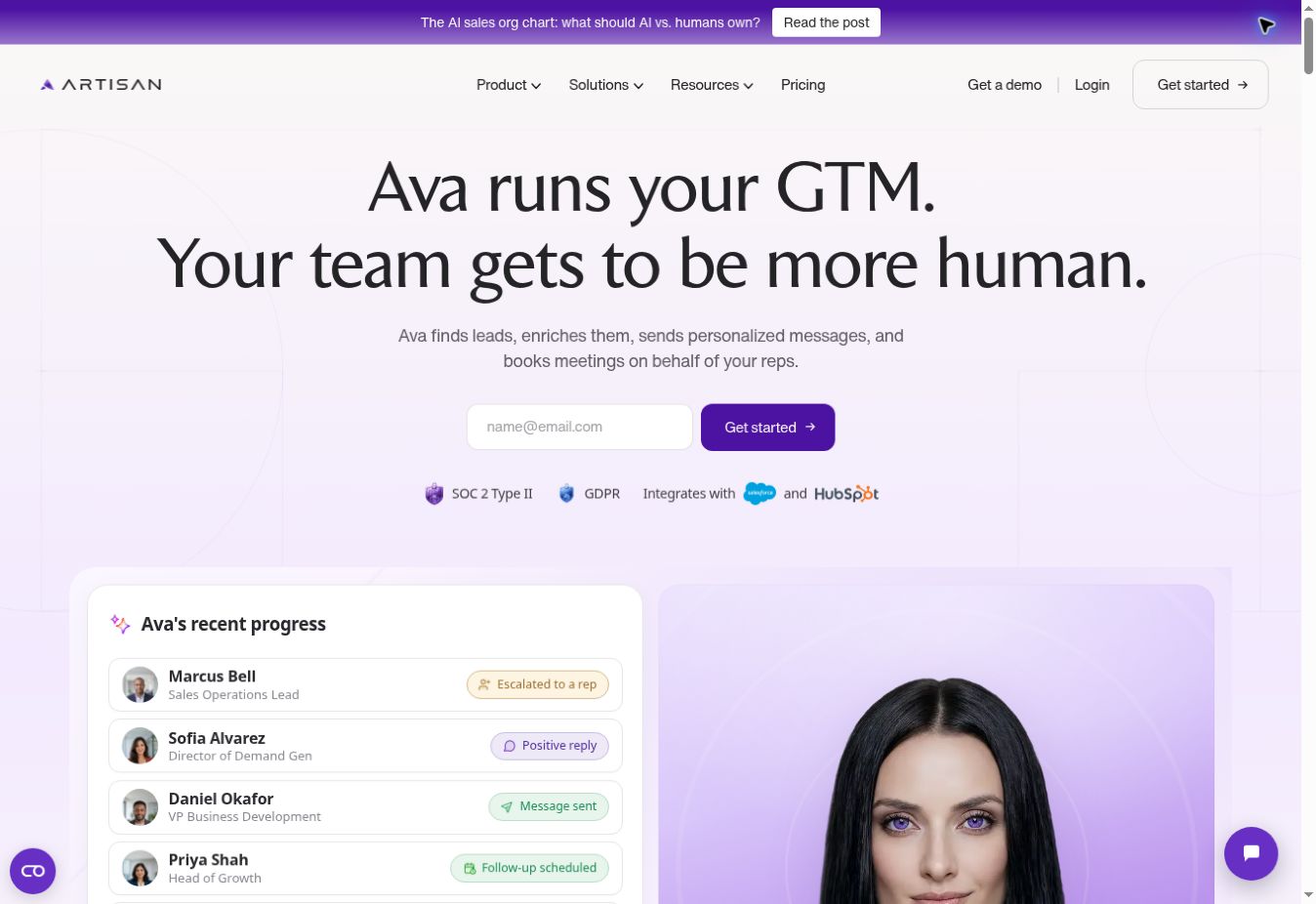
Artisan’s Ava combines research, enrichment, outreach, replies and meeting booking. The pricing page describes bidirectional Salesforce/HubSpot sync, approvals and escalation rules. [V1] [V2]
Promoted use cases
- Find and research prospects
- Run outbound campaigns and replies
- Book meetings for sales representatives
Sales-development AI ranges from data enrichment to autonomous outreach. Research quality, contact permissions, sending infrastructure, reply handling and qualification are separate responsibilities. A buyer should compare the portion of the revenue motion each vendor actually owns and the amount of human supervision required to protect reputation and data quality.
Pricing and buying model
Custom quote
Plans sized to lead volume, mailboxes and dialer seats.
Check current commercial source ↗Budget for implementation, model and tool usage, data, human review and ongoing support. Credit units and outcome definitions differ between vendors. A missing numeric rate is marked unverified rather than replaced with an old third-party estimate.
Collaboration and governance
The vendor lists SOC 2 Type II, SSO/SAML and audit logs. Obtain the relevant reports and test sending-domain and suppression controls.
The relevant unit of control is permission to contact a prospect or change a CRM record. Inspect who can propose, approve, execute, interrupt and audit that action. Shared seats, shared content and a shared live agent session are different capabilities; require a demonstration of the one your process needs.
Evaluate memory correction, permission revocation and release control for updated instructions. An improvement loop should preserve the original evidence, proposed change, test results and named approver. A safety or security badge alone cannot establish those workflow properties.
Review and customer evidence
No independent review sample was verified in this research pass. Vendor-hosted testimonials are selection-biased customer evidence, not an aggregate rating.
Before relying on a testimonial, confirm the exact product, version, package, workload and baseline. Ask a relevant customer about setup effort, failed cases, ongoing manual work and support after launch. This dossier does not convert customer logos or vendor-hosted awards into independent proof.
Focused feature documentation
Ava outbound actions, mailboxes and approval gates
Artisan presents Ava as an AI BDR that finds contacts, writes and sequences outreach, processes replies and routes qualified prospects to people. Its own Ava 2.0 announcement says approval gates can be configured at stages. The help center says outbound email requires assigned subscription mailboxes and describes Slack notifications for approvals and urgent escalations. The full autonomous promise remains a vendor claim until a real campaign is observed.
The current Ava page says a team may run in approval mode or allow sending; it explicitly says Ava does not make calls, instead queuing qualified prospects for human reps to dial. It describes Salesforce and HubSpot sync and a handoff for objections and escalations. This narrows the meaning of its end-to-end claim: test where automation stops and a rep owns the conversation. Marketing-page claims of lead volume, ROI, compliance and customer outcomes remain attributed to Artisan.
Artisan prices by the negotiated plan, lead volume, mailboxes and dialer seats rather than one public flat agent price. A pilot should test a disallowed contact, duplicate lead and sensitive pricing objection, then check whether the right human approves the exact response. Count accepted meetings and deliverability alongside human monitoring, rather than using number of emails as a success proxy.
Primary sources: Official Ava 2.0 announcement ↗ · Official current Ava page and FAQ ↗ · Official mailbox explanation ↗ · Official plans ↗
Published documentation and public illustrations; account behaviour was not independently tested.
Visual source
Fit, limitations and proof requests
Artisan is close to a managed outbound-team buying decision. Compare its actual service scope, accepted-meeting definition and ongoing operator involvement with Nagent’s custom delivery.
Priority question: Who owns the sending domains and mailboxes, and what happens to them and the contact data after exit?
The evaluation owner should be the sales-development and revenue-operations leads. Use accepted opportunities and qualified meetings that actually occur as the business target. Judge the solution in its own stack role: a cloud runtime, a specialist production tool and a managed AI team can be complementary purchases.
Use-case evaluation plan
Research that improves account selection
Start with the same account list and ideal-customer criteria. Ask for sourced research, a relevance explanation and a confidence assessment. Include ambiguous companies and stale contacts. Score whether the resulting priorities are useful to experienced representatives, not whether the system can fill every field.
Measure: factual accuracy, accepted accounts, data freshness and enrichment cost.
A controlled outbound sequence
Prepare outreach using approved claims and a suppression list. Add a reply that expresses disinterest, a referral to another person and a question the agent cannot answer. Test whether the workflow updates state, stops inappropriate follow-ups and escalates with a concise handoff.
Measure: reply handling, suppression compliance, review effort and domain-health indicators.
Meetings to accepted pipeline
Define qualification and attendance before the pilot. Audit booked meetings for fit, genuine interest, duplicates and no-shows. Follow the cohort into sales acceptance rather than counting calendar invitations as revenue. Record human effort spent repairing poor bookings and misleading personalization.
Measure: held qualified meetings, sales acceptance, pipeline progression and total cost per accepted opportunity.
Detailed comparison
Read the detailed Nagent vs Artisan guide for operating models, shared context, governance, cost, evidence gaps and a staged pilot.
Nagent vs ArtisanSources and evidence register
- V1 · Official product / pricing source
Artisan · product ↗https://www.artisan.co/ · Public material checked 21–29 September 2026 - V2 · Official product / pricing source
Artisan · commercial / feature reference ↗https://www.artisan.co/pricing · Public material checked 21–29 September 2026 - V3 · Official source
Official Ava 2.0 announcement ↗https://www.artisan.co/blog/artisan-launches-ava-2-0-first-autonomous-ai-bdr · Public material checked 21–29 September 2026 - V4 · Official source
Official current Ava page and FAQ ↗https://www.artisan.co/ai-sales-agent · Public material checked 21–29 September 2026 - V5 · Official source
Official mailbox explanation ↗https://help.artisan.co/articles/6841678403-what-are-mailboxes · Public material checked 21–29 September 2026 - V6 · Official source
Official plans ↗https://www.artisan.co/pricing · Public material checked 21–29 September 2026 - N1 · Official source
Nagent · platform, workspace and security ↗https://nagent.ai/platform · Public material checked 21–29 September 2026 - N2 · Official source
Nagent · security and compliance ↗https://nagent.ai/dev-technology/security-and-compliance · Public material checked 21–29 September 2026 - N3 · Official source
Nagent · published plans ↗https://nagent.ai/pricing · Public material checked 21–29 September 2026 - THESIS · Official source
The Nagent Thesis ↗https://nagent.ai/artefacts/nagent-thesis · Public material checked 21–29 September 2026 - GOVERNANCE-SOURCE · Official source
State of Agent Governance ↗https://nagent.ai/artefacts/state-of-agent-governance · Public material checked 21–29 September 2026