
AthenaHQ
Agent-oriented platform for improving brand presence in AI search.
What it is
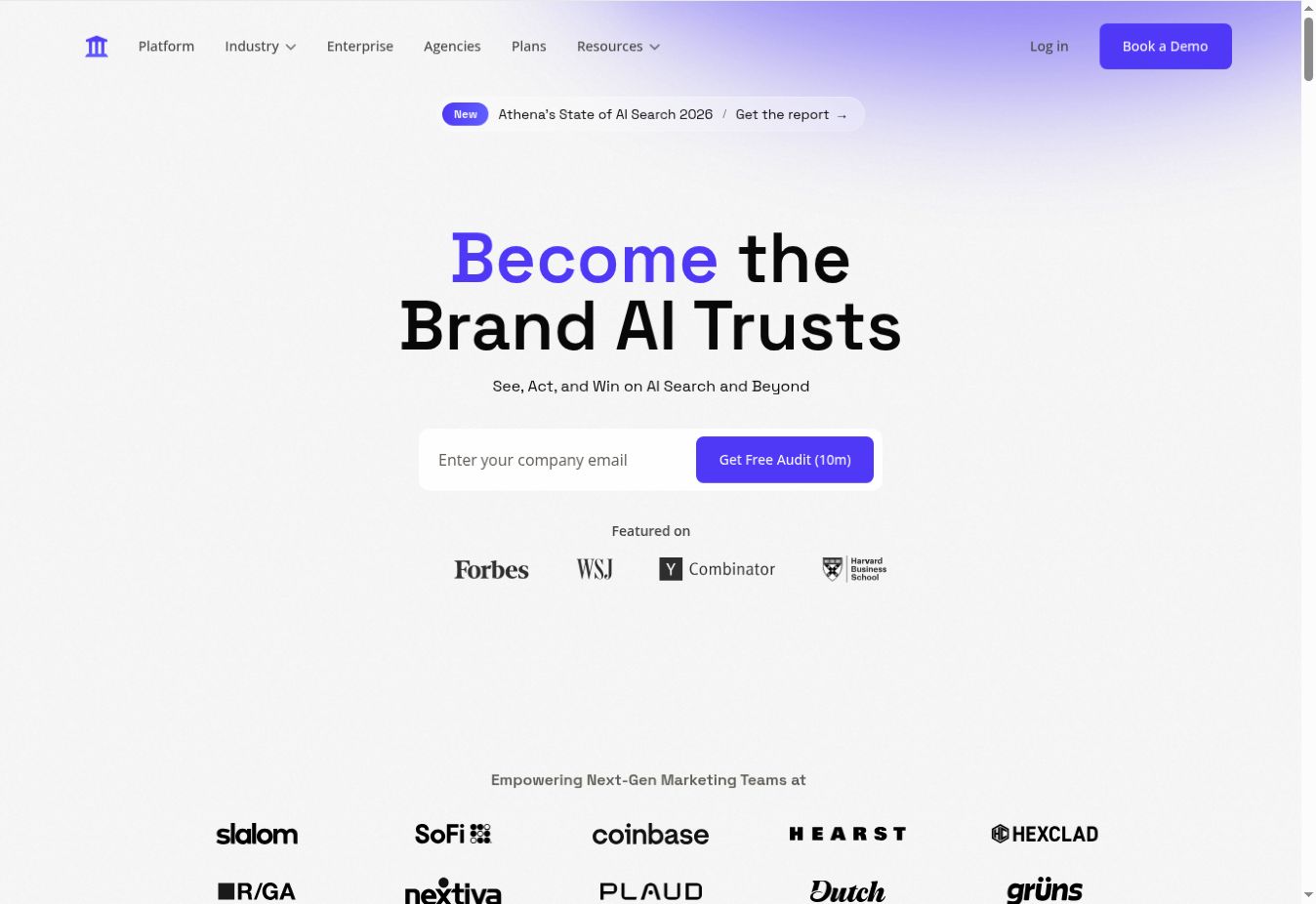
AthenaHQ offers AI-search monitoring and content/action recommendations. The reviewed plan page describes content optimization agents and on-page and off-page actions. [V1] [V2]
Promoted use cases
- Monitor AI answer presence
- Prioritize content improvements
- Track competitors and optimize discovery
AI-search tools observe a shifting answer environment. A mention, citation, ranking and customer conversion are different events. The useful comparison separates measurement coverage, diagnosis, content production and the ability to implement an approved change. An AEO dashboard is not a complete growth team, but it may supply essential evidence to one.
Pricing and buying model
$295 / month
Starter: 3,600 credits; one credit per AI response. Extra credits and API access can add cost.
Check current commercial source ↗Budget for implementation, model and tool usage, data, human review and ongoing support. Credit units and outcome definitions differ between vendors. A missing numeric rate is marked unverified rather than replaced with an old third-party estimate.
Collaboration and governance
Enterprise access controls are listed; autonomous improvement claims need validation against approved content versions.
The relevant unit of control is permission to publish a change to website content. Inspect who can propose, approve, execute, interrupt and audit that action. Shared seats, shared content and a shared live agent session are different capabilities; require a demonstration of the one your process needs.
Evaluate memory correction, permission revocation and release control for updated instructions. An improvement loop should preserve the original evidence, proposed change, test results and named approver. A safety or security badge alone cannot establish those workflow properties.
Review and customer evidence
No independent review sample was verified in this research pass. Vendor-hosted testimonials are selection-biased customer evidence, not an aggregate rating.
Before relying on a testimonial, confirm the exact product, version, package, workload and baseline. Ask a relevant customer about setup effort, failed cases, ongoing manual work and support after launch. This dossier does not convert customer logos or vendor-hosted awards into independent proof.
Focused feature documentation
Prompt-volume estimate, action scope and tier boundaries
AthenaHQ presents a model for estimating the volume of AI search prompts, alongside monitoring and a recommendation or action layer. An estimated prompt volume is a modeled signal rather than a count of verified searches for the buyer’s brand. Its current official plans page lists Starter at $295 per month with 3,600 credits, where one credit is defined as one AI response. It lists on-page and off-page actions and a content optimization agent within that entry offer.
The same plan page reserves some capabilities for Enterprise, including SAML/OIDC SSO, organization activity audit log, knowledge-base claim review and advanced content optimization. API access and additional Starter credits are billed as add-ons. When testing a claim correction, trace where an assertion was observed, who approved an edit, what was published and whether the AI-answer sample changed. The public promise of “self-learning” content improvement requires an actual release and audit demonstration.
Primary sources: Official plan and feature matrix ↗ · Official prompt-volume explanation ↗
Published documentation and public illustrations; account behaviour was not independently tested.
Visual source
Fit, limitations and proof requests
Athena is a focused AEO candidate. Compare its measurement coverage and actionable diagnostics with the work actually delivered by a custom growth team.
Priority question: Can we trace each recommendation to repeated observations, then review the proposed change before publication?
The evaluation owner should be the organic growth or content lead. Use qualified discovery and accepted editorial improvements as the business target. Judge the solution in its own stack role: a cloud runtime, a specialist production tool and a managed AI team can be complementary purchases.
Use-case evaluation plan
Visibility diagnosis with repeatable sampling
Define a buyer-question set before the pilot, segment it by intent and geography, and repeat observations across the engines in scope. Record mentions, citations and answer quality separately. Add neutral and competitor-oriented questions so the exercise does not reward a tool merely for tracking prompts already favorable to the brand.
Measure: coverage, answer variability, citation accuracy and useful diagnostic findings.
Evidence to an approved content change
Choose one material gap and ask the system to explain its source evidence. Request a proposed page revision with factual references, an editorial review and a publication boundary. A marketer should be able to reject the recommendation while preserving the underlying measurement and reasoning.
Measure: accepted recommendations, factual corrections and publishing effort.
Discovery to commercial contribution
Track meaningful website visits and qualified conversions where attribution is technically available, while acknowledging unobservable journeys. Compare the changed pages with similar unchanged pages and note concurrent campaigns. Do not call a short-term visibility movement a causal revenue result without evidence.
Measure: qualified visits, conversions, editorial cost and stability of observed improvement.
Detailed comparison
Read the detailed Nagent vs AthenaHQ guide for operating models, shared context, governance, cost, evidence gaps and a staged pilot.
Nagent vs AthenaHQSources and evidence register
- V1 · Official product / pricing source
AthenaHQ · product ↗https://athenahq.ai/ · Public material checked 21–29 September 2026 - V2 · Official product / pricing source
AthenaHQ · commercial / feature reference ↗https://athenahq.ai/plans · Public material checked 21–29 September 2026 - V3 · Official source
Official plan and feature matrix ↗https://athenahq.ai/plans · Public material checked 21–29 September 2026 - V4 · Official source
Official prompt-volume explanation ↗https://athenahq.ai/prompt-volume · Public material checked 21–29 September 2026 - N1 · Official source
Nagent · platform, workspace and security ↗https://nagent.ai/platform · Public material checked 21–29 September 2026 - N2 · Official source
Nagent · security and compliance ↗https://nagent.ai/dev-technology/security-and-compliance · Public material checked 21–29 September 2026 - N3 · Official source
Nagent · published plans ↗https://nagent.ai/pricing · Public material checked 21–29 September 2026 - THESIS · Official source
The Nagent Thesis ↗https://nagent.ai/artefacts/nagent-thesis · Public material checked 21–29 September 2026 - GOVERNANCE-SOURCE · Official source
State of Agent Governance ↗https://nagent.ai/artefacts/state-of-agent-governance · Public material checked 21–29 September 2026