
Clay
GTM data and orchestration platform with research agents, signals, workflows and sales execution.
What it is
Clay combines research agents, account data, signals, enrichment waterfalls and execution workflows. Current packaging separates actions from data credits and supports unlimited seats on the free plan. [V1] [V2]
Promoted use cases
- Research accounts and people
- Enrich and synchronize CRM data
- Build signal-driven outbound and ad audiences
Sales-development AI ranges from data enrichment to autonomous outreach. Research quality, contact permissions, sending infrastructure, reply handling and qualification are separate responsibilities. A buyer should compare the portion of the revenue motion each vendor actually owns and the amount of human supervision required to protect reputation and data quality.
Pricing and buying model
Actions + data credits
Free: 500 actions/100 data credits monthly. Paid tables are configurable; rendered totals need confirmation.
Check current commercial source ↗Budget for implementation, model and tool usage, data, human review and ongoing support. Credit units and outcome definitions differ between vendors. A missing numeric rate is marked unverified rather than replaced with an old third-party estimate.
Collaboration and governance
Confirm data-provider provenance, permitted use, export and workflow permissions. A shared table is useful context but not automatically a shared live agent session.
The relevant unit of control is permission to contact a prospect or change a CRM record. Inspect who can propose, approve, execute, interrupt and audit that action. Shared seats, shared content and a shared live agent session are different capabilities; require a demonstration of the one your process needs.
Evaluate memory correction, permission revocation and release control for updated instructions. An improvement loop should preserve the original evidence, proposed change, test results and named approver. A safety or security badge alone cannot establish those workflow properties.
Review and customer evidence
September 2026 G2 reviewers praise consolidated data enrichment. Daniel R. reports stronger record completeness while disliking integration work. An organic software-sector reviewer raises interface speed, automatic runs and credit behavior. Invitation and incentive labels vary across the sample. Match reviews to Clay.com, since unrelated products also use the name Clay; no aggregate score is used here.
Before relying on a testimonial, confirm the exact product, version, package, workload and baseline. Ask a relevant customer about setup effort, failed cases, ongoing manual work and support after launch. This dossier does not convert customer logos or vendor-hosted awards into independent proof.
Focused feature documentation
Account Agents, persistent account context and two meters
Clay’s current documentation separates Actions for orchestrating work from Data Credits for purchased enrichment and AI. The pricing page says using a buyer’s own third-party API keys can avoid Clay Data Credits while still consuming Actions. The docs identify one Action when a lead is added to a sequencer, not per email sent. Claygent can create custom data points, but the accuracy of a researched field depends on its source and prompt.
Clay now distinguishes general-purpose Claygents from Account Agents in Audiences and Workflows. Its product page says conclusions and reasoning persist on the account between runs, the agent selects only allowed actions, and CRM or warehouse updates are human approved. The workflow docs say Account Agents are available with Audiences on Launch, Growth and Enterprise, cost variable Data Credits plus one Action per processed record, and use a Clay-selected model. A limitation: an Account Agent cannot act on an account discovered mid-run before it enters Audiences. Workflow credit controls are not yet the same as those in Audiences, so a fast-changing segment can cause many paid runs.
A sales pilot should reconcile 100 researched accounts through data purchase, AI extraction, CRM sync and handoff. Compare valid contacts, data provenance, Action usage, Data Credits and external API charges. Correct a false prior conclusion and observe the next account run; inspect the reasoning trace, human approval and export permissions. This is a more direct test of Nagent’s proposed shared memory and governance than a one-shot enrichment table.
Primary sources: Official Actions and Data Credits guide ↗ · Official current plans ↗ · Official meter FAQ ↗ · Official Account Agents product ↗ · Official Account Agents workflow docs ↗
Published documentation and public illustrations; account behaviour was not independently tested.
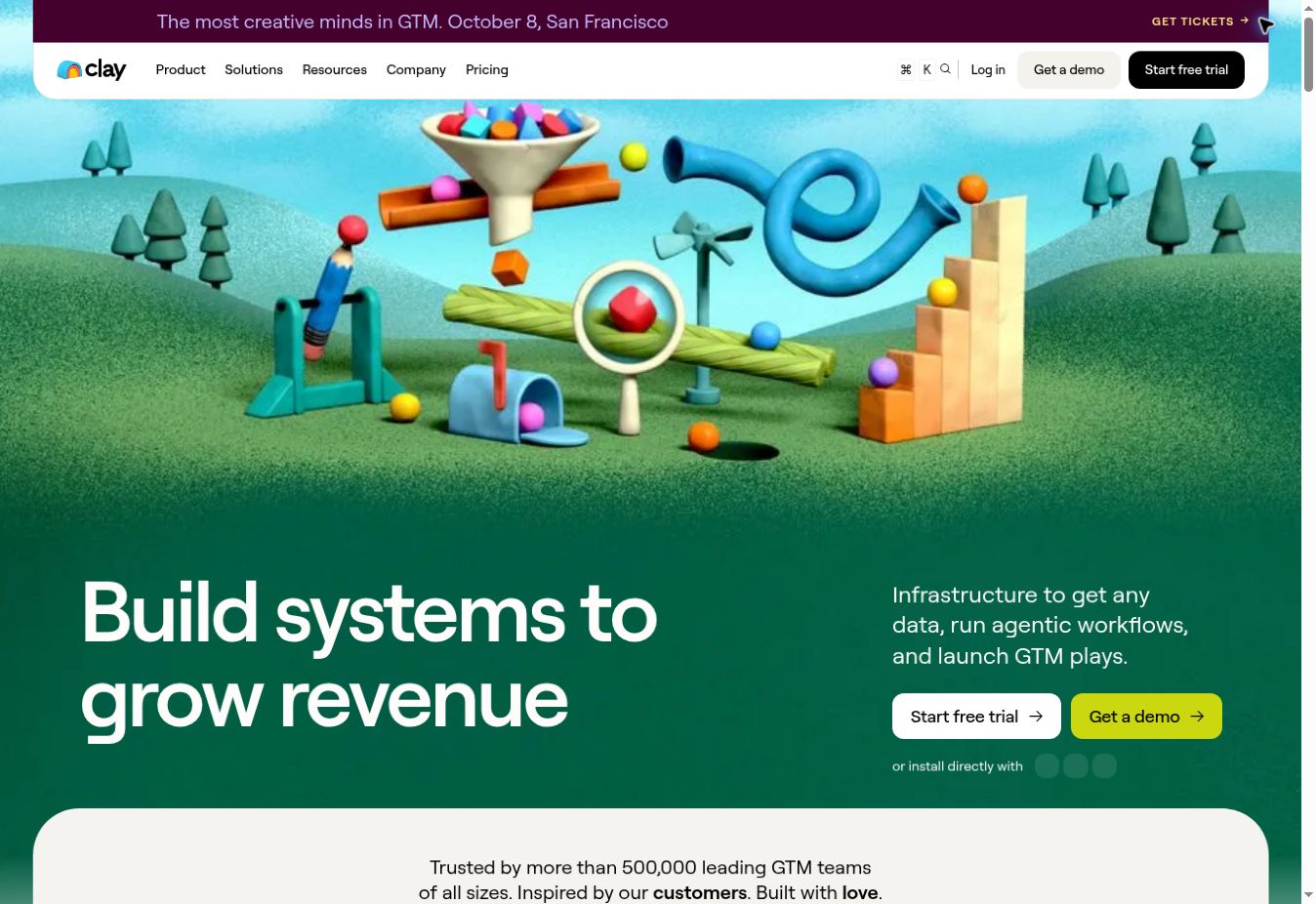
Visual source
Fit, limitations and proof requests
Clay is often a complementary GTM data layer. Compare the workflow build effort and data economics with a managed Nagent team before deciding whether one replaces the other.
Priority question: What are the separate action, enrichment, model and mailbox charges for one accepted account record?
The evaluation owner should be the sales-development and revenue-operations leads. Use accepted opportunities and qualified meetings that actually occur as the business target. Judge the solution in its own stack role: a cloud runtime, a specialist production tool and a managed AI team can be complementary purchases.
Use-case evaluation plan
Research that improves account selection
Start with the same account list and ideal-customer criteria. Ask for sourced research, a relevance explanation and a confidence assessment. Include ambiguous companies and stale contacts. Score whether the resulting priorities are useful to experienced representatives, not whether the system can fill every field.
Measure: factual accuracy, accepted accounts, data freshness and enrichment cost.
A controlled outbound sequence
Prepare outreach using approved claims and a suppression list. Add a reply that expresses disinterest, a referral to another person and a question the agent cannot answer. Test whether the workflow updates state, stops inappropriate follow-ups and escalates with a concise handoff.
Measure: reply handling, suppression compliance, review effort and domain-health indicators.
Meetings to accepted pipeline
Define qualification and attendance before the pilot. Audit booked meetings for fit, genuine interest, duplicates and no-shows. Follow the cohort into sales acceptance rather than counting calendar invitations as revenue. Record human effort spent repairing poor bookings and misleading personalization.
Measure: held qualified meetings, sales acceptance, pipeline progression and total cost per accepted opportunity.
Detailed comparison
Read the detailed Nagent vs Clay guide for operating models, shared context, governance, cost, evidence gaps and a staged pilot.
Nagent vs ClaySources and evidence register
- V1 · Official product / pricing source
Clay · product ↗https://www.clay.com/ · Public material checked 21–29 September 2026 - V2 · Official product / pricing source
Clay · commercial / feature reference ↗https://www.clay.com/pricing · Public material checked 21–29 September 2026 - V3 · Independent review surface
Independent reviews · G2, Clay.com identity checked ↗https://www.g2.com/sellers/clay-com · Public material checked 21–29 September 2026 - V4 · Official source
Official Actions and Data Credits guide ↗https://university.clay.com/docs/actions-data-credits · Public material checked 21–29 September 2026 - V5 · Official source
Official current plans ↗https://www.clay.com/pricing · Public material checked 21–29 September 2026 - V6 · Official source
Official meter FAQ ↗https://www.clay.com/faq/what-are-actions-and-data-credits-how-do-they-work · Public material checked 21–29 September 2026 - V7 · Official source
Official Account Agents product ↗https://www.clay.com/account-agents · Public material checked 21–29 September 2026 - V8 · Official source
Official Account Agents workflow docs ↗https://university.clay.com/docs/account-agents-in-workflows · Public material checked 21–29 September 2026 - N1 · Official source
Nagent · platform, workspace and security ↗https://nagent.ai/platform · Public material checked 21–29 September 2026 - N2 · Official source
Nagent · security and compliance ↗https://nagent.ai/dev-technology/security-and-compliance · Public material checked 21–29 September 2026 - N3 · Official source
Nagent · published plans ↗https://nagent.ai/pricing · Public material checked 21–29 September 2026 - THESIS · Official source
The Nagent Thesis ↗https://nagent.ai/artefacts/nagent-thesis · Public material checked 21–29 September 2026 - GOVERNANCE-SOURCE · Official source
State of Agent Governance ↗https://nagent.ai/artefacts/state-of-agent-governance · Public material checked 21–29 September 2026