
CrewAI
Enterprise build-and-runtime layer for role-based multi-agent systems.
What it is
CrewAI offers a multi-agent framework and an enterprise build/runtime product. Its enterprise pricing material lists RBAC, SSO, workload identity, policy and private deployment options. [V1] [V2]
Promoted use cases
- Build role-based agent teams
- Coordinate research and structured execution
- Operate custom agents in enterprise infrastructure
Horizontal platforms compete on how people connect company knowledge, delegate work and keep control across tools. The central question is whether a reusable workspace can become an operating process, with a named owner and a reliable path from request to approved action. A visually appealing agent builder is only one part of that decision.
Pricing and buying model
Free; Enterprise custom
Basic: 50 workflow executions/month. Enterprise capacity and support are quoted.
Check current commercial source ↗Budget for implementation, model and tool usage, data, human review and ongoing support. Credit units and outcome definitions differ between vendors. A missing numeric rate is marked unverified rather than replaced with an old third-party estimate.
Collaboration and governance
The open-source framework and enterprise managed controls are different offers. Do not infer enterprise controls from a framework demonstration.
The relevant unit of control is permission to update the CRM and release approved follow-up. Inspect who can propose, approve, execute, interrupt and audit that action. Shared seats, shared content and a shared live agent session are different capabilities; require a demonstration of the one your process needs.
Evaluate memory correction, permission revocation and release control for updated instructions. An improvement loop should preserve the original evidence, proposed change, test results and named approver. A safety or security badge alone cannot establish those workflow properties.
Review and customer evidence
No independent review sample was verified in this research pass. Vendor-hosted testimonials are selection-biased customer evidence, not an aggregate rating.
Before relying on a testimonial, confirm the exact product, version, package, workload and baseline. Ask a relevant customer about setup effort, failed cases, ongoing manual work and support after launch. This dossier does not convert customer logos or vendor-hosted awards into independent proof.
Focused feature documentation
Framework, free execution allowance and enterprise runtime
CrewAI’s pricing page lists a free Basic tier with 50 workflow executions per month, two automations and tracing, testing, guardrails and human-in-the-loop input. Enterprise is a custom quote with SSO, role-based access, workload identity, PII redaction, policies and deployment on CrewAI cloud or customer infrastructure. Those controls are product-tier terms; a Python framework example alone does not prove the enterprise policy path.
Its enterprise material lists a 45-day onboarding and offers forward-deployed engineering and training separately. When comparing CrewAI with Nagent’s custom-team proposal, split runtime, onboarding, implementation and ongoing operation into explicit lines. A realistic pilot should put a paused human input into a multi-agent workflow, then inspect the trace, policy outcome and recovery behavior after a failed tool call.
Primary sources: Official CrewAI plans and feature matrix ↗ · Official enterprise introduction ↗
Published documentation and public illustrations; account behaviour was not independently tested.
Visual source
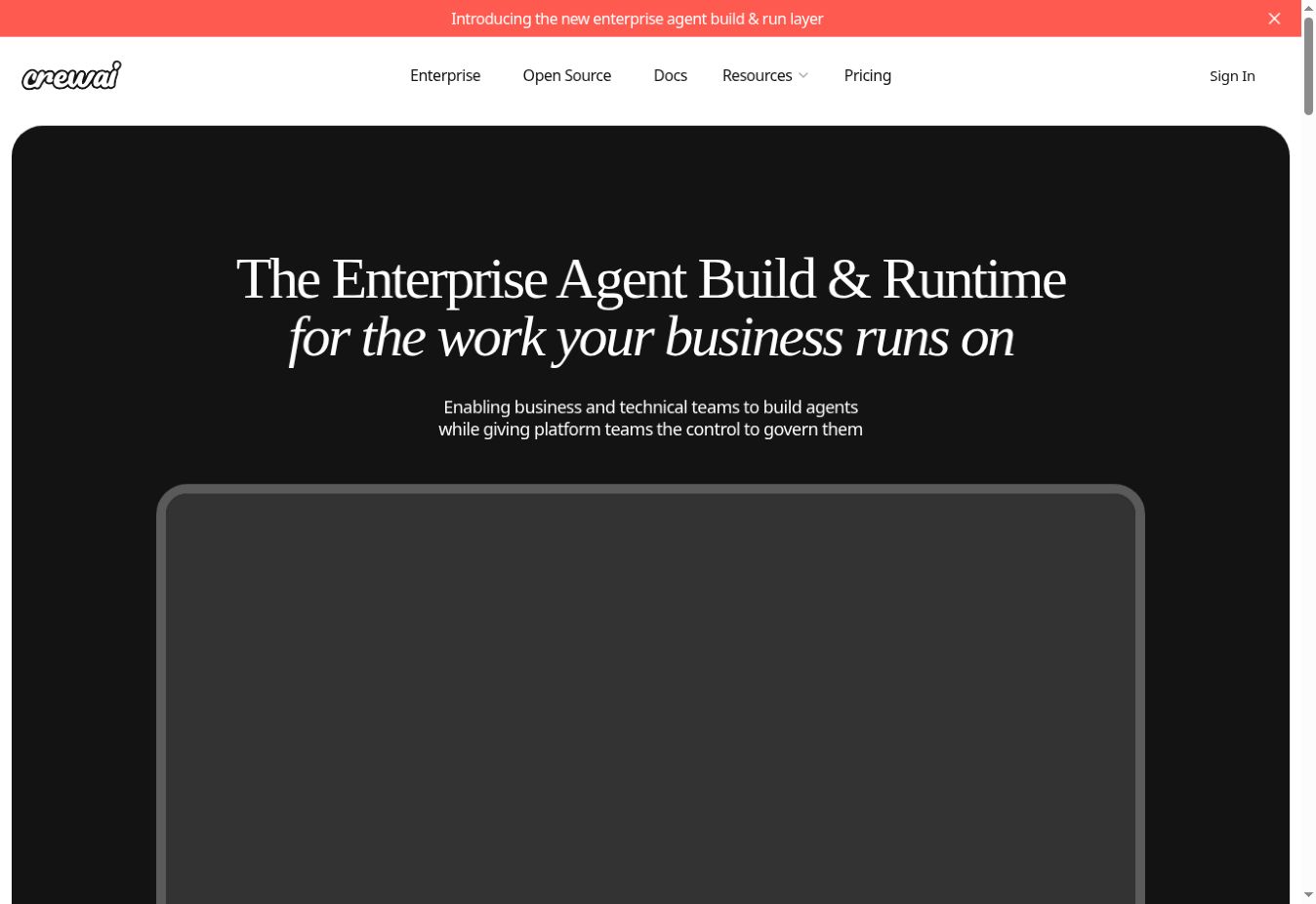
Fit, limitations and proof requests
CrewAI is closer to a build-and-operate technology choice than a turnkey managed growth service. It can also be part of a platform stack rather than an exclusive Nagent alternative.
Priority question: Which approval, identity, evaluation and audit features require the commercial runtime?
The evaluation owner should be a growth operations lead. Use accepted work completed across tools as the business target. Judge the solution in its own stack role: a cloud runtime, a specialist production tool and a managed AI team can be complementary purchases.
Use-case evaluation plan
Account research to approved follow-up
Give the team an account record, a current product brief and a small set of approved customer references. Ask it to identify a relevant problem, distinguish observed facts from inferred needs, and prepare a follow-up for review. Then change one source and require a second person to correct the draft without restarting the research.
Measure: source accuracy, reviewer minutes, approved follow-ups and CRM consistency.
Campaign brief to coordinated delivery
Start with one campaign objective, audience, budget constraint and brand guide. Require research, a brief, assets and a release checklist with distinct human owners. Introduce an unresolved claim midway through the process. The system should retain useful work while preventing that claim from silently propagating into every asset.
Measure: accepted assets, revision burden, approval latency and missing handoffs.
Customer insight to shared learning
Provide anonymized support themes and sales objections. Ask for a synthesized insight, a proposed campaign adjustment and a knowledge update. A marketing owner and a CX owner should review the same underlying evidence. The exercise tests cross-functional context and accountability, not merely summarization quality.
Measure: evidence coverage, disagreement resolution and reuse of approved learning.
Detailed comparison
Read the detailed Nagent vs CrewAI guide for operating models, shared context, governance, cost, evidence gaps and a staged pilot.
Nagent vs CrewAISources and evidence register
- V1 · Official product / pricing source
CrewAI · product ↗https://crewai.com/ · Public material checked 21–29 September 2026 - V2 · Official product / pricing source
CrewAI · commercial / feature reference ↗https://crewai.com/pricing · Public material checked 21–29 September 2026 - V3 · Official source
Official CrewAI plans and feature matrix ↗https://crewai.com/pricing · Public material checked 21–29 September 2026 - V4 · Official source
Official enterprise introduction ↗https://docs.crewai.com/enterprise/introduction · Public material checked 21–29 September 2026 - N1 · Official source
Nagent · platform, workspace and security ↗https://nagent.ai/platform · Public material checked 21–29 September 2026 - N2 · Official source
Nagent · security and compliance ↗https://nagent.ai/dev-technology/security-and-compliance · Public material checked 21–29 September 2026 - N3 · Official source
Nagent · published plans ↗https://nagent.ai/pricing · Public material checked 21–29 September 2026 - THESIS · Official source
The Nagent Thesis ↗https://nagent.ai/artefacts/nagent-thesis · Public material checked 21–29 September 2026 - GOVERNANCE-SOURCE · Official source
State of Agent Governance ↗https://nagent.ai/artefacts/state-of-agent-governance · Public material checked 21–29 September 2026