
Glean
Enterprise context, assistant and agent platform spanning search, creation and work execution.
What it is
Glean presents enterprise search and context alongside multiplayer work, agent orchestration and governance. Its platform includes observability and controls around company information. [V1] [V2]
Promoted use cases
- Research customer accounts using internal knowledge
- Prepare content grounded in company materials
- Support employees and customer-facing teams
Horizontal platforms compete on how people connect company knowledge, delegate work and keep control across tools. The central question is whether a reusable workspace can become an operating process, with a named owner and a reliable path from request to approved action. A visually appealing agent builder is only one part of that decision.
Pricing and buying model
Sales-led quote
No numerical platform price verified on the reviewed official page.
Check current commercial source ↗Budget for implementation, model and tool usage, data, human review and ongoing support. Credit units and outcome definitions differ between vendors. A missing numeric rate is marked unverified rather than replaced with an old third-party estimate.
Collaboration and governance
Permission-aware retrieval is central to the product positioning. Inspect agent write access separately from search access.
The relevant unit of control is permission to update the CRM and release approved follow-up. Inspect who can propose, approve, execute, interrupt and audit that action. Shared seats, shared content and a shared live agent session are different capabilities; require a demonstration of the one your process needs.
Evaluate memory correction, permission revocation and release control for updated instructions. An improvement loop should preserve the original evidence, proposed change, test results and named approver. A safety or security badge alone cannot establish those workflow properties.
Review and customer evidence
G2’s Glean seller profile contains a 10 September 2026 invited review praising cross-app search while acknowledging occasional misses in its headline; a 1 September review describes permission-aware discovery across work systems. Those experiences concern the broader Glean platform and search, not a validated test of the newer independent agents, scoped service identities or background write controls. Do not turn the seller-wide rating into an autonomous-agent score.
Before relying on a testimonial, confirm the exact product, version, package, workload and baseline. Ask a relevant customer about setup effort, failed cases, ongoing manual work and support after launch. This dossier does not convert customer logos or vendor-hosted awards into independent proof.
Focused feature documentation
Agent publishing, action approval and background-write boundaries
Glean’s administrative documentation separates agent creation, publishing and sharing. Default members need agent-create permission to publish, and an administrator can set an approval rule for company-wide changes or for all shared-agent changes. Moderators then review the staged version. This is a more specific governance surface than the broad Agent Governance marketing page, though a setting’s existence is not proof that a customer configured it correctly.
For interactive write actions, Glean documents a pause for user review, editing and approval. Scheduled triggers are different: they execute without per-run confirmation. Its security guide says administrators select which write tools may run unconfirmed, moderators can gate publication, and access at execution follows the executor’s identity. It recommends limiting destination, privilege, item count and concurrency. The actual coverage of a third-party connector should be tested rather than assumed.
For a growth pilot, publish an account-research agent under moderator approval, read a restricted brief, then request a CRM write and a scheduled follow-up. Revoke the user’s source access between runs and inspect the blocked read, approval state and any completed write. Ask which actions can bypass confirmation in the proposed configuration, who can change that setting, how rollback works and what audit event survives an ownership transfer.
Glean also announced independent agents with persistent identity, memory and a presence across applications; its documentation distinguishes them from Auto and Workflow mode agents. Agent identity was described as a public beta in July 2026, with an admin-scoped service account that can act across users. In August it announced sales and voice-of-customer independent-agent examples, version checkpoints and A2A support. This makes Glean a closer direct multiplayer competitor than a search-only characterization suggests. Confirm the specific independent-agent features and release status in the buyer’s tenant, and examine whether the agent identity can read material unavailable to the human who invokes it.
Primary sources: Official Agent Governance page ↗ · Official agent access and publishing settings ↗ · Official write-action approval ↗ · Official scheduled-agent security ↗ · Independent agents announcement ↗ · Agent identity beta announcement ↗ · Agent modes documentation ↗ · August agent updates ↗
Published documentation and public illustrations; account behaviour was not independently tested.
Visual source
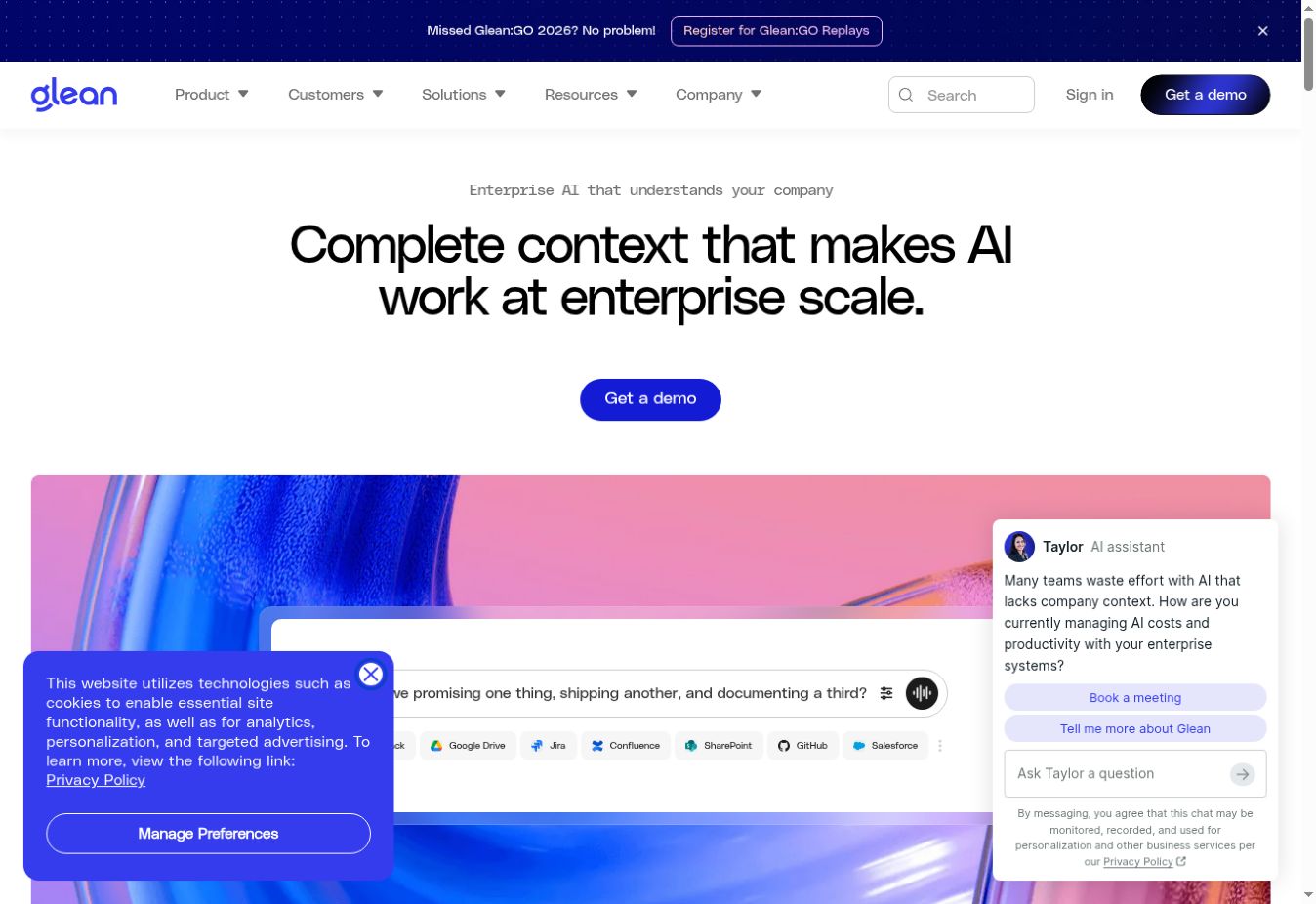
Fit, limitations and proof requests
Glean is a strong context-layer comparator when the main problem is finding and reusing organizational knowledge. Test execution depth for the actual growth workflow rather than assuming excellent search guarantees reliable external actions.
Priority question: Can an agent combine permissioned sources without leaking restricted facts to another participant?
The evaluation owner should be a growth operations lead. Use accepted work completed across tools as the business target. Judge the solution in its own stack role: a cloud runtime, a specialist production tool and a managed AI team can be complementary purchases.
Use-case evaluation plan
Account research to approved follow-up
Give the team an account record, a current product brief and a small set of approved customer references. Ask it to identify a relevant problem, distinguish observed facts from inferred needs, and prepare a follow-up for review. Then change one source and require a second person to correct the draft without restarting the research.
Measure: source accuracy, reviewer minutes, approved follow-ups and CRM consistency.
Campaign brief to coordinated delivery
Start with one campaign objective, audience, budget constraint and brand guide. Require research, a brief, assets and a release checklist with distinct human owners. Introduce an unresolved claim midway through the process. The system should retain useful work while preventing that claim from silently propagating into every asset.
Measure: accepted assets, revision burden, approval latency and missing handoffs.
Customer insight to shared learning
Provide anonymized support themes and sales objections. Ask for a synthesized insight, a proposed campaign adjustment and a knowledge update. A marketing owner and a CX owner should review the same underlying evidence. The exercise tests cross-functional context and accountability, not merely summarization quality.
Measure: evidence coverage, disagreement resolution and reuse of approved learning.
Detailed comparison
Read the detailed Nagent vs Glean guide for operating models, shared context, governance, cost, evidence gaps and a staged pilot.
Nagent vs GleanSources and evidence register
- V1 · Official product / pricing source
Glean · product ↗https://www.glean.com/ · Public material checked 21–29 September 2026 - V2 · Official product / pricing source
Glean · commercial / feature reference ↗https://www.glean.com/ · Public material checked 21–29 September 2026 - V3 · Official source
Agent governance · permission and sharing claims ↗https://www.glean.com/ai-agents/agent-governance · Public material checked 21–29 September 2026 - V4 · Independent review surface
Independent review samples · G2, Glean ↗https://www.g2.com/sellers/glean-technologies-db5ca3dc-c8a9-4900-9065-0c1ab979908a · Public material checked 21–29 September 2026 - V5 · Official source
Official agent access and publishing settings ↗https://docs.glean.com/administration/managing-agents/agent-access · Public material checked 21–29 September 2026 - V6 · Official source
Official write-action approval ↗https://docs.glean.com/agents/actions/human-in-the-loop-experience-for-actions · Public material checked 21–29 September 2026 - V7 · Official source
Official scheduled-agent security ↗https://docs.glean.com/security/agents/background-agents · Public material checked 21–29 September 2026 - V8 · Independent review surface
Independent agents announcement ↗https://www.glean.com/blog/introducing-independent-agents · Public material checked 21–29 September 2026 - V9 · Official source
Agent identity beta announcement ↗https://www.glean.com/blog/introducing-agent-identity · Public material checked 21–29 September 2026 - V10 · Official source
Agent modes documentation ↗https://docs.glean.com/agents/how-agents-work · Public material checked 21–29 September 2026 - V11 · Official source
August agent updates ↗https://www.glean.com/blog/glean-agents-go-2026 · Public material checked 21–29 September 2026 - N1 · Official source
Nagent · platform, workspace and security ↗https://nagent.ai/platform · Public material checked 21–29 September 2026 - N2 · Official source
Nagent · security and compliance ↗https://nagent.ai/dev-technology/security-and-compliance · Public material checked 21–29 September 2026 - N3 · Official source
Nagent · published plans ↗https://nagent.ai/pricing · Public material checked 21–29 September 2026 - THESIS · Official source
The Nagent Thesis ↗https://nagent.ai/artefacts/nagent-thesis · Public material checked 21–29 September 2026 - GOVERNANCE-SOURCE · Official source
State of Agent Governance ↗https://nagent.ai/artefacts/state-of-agent-governance · Public material checked 21–29 September 2026