
Gorgias AI Agent
Ecommerce AI agent for customer support, shopping guidance and revenue-oriented service.
What it is
Gorgias prices its helpdesk by ticket volume rather than human-agent seats and says AI Agent is billed when a conversation is resolved. Voice and SMS are separate volume-based additions. [V1] [V2]
Promoted use cases
- Resolve ecommerce order and return issues
- Recommend products and guide shopping
- Coordinate support in a shared commerce inbox
CX agents operate where answer quality and action correctness directly affect customers. A response that sounds useful can still be wrong, and a conversation marked resolved can reopen. The comparison should combine customer experience, transactional accuracy, human handoff, operational visibility and the exact commercial definition of an outcome.
Pricing and buying model
Tickets + resolved conversations
AI Agent on all plans; numerical rates were not rendered in reviewed pricing content.
Check current commercial source ↗Budget for implementation, model and tool usage, data, human review and ongoing support. Credit units and outcome definitions differ between vendors. A missing numeric rate is marked unverified rather than replaced with an old third-party estimate.
Collaboration and governance
Test order authentication, refund limits and separation between product advice and account-changing actions.
The relevant unit of control is permission to change an order, account or service record. Inspect who can propose, approve, execute, interrupt and audit that action. Shared seats, shared content and a shared live agent session are different capabilities; require a demonstration of the one your process needs.
Evaluate memory correction, permission revocation and release control for updated instructions. An improvement loop should preserve the original evidence, proposed change, test results and named approver. A safety or security badge alone cannot establish those workflow properties.
Review and customer evidence
The G2 seller listing contains an August 2026 seller-invited customer account saying AI Agent improved its service work. The sample is relevant but seller invitation and product-suite history limit generalization. Reconcile “AI resolved” interactions to reopened conversations and ticket fees in a buyer-owned test.
Before relying on a testimonial, confirm the exact product, version, package, workload and baseline. Ask a relevant customer about setup effort, failed cases, ongoing manual work and support after launch. This dossier does not convert customer logos or vendor-hosted awards into independent proof.
Focused feature documentation
Two billable events, handoff rules and the separate Gaia assistant
Gorgias’s billing guide is explicit that a helpdesk ticket fee applies when the helpdesk sends any message, including one from AI Agent or a rule. An additional automation fee applies when AI Agent resolves without handing off. A single fully AI-resolved ticket can incur both charges; an AI reply followed by human handoff incurs the ticket fee alone. Rates depend on tier, and accounts created before 28 May 2025 may have legacy terms. The company blog cites $0.90 per resolved interaction on most plans; use the buyer’s billing page for the actual rate and definition.
The handover documentation says certain signals—such as an explicit human request, frustration, or specified sensitive topics—always cause a transfer and cannot be turned off. Teams can add off-limits topics and rules that prevent AI Agent from answering tickets. Chat defaults to asking the shopper to confirm handover, but this can be changed. A pilot should exercise order status, refund exception, explicit human request and a revoked action, then inspect the ticket, handover and both billing meters.
Gorgias also documents Gaia, a different assistant used by staff to analyze tickets and propose changes to helpdesk configuration or AI Agent skills. Gaia asks approval before changes by default, but a user can turn on Auto-run for a conversation; it does not draft or send customer replies. Gaia respects the user’s existing role, according to the docs. Keep Gaia’s configuration approval distinct from customer-facing AI Agent action controls. Test a proposed rule change and ask which admin can enable Auto-run or edit the underlying commerce action.
Primary sources: Official billing guide and double-charge scenarios ↗ · Official AI-agent pricing explanation ↗ · Official handover rules ↗ · Official Gaia assistant scope and approvals ↗
Published documentation and public illustrations; account behaviour was not independently tested.
Visual source
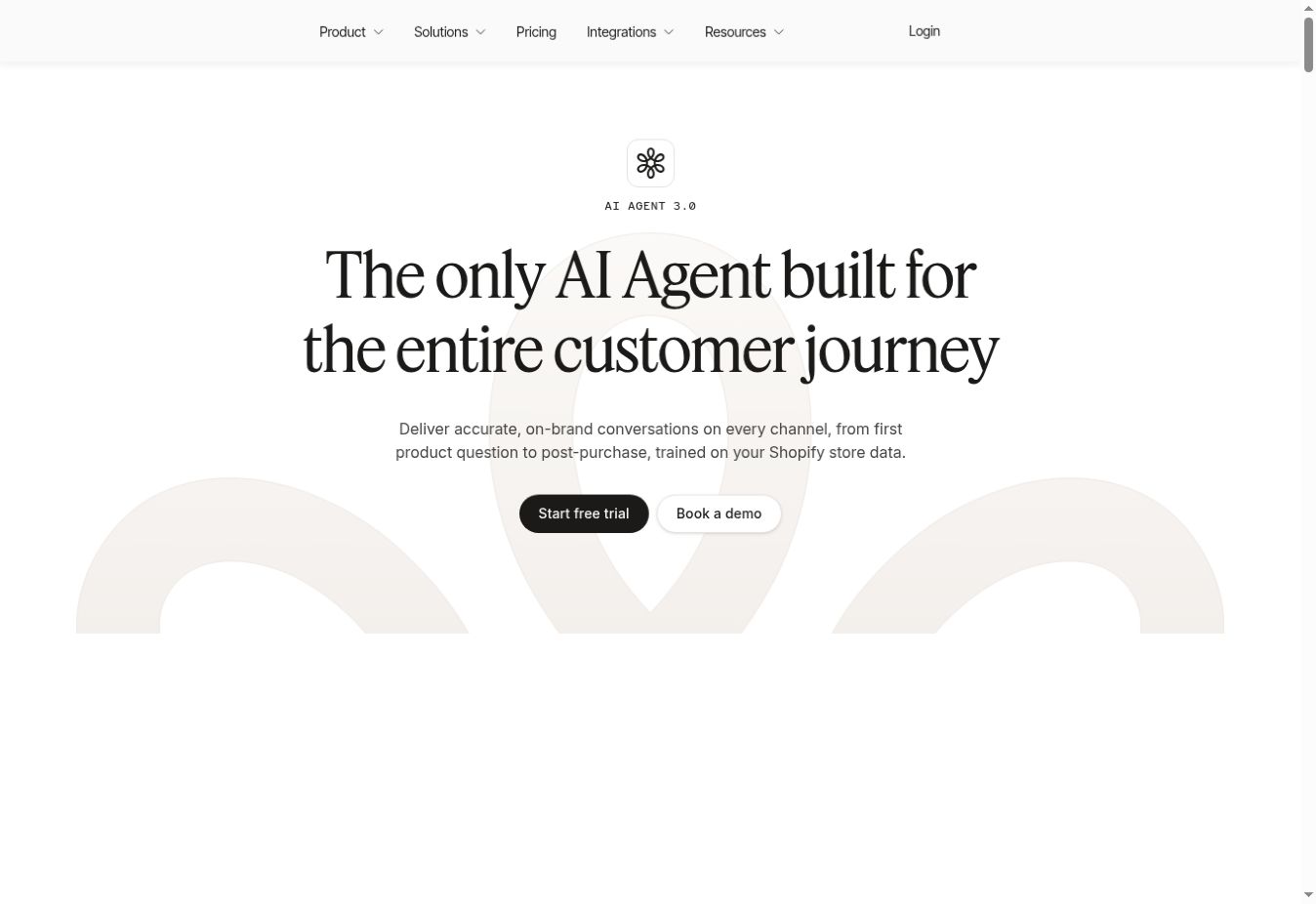
Fit, limitations and proof requests
Gorgias has a clear ecommerce-native role. Nagent should be compared on an equivalent commerce workflow with identical backend permissions and human handoff requirements.
Priority question: Can we restrict refund, cancellation and order-edit actions by value, customer state and approval owner?
The evaluation owner should be the customer-experience and support-operations leads. Use durable, accurate resolutions with appropriate human escalation as the business target. Judge the solution in its own stack role: a cloud runtime, a specialist production tool and a managed AI team can be complementary purchases.
Use-case evaluation plan
Knowledge answer with a verifiable source
Provide a current policy, an obsolete policy and an ambiguous customer question. Require the agent to use the right version, identify uncertainty and avoid inventing exceptions. Ask a human reviewer to verify the answer without reading a long hidden history.
Measure: answer accuracy, source freshness and appropriate escalation.
A bounded customer action
Use a test customer, a low-risk transaction and an explicit action limit. Try a request outside that limit and a case with conflicting identity information. Verify the backend state after execution; a conversational confirmation alone is not evidence that the transaction succeeded.
Measure: correct state changes, blocked unauthorized actions and recoverability.
Learning from a failed resolution
Introduce a repeat contact after an apparently successful interaction. Ask the system to identify the failure, propose a policy or knowledge correction and show the evidence. Require a human owner to approve the change before it affects other customers, then replay similar cases.
Measure: reopen rate, correction quality, regression results and human workload.
Detailed comparison
Read the detailed Nagent vs Gorgias AI Agent guide for operating models, shared context, governance, cost, evidence gaps and a staged pilot.
Nagent vs Gorgias AI AgentSources and evidence register
- V1 · Official product / pricing source
Gorgias AI Agent · product ↗https://www.gorgias.com/ai-agent · Public material checked 21–29 September 2026 - V2 · Official product / pricing source
Gorgias AI Agent · commercial / feature reference ↗https://www.gorgias.com/pricing · Public material checked 21–29 September 2026 - V3 · Independent review surface
Independent review venue · G2, Gorgias ↗https://www.g2.com/sellers/gorgias?survey_responses_page=6 · Public material checked 21–29 September 2026 - V4 · Official source
Official billing guide and double-charge scenarios ↗https://helpcenter.gorgias.com/en-US/how-youre-billed-for-using-gorgias-199385 · Public material checked 21–29 September 2026 - V5 · Official source
Official AI-agent pricing explanation ↗https://www.gorgias.com/blog/ai-agent-pricing · Public material checked 21–29 September 2026 - V6 · Official source
Official handover rules ↗https://docs.gorgias.com/en-US/customize-how-ai-agent-hands-over-to-your-team-6008591 · Public material checked 21–29 September 2026 - V7 · Official source
Official Gaia assistant scope and approvals ↗https://docs.gorgias.com/en-US/gaia-explained-6646561 · Public material checked 21–29 September 2026 - N1 · Official source
Nagent · platform, workspace and security ↗https://nagent.ai/platform · Public material checked 21–29 September 2026 - N2 · Official source
Nagent · security and compliance ↗https://nagent.ai/dev-technology/security-and-compliance · Public material checked 21–29 September 2026 - N3 · Official source
Nagent · published plans ↗https://nagent.ai/pricing · Public material checked 21–29 September 2026 - THESIS · Official source
The Nagent Thesis ↗https://nagent.ai/artefacts/nagent-thesis · Public material checked 21–29 September 2026 - GOVERNANCE-SOURCE · Official source
State of Agent Governance ↗https://nagent.ai/artefacts/state-of-agent-governance · Public material checked 21–29 September 2026