
Hermes Agent (Nous Research)
Open, self-hostable general agent with tool use and long-running task execution; identity interpreted as Nous Research Hermes.
What it is
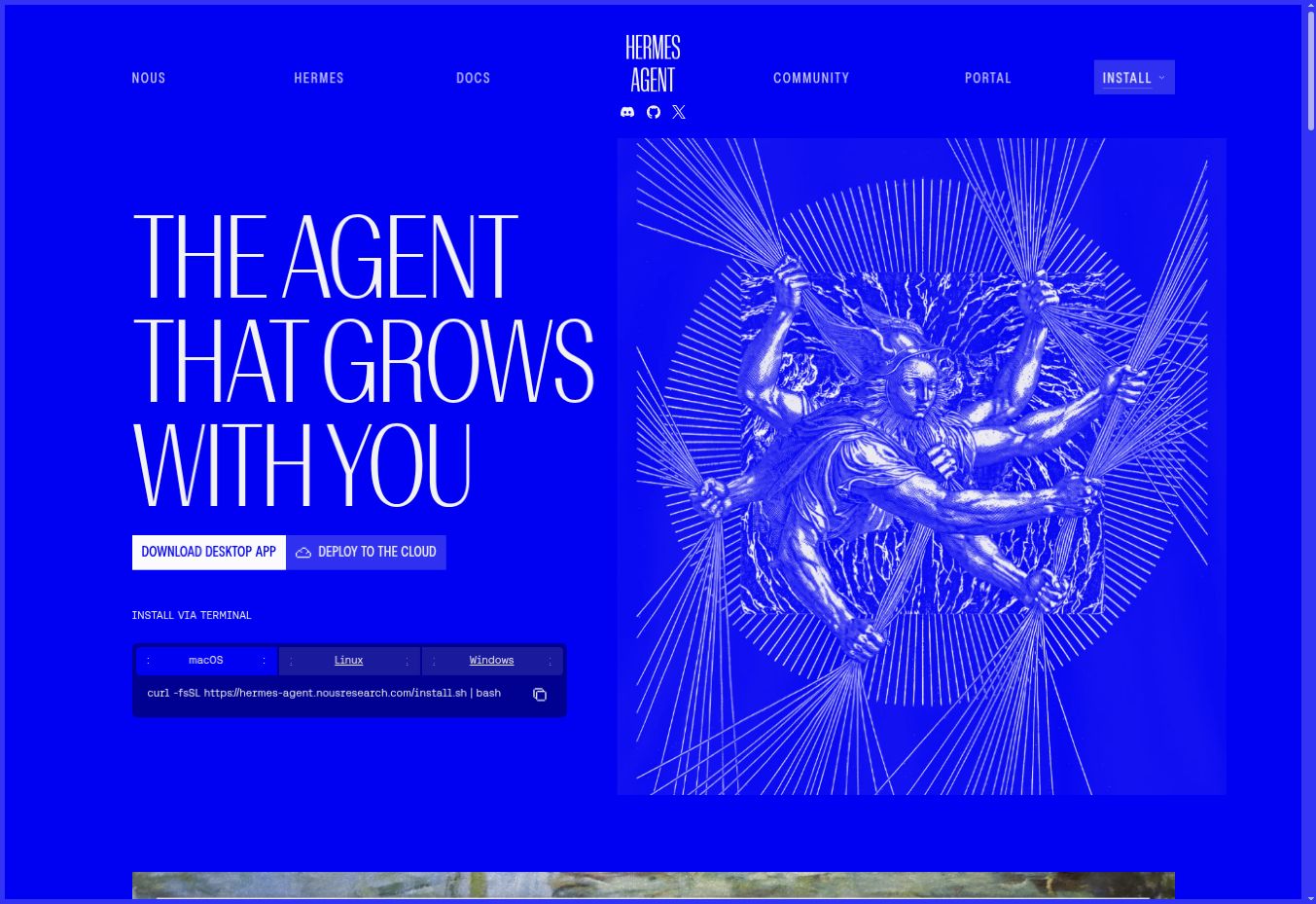
Nous describes persistent memory, generated skills, scheduled tasks, messaging surfaces and isolated subagents. Hermes can run locally or with optional hosted services. [V1] [V2]
Promoted use cases
- Automate recurring research and briefings
- Maintain task memory and reusable skills
- Run extensible personal or custom agents
General agents matter because they change expectations about what an assistant can do. Their flexibility is also why an impressive personal demonstration does not establish readiness for shared enterprise work. This category is a watchlist: product identity, team access, permission boundaries and operational support need clearer evidence before treating an entry as a direct growth-platform substitute.
Pricing and buying model
Free open-source core
MIT licence; model/hosting costs separate. Optional Nous Portal plans $20, $100 and $200/month.
Check current commercial source ↗Budget for implementation, model and tool usage, data, human review and ongoing support. Credit units and outcome definitions differ between vendors. A missing numeric rate is marked unverified rather than replaced with an old third-party estimate.
Collaboration and governance
Sandboxing is described, but a self-hosted deployment still needs identity, secrets, policy and operational ownership. MIT licensing is not a hosted-service SLA.
The relevant unit of control is permission to interact with a connected application. Inspect who can propose, approve, execute, interrupt and audit that action. Shared seats, shared content and a shared live agent session are different capabilities; require a demonstration of the one your process needs.
Evaluate memory correction, permission revocation and release control for updated instructions. An improvement loop should preserve the original evidence, proposed change, test results and named approver. A safety or security badge alone cannot establish those workflow properties.
Review and customer evidence
No independent review sample was verified in this research pass. Vendor-hosted testimonials are selection-biased customer evidence, not an aggregate rating.
Before relying on a testimonial, confirm the exact product, version, package, workload and baseline. Ask a relevant customer about setup effort, failed cases, ongoing manual work and support after launch. This dossier does not convert customer logos or vendor-hosted awards into independent proof.
Focused feature documentation
Open-source memory approval and scheduled delivery status
Hermes Agent documents persistent memory with an optional write-approval gate, allowing durable lessons to be staged before future sessions use them. Its scheduled-task documentation distinguishes successful execution from delivery failure, recording a failed send instead of calling the job complete. These are unusually concrete operational details for evaluating an autonomous agent, though they depend on the buyer’s own configuration and hosting.
Its security guide also discusses terminal and tool boundaries and secret handling; the plugin documentation states that third-party adapters do not automatically receive a blanket approval policy. A developer-led growth pilot should test a false memory correction, rejected write, scheduled outreach draft and failed delivery. MIT-licensed code is not zero operating cost: model, hosting, secret management, security review and ongoing maintenance remain with the operator.
Primary sources: Official persistent memory and approval guide ↗ · Official scheduled tasks ↗ · Official security guide ↗
Published documentation and public illustrations; account behaviour was not independently tested.
Visual source
Fit, limitations and proof requests
Hermes is an open implementation option and frontier watchlist entry. Multi-agent delegation is not by itself evidence of a governed multi-human workplace.
Priority question: Who reviews newly generated skills before they can execute, and how can a harmful memory be removed?
The evaluation owner should be an accountable pilot owner. Use useful completed work without unapproved side effects as the business target. Judge the solution in its own stack role: a cloud runtime, a specialist production tool and a managed AI team can be complementary purchases.
Use-case evaluation plan
A bounded research-and-artifact task
Choose a task using non-sensitive public inputs and require a sourced result with a clear completion condition. Include an ambiguous instruction and observe whether the agent asks an appropriate question or invents a direction. Keep the task limited enough that its output can be reviewed completely.
Measure: source accuracy, task completion and human correction effort.
Handoff between two humans
Where a team capability exists, ask a second authorized person to inspect progress and take ownership. Check whether account credentials, private context and pending actions remain correctly scoped. If the feature is undocumented, mark the result unknown rather than simulating multiplayer capability through shared passwords.
Measure: ownership clarity, access boundaries and continuity of task state.
Memory and unattended execution
Inspect how the agent stores useful facts and schedules repeat work. Correct an erroneous memory and revoke an integration before the next run. Test whether the change takes effect and whether a human can stop the process without losing the evidence needed to understand what happened.
Measure: memory correction, revocation behaviour and safe task interruption.
Detailed comparison
Read the detailed Nagent vs Hermes Agent (Nous Research) guide for operating models, shared context, governance, cost, evidence gaps and a staged pilot.
Nagent vs Hermes Agent (Nous Research)Sources and evidence register
- V1 · Official product / pricing source
Hermes Agent (Nous Research) · product ↗https://hermes-agent.nousresearch.com/ · Public material checked 21–29 September 2026 - V2 · Official product / pricing source
Hermes Agent (Nous Research) · commercial / feature reference ↗https://hermes-agent.nousresearch.com/ · Public material checked 21–29 September 2026 - V3 · Official source
Official persistent memory and approval guide ↗https://hermes-agent.nousresearch.com/docs/user-guide/features/memory · Public material checked 21–29 September 2026 - V4 · Official source
Official scheduled tasks ↗https://hermes-agent.nousresearch.com/docs/user-guide/features/cron · Public material checked 21–29 September 2026 - V5 · Official source
Official security guide ↗https://hermes-agent.nousresearch.com/docs/user-guide/security · Public material checked 21–29 September 2026 - N1 · Official source
Nagent · platform, workspace and security ↗https://nagent.ai/platform · Public material checked 21–29 September 2026 - N2 · Official source
Nagent · security and compliance ↗https://nagent.ai/dev-technology/security-and-compliance · Public material checked 21–29 September 2026 - N3 · Official source
Nagent · published plans ↗https://nagent.ai/pricing · Public material checked 21–29 September 2026 - THESIS · Official source
The Nagent Thesis ↗https://nagent.ai/artefacts/nagent-thesis · Public material checked 21–29 September 2026 - GOVERNANCE-SOURCE · Official source
State of Agent Governance ↗https://nagent.ai/artefacts/state-of-agent-governance · Public material checked 21–29 September 2026