
HubSpot Agent Hub
Agents embedded across HubSpot’s customer platform, using CRM context for growth workflows.
What it is
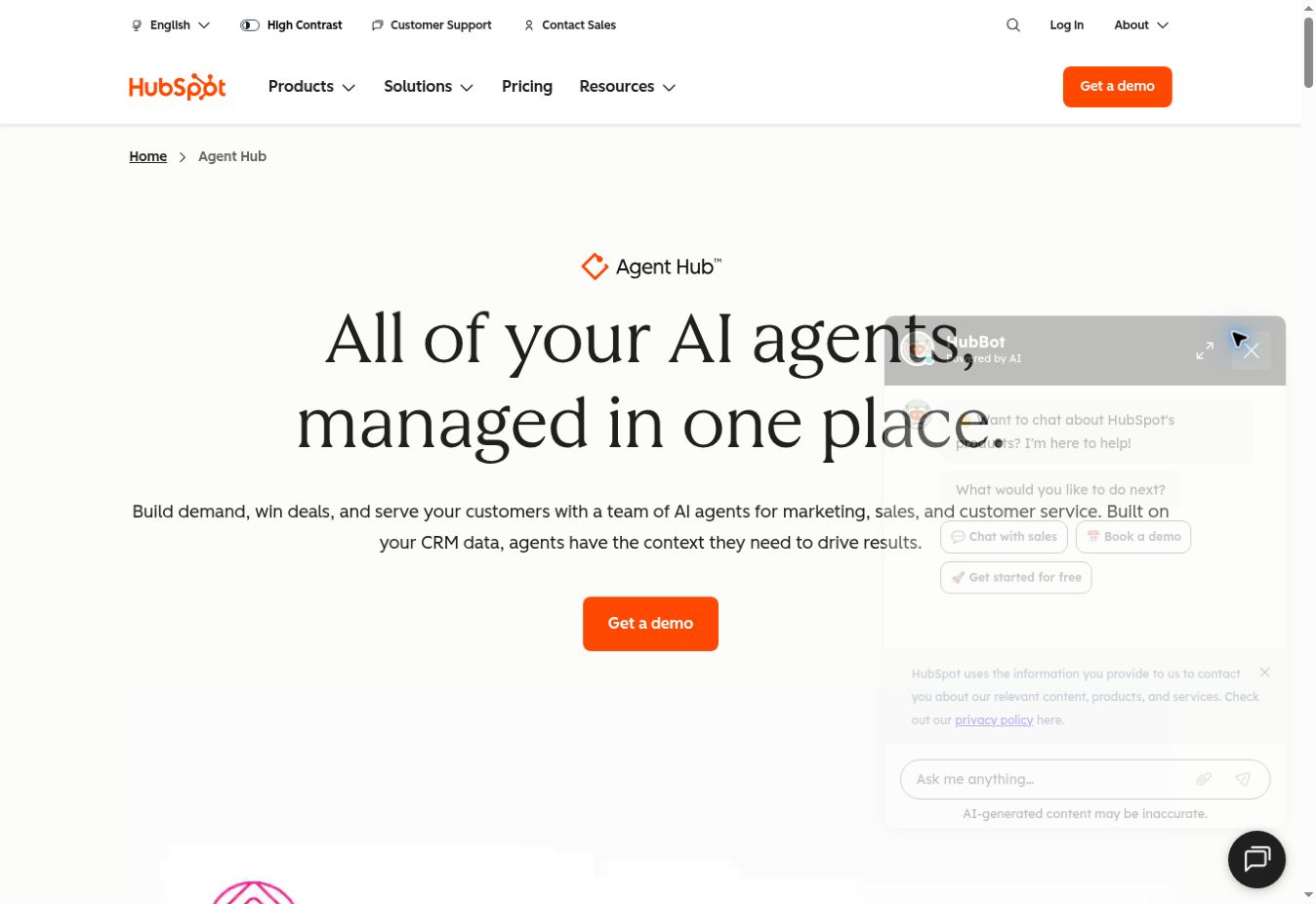
HubSpot now groups campaign, content, nurture, prospecting, customer and data agents around Agent Hub and its CRM context. Its AEO offering is presented separately as beta. [V1] [V2]
Promoted use cases
- Plan and produce campaigns
- Research and nurture prospects
- Resolve customer queries using CRM context
Suite-native agents inherit an established environment of records, permissions, business rules and human work. Their advantage can be operational proximity rather than model intelligence. Their constraint can be the cost and complexity of crossing suite boundaries. A separate platform earns its place only if the missing workflow is important enough to support another operating layer.
Pricing and buying model
Hub / credit dependent
No comparable Agent Hub price verified; underlying HubSpot subscriptions and usage matter.
Check current commercial source ↗Budget for implementation, model and tool usage, data, human review and ongoing support. Credit units and outcome definitions differ between vendors. A missing numeric rate is marked unverified rather than replaced with an old third-party estimate.
Collaboration and governance
CRM permissions and human handoff are relevant, but confirm agent-specific action limits and feature availability in your hubs.
The relevant unit of control is permission to change a business record or trigger customer communication. Inspect who can propose, approve, execute, interrupt and audit that action. Shared seats, shared content and a shared live agent session are different capabilities; require a demonstration of the one your process needs.
Evaluate memory correction, permission revocation and release control for updated instructions. An improvement loop should preserve the original evidence, proposed change, test results and named approver. A safety or security badge alone cannot establish those workflow properties.
Review and customer evidence
G2’s HubSpot seller profile spans Marketing Hub, Sales Hub, Service Hub and other products. Its large aggregate review base is evidence about the broader suite, not a separate validation of Agent Hub. No Agent Hub-specific independent sample was established in this pass. The product page’s G2 badges and customer outcome statistics remain vendor-presented evidence.
Before relying on a testimonial, confirm the exact product, version, package, workload and baseline. Ask a relevant customer about setup effort, failed cases, ongoing manual work and support after launch. This dossier does not convert customer logos or vendor-hosted awards into independent proof.
Focused feature documentation
Breeze Studio approval, Agent Inbox and credit accounting
HubSpot’s prospecting-agent setup requires an account administrator or an explicit agent permission and enabled AI access to CRM, conversation and file data. Its help page describes the recent engagement data used by the agent, including activity up to a year old, and says credit-consuming agent actions cannot be completed in a sandbox account.
Breeze Studio lets a builder configure agent inputs, extra instructions, tools, knowledge vaults and supported automation. HubSpot says its prebuilt agent’s default instructions and tools cannot simply be deleted. For CRM-write tools, the builder can turn on Review before running this tool; the Studio guide says that switch requires approval for CRM updates. Automation has a stated 1,000-run daily limit and needs a Professional or Enterprise subscription for configuration. These are edition- and configuration-dependent boundaries, not an assertion that every HubSpot agent needs human approval.
Agent Inbox records run status, trigger, user, estimated credits and sources in output. For automated runs the agent owner’s permissions apply, so a failed action may reflect that owner’s access. The Customer Agent has a separate resolution-based credit rule: a qualifying visitor-initiated human handoff prevents a conversation from counting as resolved, while a manual reassignment alone does not. For replies, resolution is assessed after 72 hours; later replies can trigger another billable resolution. Do not infer its economics from a seat subscription or equate a vendor-defined resolution with sustained customer satisfaction.
That sandbox constraint matters when comparing a CRM-native agent with a custom growth team: a realistic controlled test may require a paid production-adjacent scope. HubSpot says its prospecting agent currently supports only the default brand voice. Test prospecting, CRM writes and customer-agent resolution as separate scenarios, then ask for the relevant credits and role entitlements.
HubSpot’s newer custom agent builder is separately marked beta. Its July documentation lists Professional or Enterprise for specified hubs and HubSpot Credits, with Super Admin or Agent Builder permission to configure. It supports HubSpot, default and MCP actions plus persistent knowledge and per-run inputs. By default, Super Admins can edit while all users can run an agent, but feature permissions can still block a run; the builder offers tighter team or user access. Builder tests do not consume credits, and its displayed credit estimates may differ from actual costs. Do not assume this beta surface is included in a lower-tier Agent Hub subscription or that its permissions match every prebuilt agent.
Primary sources: Official prospecting-agent setup and limits ↗ · Official Breeze Studio guide ↗ · Official custom agent builder beta ↗ · Official Agent Inbox guide ↗ · Official customer-agent credit definition ↗
Published documentation and public illustrations; account behaviour was not independently tested.
Visual source
Fit, limitations and proof requests
HubSpot is a direct operating-environment decision for teams already using its customer platform. Nagent’s case rests on custom workflows or cross-stack coordination that the native suite does not meet in a pilot.
Priority question: Which agents and credit allowances are included in our existing hubs, and which require upgrades?
The evaluation owner should be the CRM or business-application owner. Use correctly completed customer workflows as the business target. Judge the solution in its own stack role: a cloud runtime, a specialist production tool and a managed AI team can be complementary purchases.
Use-case evaluation plan
A lead becomes a governed opportunity
Give the agent a new lead with an existing account, a territory rule, a suppression flag and an open opportunity. Ask it to recommend an owner, draft a response and propose CRM changes. The test should reveal whether the agent understands existing state or simply creates more records and activity.
Measure: duplicate records, routing accuracy, accepted updates and time to first useful response.
Campaign and service context converge
Use a customer currently receiving marketing messages who also has an unresolved service issue. Ask the workflow to adjust the planned contact and route the case to its human owner. Require a clear explanation of which customer state and permission rule influenced the decision.
Measure: contact-policy consistency, service context retention and incorrect sends.
Extend beyond the native application
Select one workflow that must use a system outside the suite, such as an external content repository or a separate customer portal. Test identity propagation, write permissions and failure recovery across the boundary. Measure integration ownership as well as the agent’s apparent intelligence.
Measure: integration effort, successful handoffs and recoverable failures.
Detailed comparison
Read the detailed Nagent vs HubSpot Agent Hub guide for operating models, shared context, governance, cost, evidence gaps and a staged pilot.
Nagent vs HubSpot Agent HubSources and evidence register
- V1 · Official product / pricing source
HubSpot Agent Hub · product ↗https://www.hubspot.com/products/artificial-intelligence · Public material checked 21–29 September 2026 - V2 · Official product / pricing source
HubSpot Agent Hub · commercial / feature reference ↗https://www.hubspot.com/products/artificial-intelligence · Public material checked 21–29 September 2026 - V3 · Official source
Prospecting agent · official setup and limits ↗https://knowledge.hubspot.com/prospecting/use-the-prospecting-agent · Public material checked 21–29 September 2026 - V4 · Independent review surface
Independent review scope · G2, HubSpot suite ↗https://www.g2.com/sellers/hubspot · Public material checked 21–29 September 2026 - V5 · Official source
Official Breeze Studio guide ↗https://knowledge.hubspot.com/ai/use-assistants-and-agents-in-breeze-studio · Public material checked 21–29 September 2026 - V6 · Official source
Official custom agent builder beta ↗https://knowledge.hubspot.com/ai/create-and-customize-agents-in-the-agent-builder · Public material checked 21–29 September 2026 - V7 · Official source
Official Agent Inbox guide ↗https://knowledge.hubspot.com/ai/review-agent-output · Public material checked 21–29 September 2026 - V8 · Official source
Official customer-agent credit definition ↗https://knowledge.hubspot.com/customer-agent/understand-the-customer-agent · Public material checked 21–29 September 2026 - N1 · Official source
Nagent · platform, workspace and security ↗https://nagent.ai/platform · Public material checked 21–29 September 2026 - N2 · Official source
Nagent · security and compliance ↗https://nagent.ai/dev-technology/security-and-compliance · Public material checked 21–29 September 2026 - N3 · Official source
Nagent · published plans ↗https://nagent.ai/pricing · Public material checked 21–29 September 2026 - THESIS · Official source
The Nagent Thesis ↗https://nagent.ai/artefacts/nagent-thesis · Public material checked 21–29 September 2026 - GOVERNANCE-SOURCE · Official source
State of Agent Governance ↗https://nagent.ai/artefacts/state-of-agent-governance · Public material checked 21–29 September 2026