
Klaviyo K:AI
B2C CRM agents for campaign creation, customer service and cross-channel optimization.
What it is
Klaviyo presents Composer for marketing work grounded in account context and a Customer Agent that can use APIs and update profiles. Its positioning spans creation, service and optimization. [V1] [V2]
Promoted use cases
- Create lifecycle campaigns
- Personalize B2C messaging
- Handle customer questions and connected actions
Suite-native agents inherit an established environment of records, permissions, business rules and human work. Their advantage can be operational proximity rather than model intelligence. Their constraint can be the cost and complexity of crossing suite boundaries. A separate platform earns its place only if the missing workflow is important enough to support another operating layer.
Pricing and buying model
Profiles / messages / usage dependent
No numerical K:AI bundle quote verified in this pass.
Check current commercial source ↗Budget for implementation, model and tool usage, data, human review and ongoing support. Credit units and outcome definitions differ between vendors. A missing numeric rate is marked unverified rather than replaced with an old third-party estimate.
Collaboration and governance
Pre-launch testing and human control are part of the positioning. Check profile access, suppression rules and channel-specific send approvals.
The relevant unit of control is permission to change a business record or trigger customer communication. Inspect who can propose, approve, execute, interrupt and audit that action. Shared seats, shared content and a shared live agent session are different capabilities; require a demonstration of the one your process needs.
Evaluate memory correction, permission revocation and release control for updated instructions. An improvement loop should preserve the original evidence, proposed change, test results and named approver. A safety or security badge alone cannot establish those workflow properties.
Review and customer evidence
No independent review sample was verified in this research pass. Vendor-hosted testimonials are selection-biased customer evidence, not an aggregate rating.
Before relying on a testimonial, confirm the exact product, version, package, workload and baseline. Ask a relevant customer about setup effort, failed cases, ongoing manual work and support after launch. This dossier does not convert customer logos or vendor-hosted awards into independent proof.
Focused feature documentation
B2C CRM data, two agent roles and language scope
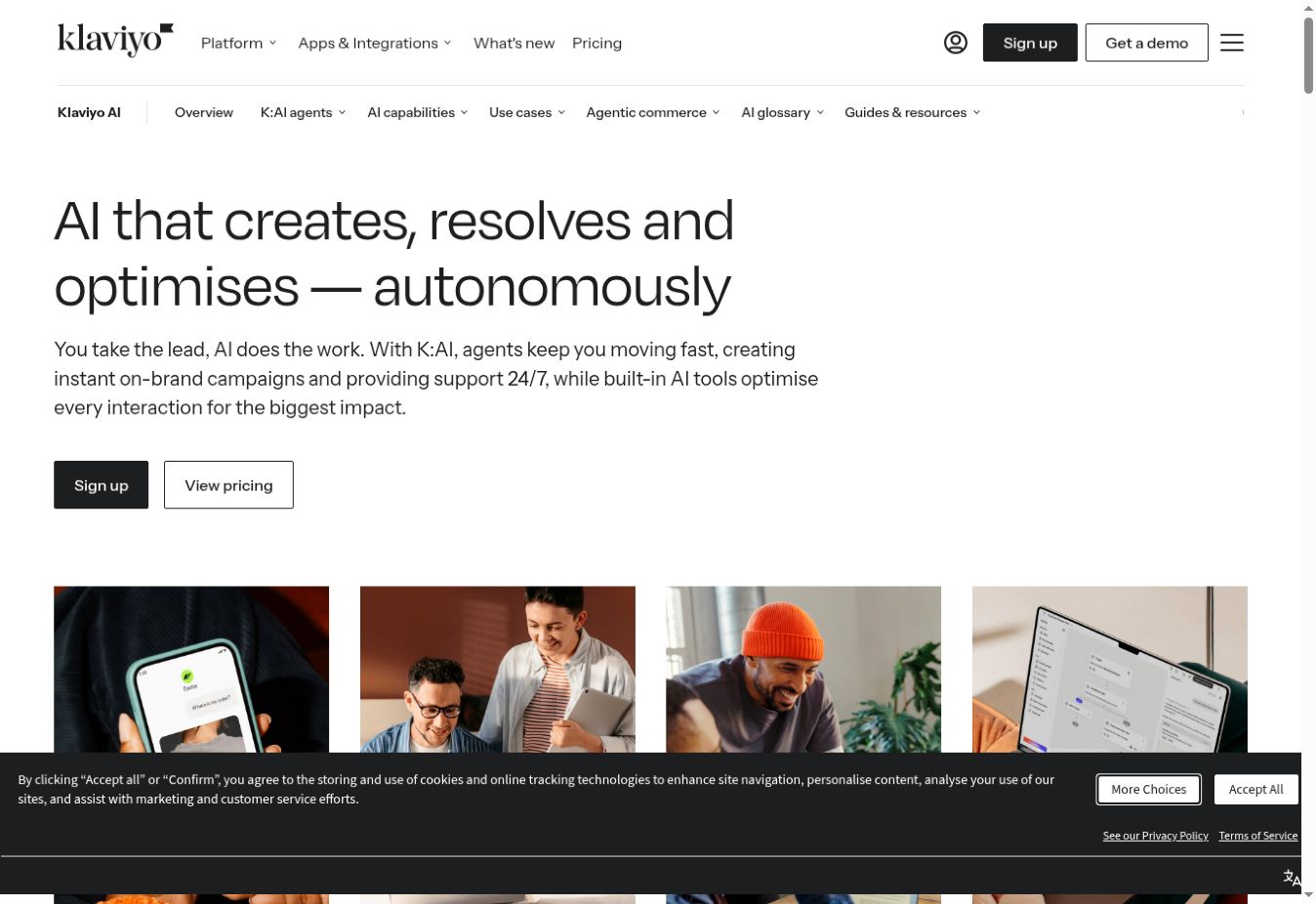
Klaviyo’s current K:AI description separates its marketing agent, now presented as Composer in navigation, from its Customer Agent. The marketing role plans and drafts campaigns, flows and forms using a brand site and customer context; the customer role answers product questions, recommends items and handles supported order and return tasks. Klaviyo says both draw on shared customer profiles across its B2C CRM. These descriptions establish a promoted use case, not independently measured campaign performance.
Its product explanation says the K:AI agents are currently available in English, with additional languages planned for 2026. The language statement should be checked for the buyer’s exact account and release. Pricing combines the underlying marketing/service products and an AI-agent offer, so request a worked forecast for contact volume, channels and agent interactions. A pilot should test a consent or profile change between a marketing draft and a customer-service response.
Primary sources: Official K:AI product explanation ↗ · Official pricing page ↗
Published documentation and public illustrations; account behaviour was not independently tested.
Visual source
Fit, limitations and proof requests
Klaviyo is particularly relevant to lifecycle marketing where profiles, events and channels already live together. Compare retention and incremental revenue, not content volume alone.
Priority question: Can we test a proposed campaign against suppression, consent and brand rules before it reaches customers?
The evaluation owner should be the CRM or business-application owner. Use correctly completed customer workflows as the business target. Judge the solution in its own stack role: a cloud runtime, a specialist production tool and a managed AI team can be complementary purchases.
Use-case evaluation plan
A lead becomes a governed opportunity
Give the agent a new lead with an existing account, a territory rule, a suppression flag and an open opportunity. Ask it to recommend an owner, draft a response and propose CRM changes. The test should reveal whether the agent understands existing state or simply creates more records and activity.
Measure: duplicate records, routing accuracy, accepted updates and time to first useful response.
Campaign and service context converge
Use a customer currently receiving marketing messages who also has an unresolved service issue. Ask the workflow to adjust the planned contact and route the case to its human owner. Require a clear explanation of which customer state and permission rule influenced the decision.
Measure: contact-policy consistency, service context retention and incorrect sends.
Extend beyond the native application
Select one workflow that must use a system outside the suite, such as an external content repository or a separate customer portal. Test identity propagation, write permissions and failure recovery across the boundary. Measure integration ownership as well as the agent’s apparent intelligence.
Measure: integration effort, successful handoffs and recoverable failures.
Detailed comparison
Read the detailed Nagent vs Klaviyo K:AI guide for operating models, shared context, governance, cost, evidence gaps and a staged pilot.
Nagent vs Klaviyo K:AISources and evidence register
- V1 · Official product / pricing source
Klaviyo K:AI · product ↗https://www.klaviyo.com/solutions/ai · Public material checked 21–29 September 2026 - V2 · Official product / pricing source
Klaviyo K:AI · commercial / feature reference ↗https://www.klaviyo.com/au/solutions/ai · Public material checked 21–29 September 2026 - V3 · Official source
Official K:AI product explanation ↗https://www.klaviyo.com/solutions/ai/what-is-kai · Public material checked 21–29 September 2026 - V4 · Official source
Official pricing page ↗https://www.klaviyo.com/pricing/ · Public material checked 21–29 September 2026 - N1 · Official source
Nagent · platform, workspace and security ↗https://nagent.ai/platform · Public material checked 21–29 September 2026 - N2 · Official source
Nagent · security and compliance ↗https://nagent.ai/dev-technology/security-and-compliance · Public material checked 21–29 September 2026 - N3 · Official source
Nagent · published plans ↗https://nagent.ai/pricing · Public material checked 21–29 September 2026 - THESIS · Official source
The Nagent Thesis ↗https://nagent.ai/artefacts/nagent-thesis · Public material checked 21–29 September 2026 - GOVERNANCE-SOURCE · Official source
State of Agent Governance ↗https://nagent.ai/artefacts/state-of-agent-governance · Public material checked 21–29 September 2026