
OpenAI
Frontier-model and agent-building provider powering many downstream growth applications.
What it is
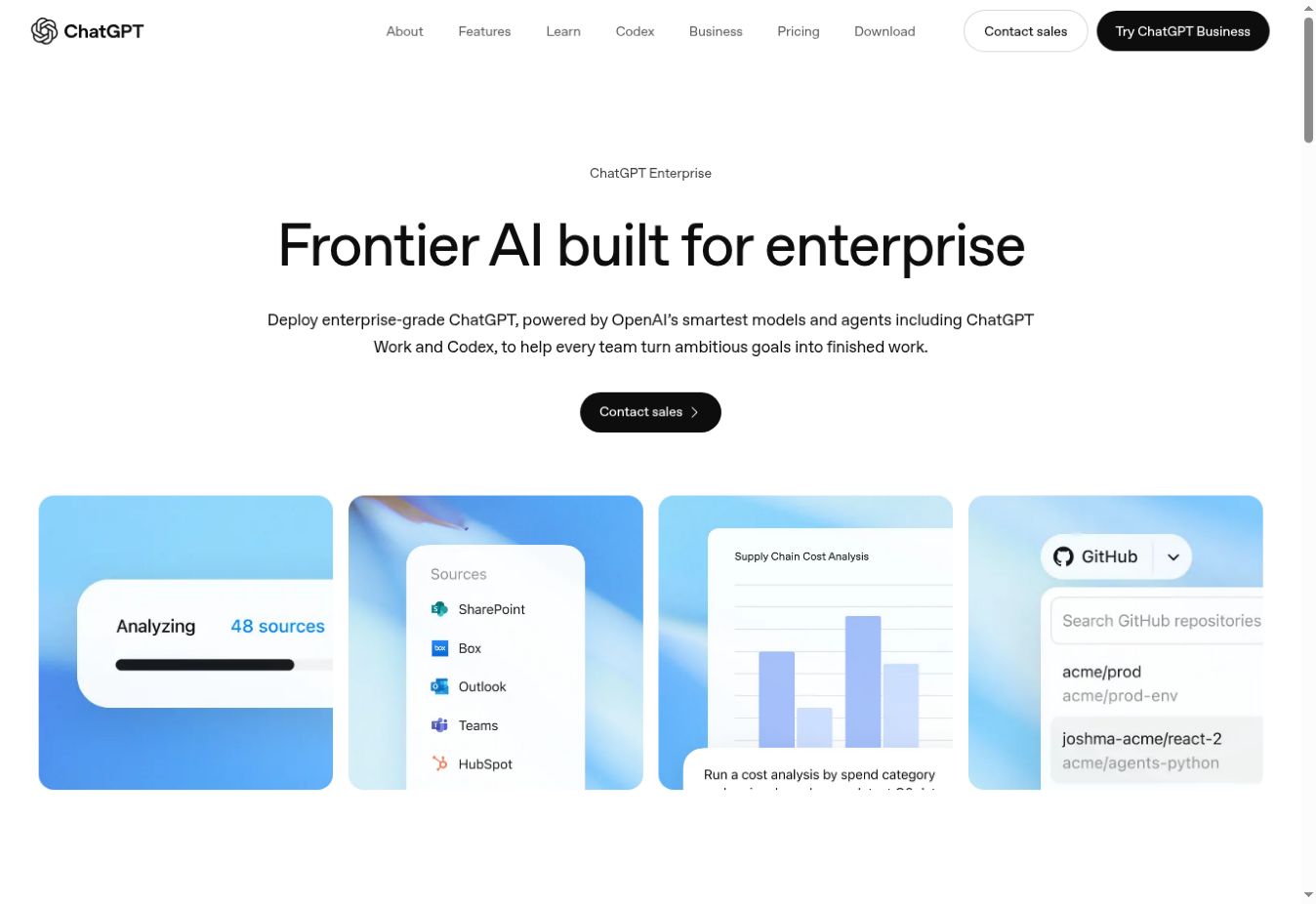
OpenAI’s current business page includes shared projects, company context and workspace agents. Enterprise adds controls such as SCIM, role-based access and additional data options. [V1] [V2]
Promoted use cases
- Research and create across shared company context
- Build workspace-specific workflows
- Use models and tools in custom applications
A model provider can sell a collaborative workplace product and a developer API at the same time. These are different buying decisions. The workspace may solve a team’s knowledge-work problem directly; the API supplies capabilities for an application someone must build and maintain. Compare a specific offer before drawing conclusions about Nagent or any specialist platform.
Pricing and buying model
$25 / standard Business seat / month
$20 on annual billing; Premium $125 monthly/$100 annual. Enterprise custom; API separate.
Check current commercial source ↗Budget for implementation, model and tool usage, data, human review and ongoing support. Credit units and outcome definitions differ between vendors. A missing numeric rate is marked unverified rather than replaced with an old third-party estimate.
Collaboration and governance
Distinguish ChatGPT workspace governance from API application governance. API integration requires its own access, evaluation and action controls.
The relevant unit of control is permission to use an external tool or modify business data. Inspect who can propose, approve, execute, interrupt and audit that action. Shared seats, shared content and a shared live agent session are different capabilities; require a demonstration of the one your process needs.
Evaluate memory correction, permission revocation and release control for updated instructions. An improvement loop should preserve the original evidence, proposed change, test results and named approver. A safety or security badge alone cannot establish those workflow properties.
Review and customer evidence
No independent review sample was verified in this research pass. Vendor-hosted testimonials are selection-biased customer evidence, not an aggregate rating.
Before relying on a testimonial, confirm the exact product, version, package, workload and baseline. Ask a relevant customer about setup effort, failed cases, ongoing manual work and support after launch. This dossier does not convert customer logos or vendor-hosted awards into independent proof.
Focused feature documentation
Business workspace versus developer agent platform
OpenAI sells ChatGPT Business or Enterprise workspaces and a separately metered developer platform. Shared workspace and agent features in the business product should not be equated with an API-based application merely because both can use OpenAI models. Business seat tiers, agent-run credits and API model or tool charges need their own quotation and controls.
A growth-team pilot should specify the exact product: internal research in ChatGPT, a workflow built with the API, or a custom Nagent-led system using an OpenAI model. Inspect shared context, tool permissions and review before an external customer action. Model quality alone does not supply tenant-specific integration, account ownership or an accountable human handoff.
Primary sources: Official business plan pricing ↗ · Official ChatGPT Business release notes ↗ · Official API platform documentation ↗
Published documentation and public illustrations; account behaviour was not independently tested.
Visual source
Fit, limitations and proof requests
OpenAI is both an end-user workspace provider and a foundation supplier. A Nagent comparison should select one offer explicitly; a model API is not a managed growth team.
Priority question: Are we buying a shared workspace, building an API application, or combining both, and who governs external actions?
The evaluation owner should be the AI application owner and growth operations lead. Use accepted work with known quality, cost and ownership as the business target. Judge the solution in its own stack role: a cloud runtime, a specialist production tool and a managed AI team can be complementary purchases.
Use-case evaluation plan
Shared knowledge work in the workspace
Give two colleagues an approved source set and a shared task. Test whether they can collaborate, inspect sources and preserve decisions without passing disconnected transcripts. Introduce a restricted document and verify that collaboration does not expand access unintentionally.
Measure: shared context quality, permission behaviour and human revision effort.
An API-backed growth workflow
Build a small tool-using application around the same business task. Include structured outputs, validation, failure handling and a human approval step. Track model behaviour separately from the reliability of the application code that surrounds it.
Measure: accepted task completion, model cost, engineering effort and action correctness.
Model change without operational surprise
Replay a representative evaluation set when changing models or prompts. Include difficult examples, unsupported claims and prohibited tool actions. Confirm that better average output quality does not hide regressions in important exceptions or materially higher usage costs.
Measure: quality by task class, regression rate and cost per accepted output.
Detailed comparison
Read the detailed Nagent vs OpenAI guide for operating models, shared context, governance, cost, evidence gaps and a staged pilot.
Nagent vs OpenAISources and evidence register
- V1 · Official product / pricing source
OpenAI · product ↗https://openai.com/enterprise/ · Public material checked 21–29 September 2026 - V2 · Official product / pricing source
OpenAI · commercial / feature reference ↗https://openai.com/business/chatgpt-pricing/ · Public material checked 21–29 September 2026 - V3 · Official source
API / business pricing surface ↗https://openai.com/business/pricing/ · Public material checked 21–29 September 2026 - V4 · Official source
Official ChatGPT Business release notes ↗https://help.openai.com/en/articles/11391654-chatgpt-business-release-notes · Public material checked 21–29 September 2026 - V5 · Official source
Official API platform documentation ↗https://platform.openai.com/docs/ · Public material checked 21–29 September 2026 - N1 · Official source
Nagent · platform, workspace and security ↗https://nagent.ai/platform · Public material checked 21–29 September 2026 - N2 · Official source
Nagent · security and compliance ↗https://nagent.ai/dev-technology/security-and-compliance · Public material checked 21–29 September 2026 - N3 · Official source
Nagent · published plans ↗https://nagent.ai/pricing · Public material checked 21–29 September 2026 - THESIS · Official source
The Nagent Thesis ↗https://nagent.ai/artefacts/nagent-thesis · Public material checked 21–29 September 2026 - GOVERNANCE-SOURCE · Official source
State of Agent Governance ↗https://nagent.ai/artefacts/state-of-agent-governance · Public material checked 21–29 September 2026