
Pencil
AI operating system for governed, brand-safe creative production and ad workflows.
What it is
Pencil describes AI agents, multi-step workflows, creative scoring and collaboration. Pro terms include role access, data ring-fencing, no-training provisions and AI governance controls. [V1] [V2]
Promoted use cases
- Generate brand-grounded ads
- Build repeatable creative workflows
- Use performance feedback to prioritize variants
Advertising AI spans several jobs: making assets, selecting variants, launching campaigns and changing media decisions. These jobs require different permissions and evidence. A generation tool can be excellent without running a campaign, and an autonomous advertiser should prove more than visual quality. Compare the specific part of the creative-to-media process being purchased.
Pricing and buying model
Core / Growth rate unverified
Pro enterprise custom; generation allowances and overages matter.
Check current commercial source ↗Budget for implementation, model and tool usage, data, human review and ongoing support. Credit units and outcome definitions differ between vendors. A missing numeric rate is marked unverified rather than replaced with an old third-party estimate.
Collaboration and governance
Pro governance terms differ from self-service plans. Generation limits, export access and post-cancellation access should be checked.
The relevant unit of control is permission to launch creative or change a paid campaign. Inspect who can propose, approve, execute, interrupt and audit that action. Shared seats, shared content and a shared live agent session are different capabilities; require a demonstration of the one your process needs.
Evaluate memory correction, permission revocation and release control for updated instructions. An improvement loop should preserve the original evidence, proposed change, test results and named approver. A safety or security badge alone cannot establish those workflow properties.
Review and customer evidence
No independent review sample was verified in this research pass. Vendor-hosted testimonials are selection-biased customer evidence, not an aggregate rating.
Before relying on a testimonial, confirm the exact product, version, package, workload and baseline. Ask a relevant customer about setup effort, failed cases, ongoing manual work and support after launch. This dossier does not convert customer logos or vendor-hosted awards into independent proof.
Focused feature documentation
Approval canvas, write-tool switch and brand input limits
Pencil’s help material says generation credits depend on the selected model, while its newer Scribble assistant uses seven size buckets based on the underlying model calls and processed information. A published Share of Model feature also connects AI-search visibility to creative work. These are distinct meters and scopes; a single “ad created” cost can conceal several model and revision charges.
Its Brief Mode ties objective, deliverables, reviewers and source material to a canvas. Full ad or work items can enter an Approvals sub-canvas; raw assets and generations do not count as deliverables there. Assigned reviewers receive a request, approved work becomes downloadable to clients, and a completed brief locks. The workspace activity log records changes. This is a specific creative review workflow, distinct from a runtime approval on a connected action.
Pencil’s governance help says all external write tools are disabled by default. A Workspace Admin must explicitly enable them in AI Governance and acknowledge terms; this gates tool availability but does not on its own prove a separate approval for every future write. Its brand-library guide says text knowledge and tone reach LLM prompts for image and video agents, while visual library elements do not directly influence prompt-based image/video generation and are drawn into the static ads agent. In a pilot, use a visual rule and logo to test this boundary, then enable one external write tool and inspect who may publish. Workflows are sequential for dependent nodes and do not accept input changes mid-execution; later nodes need rerunning after changes.
Pre-register a brand brief and five acceptable variants, then count generations, revisions, human edits, approved exports and media tests. Ask whether performance predictions are validated on the buyer’s campaigns. Reconcile model credits and Scribble charges separately, and request the exact Core, Growth or Pro entitlement before assuming every governance feature is included.
Primary sources: Official pricing page ↗ · Official generation counting ↗ · Official Scribble billing guide ↗ · Official Brief Mode approval workflow ↗ · Official external write-tool control ↗ · Official brand library limits ↗ · Official workflow limits ↗
Published documentation and public illustrations; account behaviour was not independently tested.
Visual source
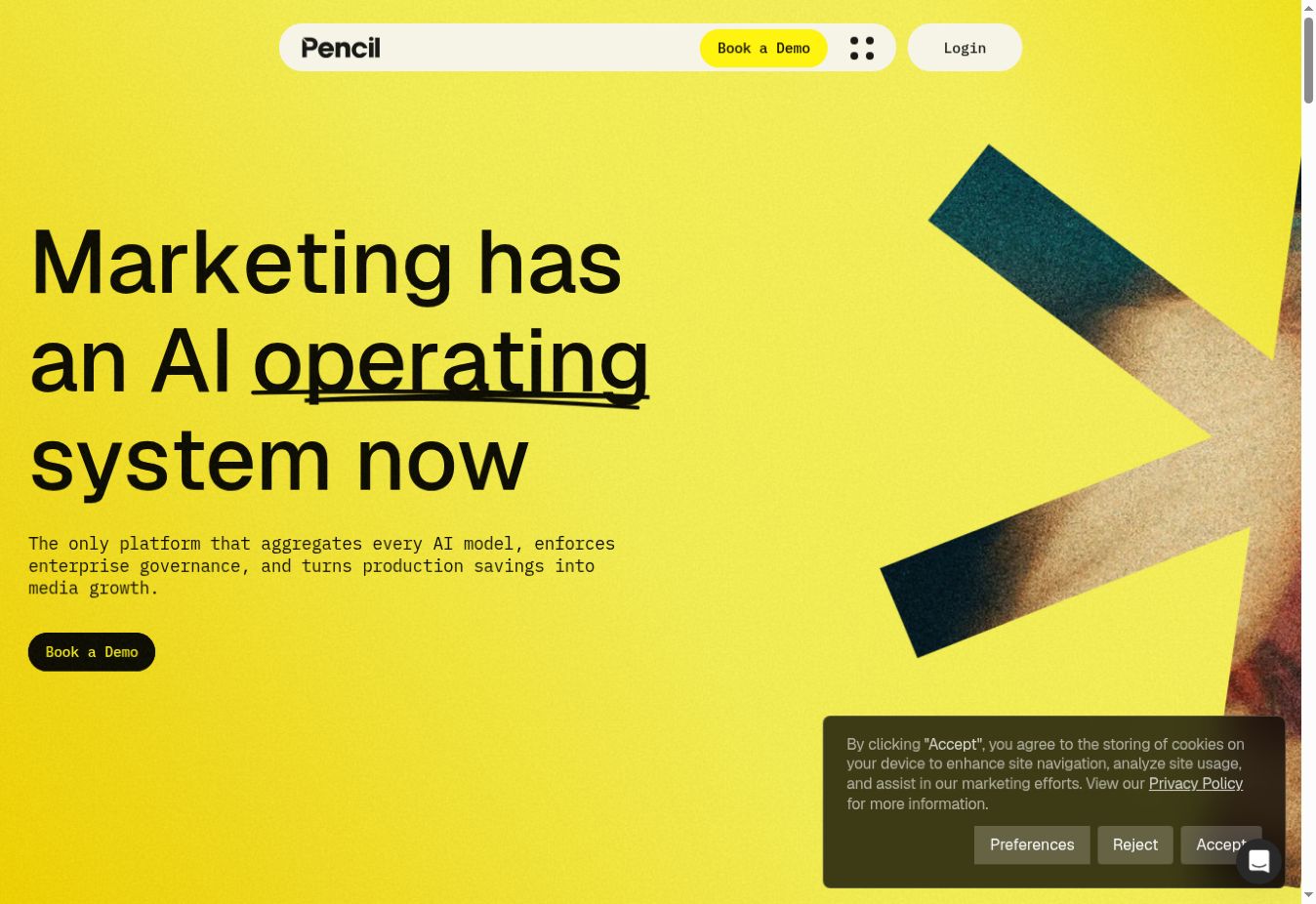
Fit, limitations and proof requests
Pencil is relevant to governed creative operations, especially for larger brands. Treat creative performance predictions as hypotheses that need real media validation.
Priority question: What assets, agent definitions and performance data remain exportable after the subscription ends?
The evaluation owner should be the creative lead and media owner. Use accepted creative and experimentally measured campaign results as the business target. Judge the solution in its own stack role: a cloud runtime, a specialist production tool and a managed AI team can be complementary purchases.
Use-case evaluation plan
Brief to usable creative variations
Provide the same product images, audience, offer, dimensions and prohibited claims. Ask for a small portfolio of genuinely different concepts rather than superficial copy changes. Have a reviewer score factual accuracy, brand fit and production readiness without knowing which candidate produced the asset.
Measure: accepted concepts, edits per asset, rights issues and cost per approved variation.
Approval before campaign launch
Move an approved asset into a test campaign with explicit spend and audience boundaries. Change the offer after creative approval and require the workflow to identify the stale asset. Keep asset approval separate from approval to spend, because a correct image does not make a campaign configuration acceptable.
Measure: incorrect launches, approval provenance and adherence to spend boundaries.
A measured creative learning loop
Use a controlled media test with consistent audience, timing and budget assumptions. Record the number of impressions and conversions behind each conclusion. Ask the system to propose the next experiment while retaining losing results. A predicted performance score should remain a hypothesis until tested.
Measure: incremental performance, sample sufficiency and the quality of the next experiment.
Detailed comparison
Read the detailed Nagent vs Pencil guide for operating models, shared context, governance, cost, evidence gaps and a staged pilot.
Nagent vs PencilSources and evidence register
- V1 · Official product / pricing source
Pencil · product ↗https://trypencil.com/ · Public material checked 21–29 September 2026 - V2 · Official product / pricing source
Pencil · commercial / feature reference ↗https://trypencil.com/pricing · Public material checked 21–29 September 2026 - V3 · Official source
Official pricing page ↗https://trypencil.com/pricing · Public material checked 21–29 September 2026 - V4 · Official source
Official generation counting ↗https://help.trypencil.com/en/articles/9948473-how-are-generations-counted · Public material checked 21–29 September 2026 - V5 · Official source
Official Scribble billing guide ↗https://help.trypencil.com/en/articles/16538820-how-does-scribble-pricing-work · Public material checked 21–29 September 2026 - V6 · Official source
Official Brief Mode approval workflow ↗https://help.trypencil.com/en/articles/15291456-what-is-brief-mode-and-how-do-i-use-it · Public material checked 21–29 September 2026 - V7 · Official source
Official external write-tool control ↗https://help.trypencil.com/en/articles/13645908-how-do-you-manage-agent-write-tools · Public material checked 21–29 September 2026 - V8 · Official source
Official brand library limits ↗https://help.trypencil.com/en/articles/12010889-how-do-pencil-s-ai-models-use-my-brand-library · Public material checked 21–29 September 2026 - V9 · Official source
Official workflow limits ↗https://help.trypencil.com/en/articles/13570795-what-are-workflows-and-how-do-you-use-them · Public material checked 21–29 September 2026 - N1 · Official source
Nagent · platform, workspace and security ↗https://nagent.ai/platform · Public material checked 21–29 September 2026 - N2 · Official source
Nagent · security and compliance ↗https://nagent.ai/dev-technology/security-and-compliance · Public material checked 21–29 September 2026 - N3 · Official source
Nagent · published plans ↗https://nagent.ai/pricing · Public material checked 21–29 September 2026 - THESIS · Official source
The Nagent Thesis ↗https://nagent.ai/artefacts/nagent-thesis · Public material checked 21–29 September 2026 - GOVERNANCE-SOURCE · Official source
State of Agent Governance ↗https://nagent.ai/artefacts/state-of-agent-governance · Public material checked 21–29 September 2026