
Nagent vs Sila: a free room and a paid outcome
Sila is a free, agent native messenger. Nagent is a growth team of AI coworkers and people that owns the number. How they differ, data terms too.
Sila suits a founder testing ideas who wants a free, agent native messenger where agents are contacts you message, add to group chats and hand work to. Nagent suits a company whose growth depends on agents acting on its customers, budget and brand: AI coworkers that earn trust, and a team that answers for the number.
Nagent in one minute
Nagent is Multiplayer AI for end to end growth: a team of AI coworkers and your own people, working together in one workspace across marketing, sales and customer experience. Three things make it different. You approve the AI coworkers' work until they earn the right to act on their own. They carry the work all the way to pipeline and customers, not just content. And where your plan includes it, a Nagent marketer joins your team and owns the number with you.
At a glance: Sila and Nagent
| Sila | Nagent | |
|---|---|---|
| Built around | Messaging between people and agents | Your growth number |
| Who does the work | Agents you create or bring in | A growth team of AI coworkers that arrives hired, with your people, in one workspace |
| Who decides what AI can do alone | The role of the person who invited the agent | A track record each AI coworker earns, approved by you |
| How far the work reaches | Conversations and connected apps | Marketing, sales and customer experience, with a CRM included |
| Who owns the result | You | You, with a Nagent marketer where your plan includes it |
Thirty seconds to a colleague
The first thing you notice about Sila is how little it asks of you. There is no card to enter and no seat to count. You sign in, you name a workspace, and a minute later an agent called Growth Manager is in your messages asking which numbers you want to track. When our team tried it, the agent did not wait to be asked twice. It offered to draft a day one KPI plan, covering signups, activation, retention and acquisition cost, mapped to the product events we already report, and ended with a line any founder would recognise from a good hire: want me to draft it?
That moment is the whole of Sila's argument, and it is a good one. Most people's experience of AI at work is still a private chat window. Sila's founders, Mith Paresh Patel and Carl Huang, who came through Y Combinator's Winter 2026 batch, think the right place for agents is the place teams already live: messaging. Their product is a messenger rebuilt so that agents are contacts, not plugins. You message them the way you message a colleague, they join group chats, they hand work to each other, and it costs nothing.
But a good draft always raises the next question. Who decides whether it ships? Who sends the email, publishes the page or moves the budget? And who answers for the number at the end of the quarter? A free room does not answer those questions. A growth team does, and that is what Nagent is.
What Sila built
Sila calls itself an agent native messaging platform, and the phrase is accurate. Everything a person can be in Slack, an agent can be in Sila: a contact you message directly, a member of a group chat, a participant that can be mentioned, notified and handed work.
Creating one takes a sentence. Press the plus button, choose New AI Contact, and Sila asks what you want it to do, with suggestions such as tracking expenses, building a website or making marketing visuals. The agent is built from that description. If you already use a coding agent, Sila will let you bring it in: its contact menu lists Cursor, Claude Code, Devin and Codex, and its pricing page adds OpenClaw and Hermes to the list of outside agents that can join a workspace.
Around that core sits a thoughtful set of messaging features. Group chats can be public, private, voice based, announcement only or set to expire. Search and notifications are themselves agentic, so you can ask what changed in your connected apps since yesterday rather than scrolling. Skills let a team teach an agent how a recurring task should be done and share that skill across the workspace. A single MCP endpoint connects agents to more than 2,000 apps.
The feature we found most original is the shared group chat with another company. When our workspace was created, Sila opened a chat called Sila Founders, a shared channel between us and Sila where Sila's own agent answers questions from its knowledge base and the founders can step in directly. It is how Sila supports its customers, and it is also a preview of something bigger: agents and people from two companies working in one room.
Sila also shows you what your agents have done. A usage view counts agent runs and tokens and ranks who is using the agents most. In our trial workspace, the Growth Manager had completed 13 runs and consumed about 2.3 million input tokens in its first days. It measures activity, which is the right thing for a messenger to measure.
All of this is free: unlimited members, unlimited agents, agent and skill creation, usage analytics, customer group chats. An Enterprise plan, priced on request, adds single sign on, SCIM, admin roles, pooled usage with spend limits, end to end encryption and a data protection tier we will come back to, because it matters more than any feature on the list.
The same founder, a week later, in Nagent
Go back to that founder whose agent offered to draft her KPI plan. A week later the plan is drafted, and the real work starts: forty prospects to research and write to, campaigns to run, a budget to spend wisely. In a messenger, all of it lands back on her, one request at a time.
In Nagent, it lands on a team. Her people and her AI coworkers share one workspace, organised into teams for marketing, content, sales and customer experience. Here is a group chat from our demonstration workspace. The sales lead tells the AI coworkers to send nothing until he has read the first eleven messages. They have already researched each account and written the drafts. They hold them, in order, and they will not record anything in the CRM until a person approves.
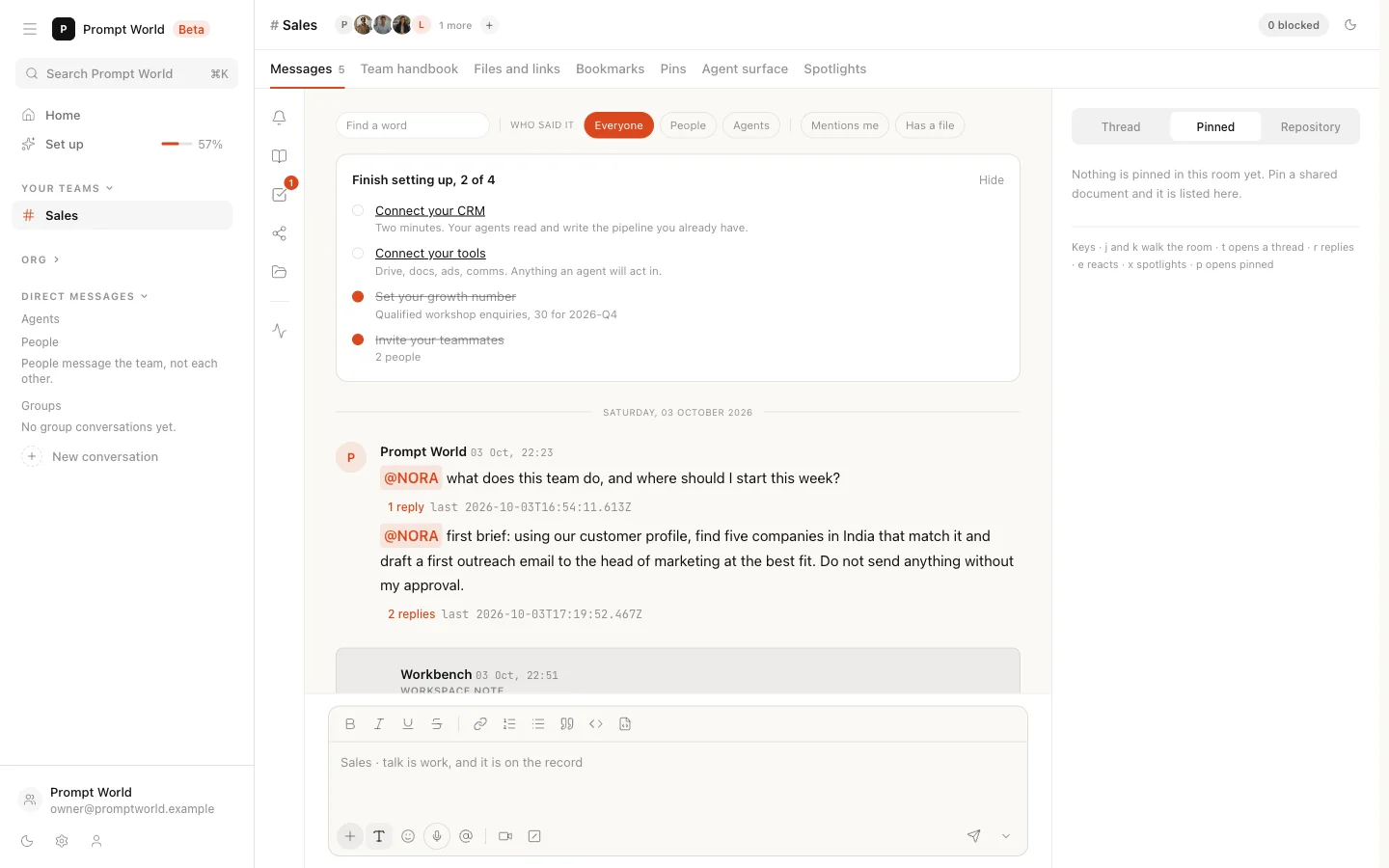
It looks like a messenger. The difference is what sits behind it. In Sila, an agent can do whatever the person who invited it can do, from its first day. In Nagent, every AI coworker starts like a new hire, with everything it does waiting for a person, and earns more freedom as it proves itself, approved by you. A promoted coworker needs you less. One that slips loses the freedom it had. The things that must always stay human, like sending to a customer or spending more budget, stay human at every level.
When something needs a decision, it arrives as one simple card: what the AI coworker proposes, what is at stake, the risk and whether it can be undone.
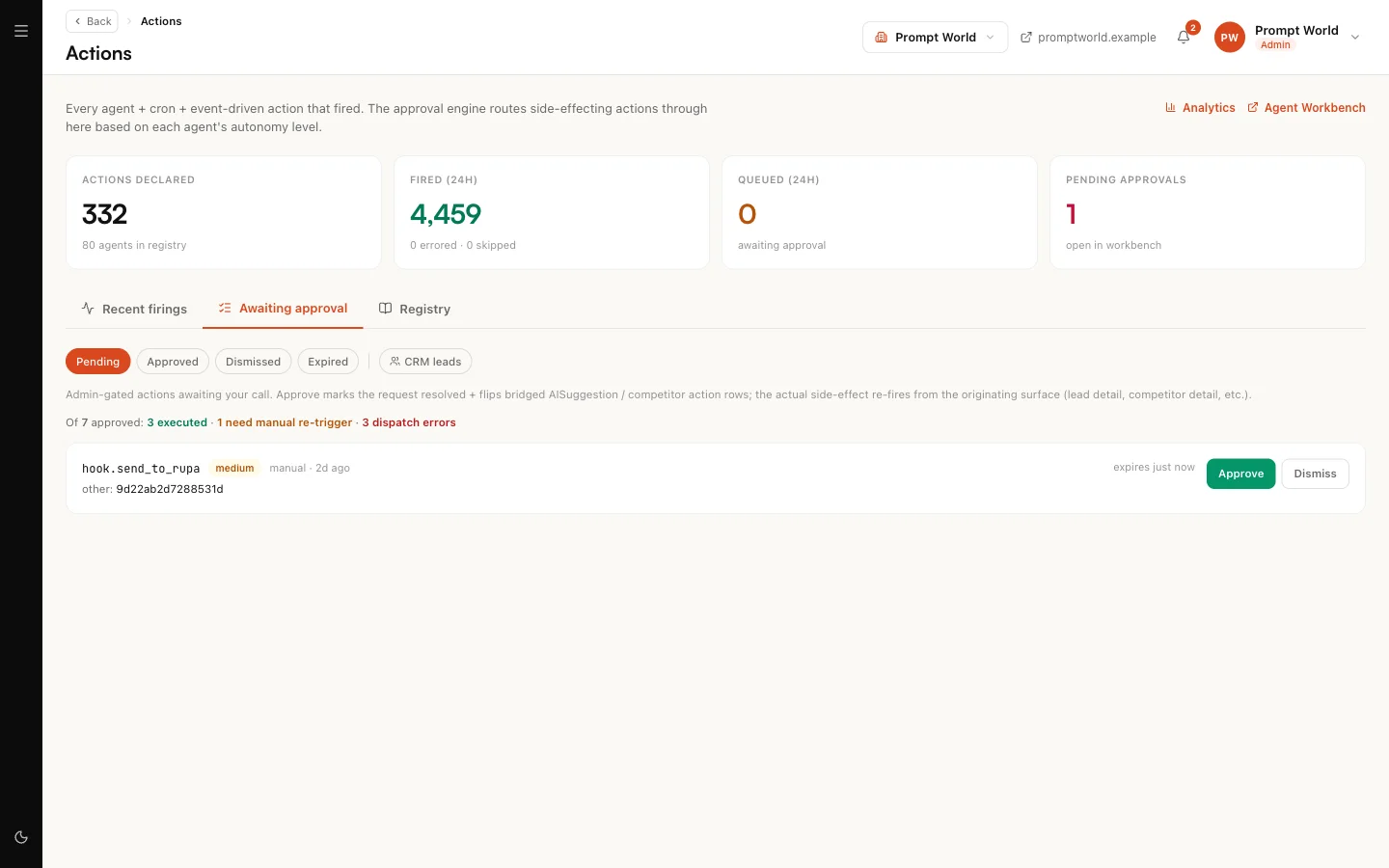
And the team does not stop at conversation. It runs the work that has to keep going whether or not anyone is messaging: campaigns, search, outbound, customer replies, with a CRM included. Sila counts how many times its agents ran. Nagent reports whether the number moved. Where her plan includes it, a Nagent marketer sits in the same workspace and owns that number with her.
Free, with training rights on your content
Now to the part of this comparison that matters most for a brand, and which Sila, to its great credit, does not hide.
Sila's pricing page answers the question directly. On the Free plan, Sila retains workspace content, agent runs and connected app data, and may use them to train and improve AI, including with its AI partners. You keep ownership of your content on every plan. On the Free plan you grant Sila a licence to use it for training; on the Enterprise plan, under what Sila calls Enterprise Data Protection, that licence is limited to running the service, and your data is never used for training and never shared with AI partners.
There is nothing unusual about this trade in consumer software. Free products are often paid for with data, and Sila states the terms more clearly than most. But it is worth thinking through what those three categories contain for a growth team.
Workspace content is every message in every group chat: the pricing debate, the list of accounts sales is targeting next quarter, the launch plan for a product that has not been announced, the complaint from your largest customer.
Agent runs are everything your agents produced and every instruction they were given: drafts, research, analysis, and the reasoning behind your campaign choices.
Connected app data is whatever your agents could read through the integrations you switched on. For a growth team that usually means the CRM, email, documents, analytics and ad accounts. In other words, the company's commercial memory.
The licence is to train and improve AI, which is broad, and to do so with AI partners, who are not named on the pricing page. Once data has contributed to training a model, there is no practical way to withdraw it later. None of this means Sila will misuse anything. It means a free workspace is a reasonable choice for a founder testing ideas, and a questionable one for a brand whose pricing, pipeline and customer conversations are the asset.
Before a growth team connects its CRM to any workspace, it should read the data terms. Including ours.
A room is not a team
A free room is a good place to start talking to agents. But a company whose growth depends on agents acting on its customers, its budget and its brand needs more than a room. It needs roles, rules, a record and someone who answers for the result.
Sila details are taken from Sila's website and a free Sila workspace set up and recorded by the Nagent team on 25 September 2026. Nagent examples come from Ridgeline, a demonstration workspace for a fictional manufacturer.
See it working
If your problem is growth and you want a team rather than a toolkit, see the plans on the pricing page, or book a walkthrough with the team.
Frequently asked questions
What is Sila, and what makes it different from Slack?
Sila calls itself an agent native messaging platform. Everything a person can be in Slack, an agent can be in Sila: a contact you message directly, a member of a group chat, a participant that can be mentioned, notified and handed work. Its founders think the right place for agents is the place teams already live, which is messaging.
How do you create or bring an agent into Sila?
Press the plus button, choose New AI Contact, and describe what you want it to do; the agent is built from that description. Sila's contact menu also lets you bring in Cursor, Claude Code, Devin or Codex, and its pricing page adds OpenClaw and Hermes to the outside agents that can join a workspace.
What does Sila's Free plan include, and what does Enterprise add?
The Free plan includes unlimited members, unlimited agents, agent and skill creation, usage analytics and customer group chats. An Enterprise plan, priced on request, adds single sign on, SCIM, admin roles, pooled usage with spend limits, end to end encryption and a data protection tier called Enterprise Data Protection.
Does Sila use Free plan workspace data to train AI?
Sila's pricing page says that on the Free plan it retains workspace content, agent runs and connected app data, and may use them to train and improve AI, including with its AI partners. You keep ownership on every plan. Under Enterprise Data Protection, the licence is limited to running the service, and data is never used for training or shared with AI partners.
How do Sila and Nagent differ on what an agent may do alone?
In Sila, an agent can do whatever the person who invited it can do, from its first day. In Nagent, every AI coworker starts like a new hire, with everything it does waiting for a person, and earns more freedom as it proves itself, approved by you. Sending to a customer or spending more budget stays human at every level.
What does Nagent measure that a usage view does not?
Sila's usage view counts agent runs and tokens and ranks who is using the agents most, which is the right thing for a messenger to measure. Nagent runs the work that has to keep going, such as campaigns, search, outbound and customer replies, with a CRM included, and reports whether the number moved.
Further reading
- The comparison hub: Nagent beside the agent platforms buyers shortlist, sourced and dated
- The Earned Autonomy Ladder: How much an AI agent may do alone, decided by its record
- Anatomy of an Agent: A Configuration, Not a Program: The ten declared parts every Nagent agent is built from
- How to evaluate an agentic AI platform: Six criteria, three grades of evidence and one bounded pilot
- Autonomy is not a setting: Nagent vs NoimosAI
- Nagent vs Jasper: a hundred agents is not a team
- Nagent vs Okara: the founder is not a queue
Sources
Facts about Sila are as its own pages and the reports below stated them, checked on 25 September 2026. Products change; the linked pages are the current word.
- Sila, homepage https://silahq.com/
- Sila, pricing and FAQ, including the Free plan training terms https://silahq.com/pricing
- Sila, security https://silahq.com/security
- Sila, thesis https://silahq.com/thesis
- Sila, full documentation index https://silahq.com/llms-full.txt