
Nagent vs Jasper: a hundred agents is not a team
Jasper offers a library of 100 plus content agents. Nagent ships a growth team of AI coworkers with a manager, earning trust and owning the number.
Jasper suits a large marketing team producing enormous volumes of content in many voices and markets, with more than 100 specialised agents and brand voice held in one place. Nagent suits a team whose problem is growth: AI coworkers with a manager, trust earned through a track record you approve, and work that reaches pipeline and customers.
Nagent in one minute
Nagent is Multiplayer AI for end to end growth: a team of AI coworkers and your own people, working together in one workspace across marketing, sales and customer experience. Three things make it different. You approve the AI coworkers' work until they earn the right to act on their own. They carry the work all the way to pipeline and customers, not just content. And where your plan includes it, a Nagent marketer joins your team and owns the number with you.
At a glance: Jasper and Nagent
| Jasper | Nagent | |
|---|---|---|
| Built around | Content and brand voice | Your growth number |
| Who does the work | 100 plus specialised agents in a library | AI coworkers with a manager, and your people, in one workspace |
| Who decides what AI can do alone | You review the pipeline's output | A track record each AI coworker earns, approved by you |
| How far the work reaches | Plan, create, adapt, activate and optimise content | Marketing, sales and customer experience |
| Who owns the result | Your team | Your team, with a Nagent marketer where your plan includes it |
Overview
Imagine hiring a hundred specialists on the same Monday.
A keyword researcher. A press release writer. A localisation expert for each of eight markets. Someone who does nothing but landing pages. Someone who only writes nurture emails. Someone who scores content for answer engine visibility. Each of them is excellent at exactly one thing, and each of them is ready to start work the moment you hand them a brief.
Now imagine that none of them has a manager. None of them knows what the others are doing. None of them has been told what matters this quarter, and none of them is allowed to do anything until you personally sign off. You would not have hired a marketing team. You would have hired a hundred freelancers and made yourself their only project manager.
That is where a great deal of AI marketing has quietly arrived. The number of agents has become the headline. And almost nobody is asking the question that matters once you have more than a handful of them: who runs them?
Brand voice, at scale
Jasper is one of the most important companies in the history of AI marketing, and its evolution tells the story of the category. It began as a writing assistant that helped marketers produce copy in their brand's voice. Today it describes itself as the execution platform for intelligent marketing, an agent workspace for modern marketing teams with more than 100 specialised AI agents and connected content pipelines, structured workflows that turn plans into live marketing.
The architecture is elegant. Agents do the work. Content pipelines chain them into repeatable workflows that move from idea to launch. Jasper IQ holds the brand voice, the style guides and the knowledge that keeps every output consistent and authentic. Jasper maps its agents directly onto a five stage content pipeline: plan, create, adapt, activate and optimise.
The homepage claims are compelling: scale a launch campaign into eight markets within days, create 6,000 personalised emails within minutes, bulk create 5,000 retail product pages, optimise 2,000 web pages for search at once. And the Agent Library is extraordinary in its breadth, more than a hundred specialised agents, each designed, in Jasper's words, to execute a specific job within the content pipeline.
For a large marketing team that produces enormous volumes of content in many voices and markets, this is a powerful toolkit. Jasper has done more than almost anyone to make brand voice a solved problem.
The library problem
But notice the words Jasper chooses. A library. A pipeline. Agents that each execute a specific job. These are the metaphors of a factory floor, and they are exactly right for producing content. They are the wrong metaphors for running growth.
A library is a collection of capabilities waiting to be picked up. It has no manager. It does not know which of its hundred agents should be working on what this week, which ones have earned the right to act without review and which ones have not, or how the email agent's work affects the landing page agent's numbers. All of that coordination falls to the marketer who opens the library. The more agents on the shelf, the more coordination she has to do.
We call this the library problem, and it is the hidden cost of the agent count race. Every agent you add is another thing to brief, review and reconcile. Past a certain point, a bigger library makes the team slower, not faster, because the bottleneck is no longer production. It is management.
There is a second limit, and it is the same one every content platform eventually meets. Look at the five stages again: plan, create, adapt, activate, optimise. Every one of them is a stage in the life of a piece of content. The pipeline ends when the content is live and optimised. But growth does not end there. It continues through the account that clicked, the first message to the right buyer, the conversation, the record in the CRM, the deal and the renewal. A content pipeline, however many agents it holds, stops at the edge of the content.
And there is a third limit, the quietest and most important. Brand voice tells an agent how to say something. It says nothing about whether the agent should be trusted to say it on its own. That question, who is allowed to do what without a person, is not a style guide question. It is an organisational one.
The same Monday, with a manager in the room
Go back to those hundred specialists, and change one thing. Give them a manager.
That is the simplest way to describe Nagent. You do not get a shelf of agents to pick from. You get a growth team: a handful of AI coworkers, each owning one job, and an AI chief of staff called MIRA who runs them. MIRA turns your goal for the quarter into a weekly plan, hands out the work, chases what is late and tells you only what needs you. Your own people sit in the same workspace, so the team is people and AI coworkers together.
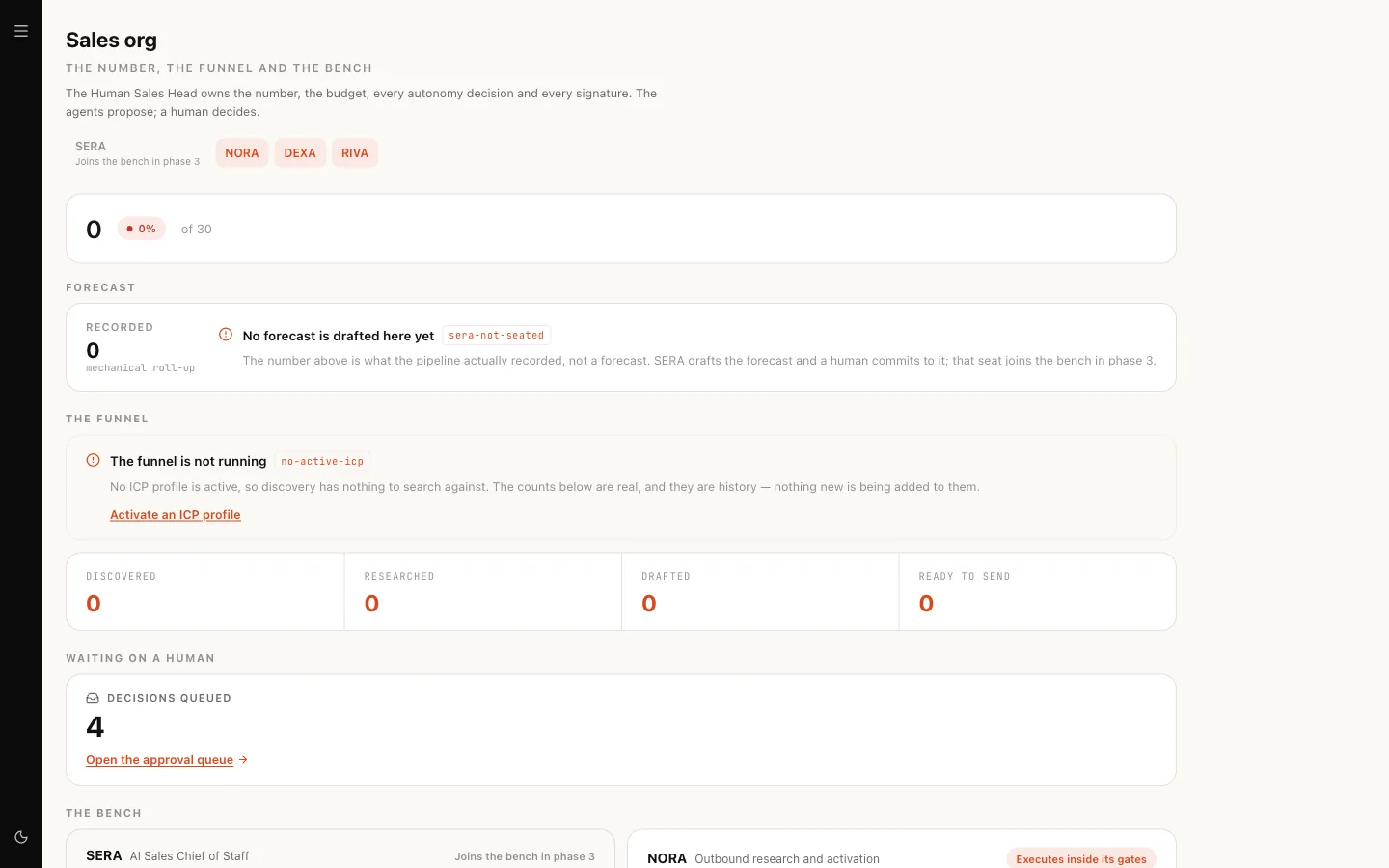
The second thing a library cannot give an agent is a track record. In Nagent, every AI coworker starts like a new hire: everything it does waits for a person. As it proves itself, with good work approved without edits and risky calls handed up instead of made alone, Nagent recommends a promotion and you sign it off. A promoted coworker needs you less. One that slips loses the freedom it had. So the team gets faster as it matures, instead of slower as it grows.
In our demonstration workspace, after three months of clean work, the AI coworker for search earned the right to make routine website fixes on its own. A person approved the promotion.
The third thing a content pipeline cannot do is follow the customer. When your content brings a business buyer to the pricing page, the work in Nagent does not stop there. NORA, the AI coworker for outbound, researches the account and drafts a first message to the right person. Your sales lead reads it before anything is sent. Content is made in Nagent too, and made in your brand's voice, but it is one job inside a growth team, not the whole team.
And where your plan includes it, a Nagent marketer joins the workspace and owns the number with you.
Count the managers, not the agents
The first era of AI marketing measured progress in outputs: words, then assets, then agents. A hundred agents is an impressive number. But the question that decides your quarter is simpler: how many of them have a manager, how many have earned the right to act on their own, and whose name is on the number?
For a side by side view of the two products, see Nagent vs Jasper.
Jasper product details are taken from jasper.ai as it appeared in September 2026. Nagent examples come from Ridgeline, a demonstration workspace for a fictional manufacturer.
See it working
If your problem is growth and you want a team rather than a toolkit, see the plans on the pricing page, or book a walkthrough with the team. To put numbers on your own case, run the cost calculator in the Jasper guide.
Frequently asked questions
What is Jasper today, and how has it changed?
Jasper began as a writing assistant that helped marketers produce copy in their brand's voice. On its website it now describes itself as the execution platform for intelligent marketing, an agent workspace for modern marketing teams with more than 100 specialised AI agents and connected content pipelines that turn plans into live marketing.
How does Jasper keep its agents' output on brand?
Agents do the work, content pipelines chain them into repeatable workflows, and Jasper IQ holds the brand voice, the style guides and the knowledge that keeps every output consistent. Jasper maps its agents onto a five stage content pipeline: plan, create, adapt, activate and optimise.
What is the library problem with AI marketing agents?
A library is a collection of capabilities waiting to be picked up, with no manager. It does not know which agent should work on what this week, which have earned the right to act without review, or how one agent's work affects another's numbers. That coordination falls to the marketer, so past a point a bigger library makes the team slower.
Who runs the AI coworkers in Nagent?
An AI chief of staff called MIRA. MIRA turns your goal for the quarter into a weekly plan, hands out the work, chases what is late and tells you only what needs you. You get a growth team of AI coworkers, each owning one job, and your own people sit in the same workspace.
How does an AI coworker in Nagent earn the right to act on its own?
Every AI coworker starts like a new hire, with everything it does waiting for a person. As it proves itself, with good work approved without edits and risky calls handed up instead of made alone, Nagent recommends a promotion and you sign it off. A promoted coworker needs you less, and one that slips loses the freedom it had.
Does Nagent's work stop once the content is live?
No. When your content brings a business buyer to the pricing page, NORA, the AI coworker for outbound, researches the account and drafts a first message to the right person, and your sales lead reads it before anything is sent. Content is made in your brand's voice too, but it is one job inside a growth team.
Further reading
- Nagent vs Jasper: the sourced comparison guide, with dated screenshots
- Jasper alternatives: the other platforms in its category
- Jasper dossier: pricing, governance and evidence in one place
- The Earned Autonomy Ladder: How much an AI agent may do alone, decided by its record
- Anatomy of an Agent: A Configuration, Not a Program: The ten declared parts every Nagent agent is built from
- How to evaluate an agentic AI platform: Six criteria, three grades of evidence and one bounded pilot
- Autonomy is not a setting: Nagent vs NoimosAI
- Nagent vs Okara: the founder is not a queue
- Nagent vs Salesforce Agentforce Marketing: assembly required
Sources
Facts about Jasper are as its own pages and the reports below stated them, checked on 30 September 2026. Products change; the linked pages are the current word.
- Jasper, website and Agent Library, September 2026 https://www.jasper.ai/