
Nagent vs Salesforce Agentforce Marketing: assembly required
Agentforce Marketing sells every part of a growth organisation. Nagent ships a growth team of AI coworkers that is working from the first week.
Agentforce Marketing suits a company already standardised on Salesforce, with the data, admins and partners to assemble a broad suite of marketing platforms on one data model. Nagent suits a team that wants someone moving its growth number from the first week: a working team of AI coworkers and your people, governed from day one.
Nagent in one minute
Nagent is Multiplayer AI for end to end growth: a team of AI coworkers and your own people, working together in one workspace across marketing, sales and customer experience. Three things make it different. You approve the AI coworkers' work until they earn the right to act on their own. They carry the work all the way to pipeline and customers, not just content. And where your plan includes it, a Nagent marketer joins your team and owns the number with you.
At a glance: Salesforce Agentforce Marketing and Nagent
| Salesforce Agentforce Marketing | Nagent | |
|---|---|---|
| Built around | A suite of marketing platforms on one data model | Your growth number |
| Who does the work | Agents you configure across several products | AI coworkers and your people, in one workspace, from day one |
| Who decides what AI can do alone | Your admins and implementation partner | A track record each AI coworker earns, approved by you |
| How far the work reaches | Marketing, with a separate SDR agent | Marketing, sales and customer experience |
| Who owns the result | Your team | Your team, with a Nagent marketer where your plan includes it |
Overview
There is a particular kind of meeting that happens in large companies about three months after they buy an enterprise marketing suite. The contract is signed. The licences are live. The logos are on the architecture slide. And someone from the growth team asks, a little nervously, when the agents will actually start doing the work.
The answer is almost always the same. Soon. First the customer data platform needs to be unified. Then the journeys need to be rebuilt. Then the agents need to be configured, the permissions mapped, the integrations tested, and the partner who is doing all of this needs another statement of work. The platform can do everything. It just cannot do anything yet.
This is the oldest trade in enterprise software, and the agent era has not abolished it. You can buy breadth, every capability from one vendor on one data model, or you can buy depth, a specialist that does one important thing exceptionally well from the first week. For most of the last two decades, big companies chose breadth, because depth usually meant another point tool to integrate.
Agents change that calculation. When the specialist is not a tool but a working team, the question is no longer which product has more features. It is how long until someone is actually moving your number, and who that someone is.
The broadest marketing platform in the world
Salesforce's marketing business is the purest expression of breadth. Its page now introduces Agentforce Marketing, formerly Marketing Cloud, and describes it as Salesforce's marketing solution for the agentic enterprise: AI agents that help marketers plan, create campaigns and content, optimise, and orchestrate adaptive customer experiences across every channel and interaction, built on what Salesforce calls the world's number one CDP, connecting data, AI, automation and engagement into one platform for B2B and B2C marketing.
The breadth is genuine. Scroll down and the platform divides into products: Marketing Cloud Next, a B2C agentic marketing platform, a B2B agentic marketing platform, a small business edition, a customer data platform called Data 360, and personalisation at scale, with agentic demand generation and digital advertising below them. On the same page, Salesforce cites customer success metrics of a 32 percent increase in overall marketing ROI and a 27 percent decrease in the cost to acquire new customers, and its customer stories include Indeed, which sends more than 300 million emails a year.
And for the part of growth that sits between marketing and sales, Salesforce now offers Piper, which it calls the number one AI SDR agent, from Qualified, which the page presents as now part of Salesforce. Piper engages and converts inbound buyers across the website and email inbox around the clock.
It is an extraordinary catalogue. If your company already runs on Salesforce, with the data, the admins and the partners to match, this is the natural place to put agents.
Assembly required
But look at the catalogue the way a head of growth would on a Monday morning. Six platforms. A customer data platform to unify first. A separate SDR agent from another brand. Journeys to rebuild, agents to configure, permissions to map. Every part is there. None of them arrives as a team.
We call this the assembly problem. A suite gives you the parts of a growth organisation, and assumes you, your admins and your implementation partner will assemble them into one. The assembly is where the months go, and where most of the cost hides. And when it is done, you still have to answer the questions no product page mentions: which agent is responsible for which number, what each one may do without a person, who reviews the risky decisions, and who owns the result when the quarter ends.
The rename on the page tells the same story. Marketing Cloud becomes Agentforce Marketing, and the agents are layered onto a decade of products, data models and journeys. That is a sensible strategy for the world's largest CRM company. It is also why its customers experience agents as a project rather than a team.
The same meeting, in week one
Go back to that meeting three months after the contract was signed, where the growth team asks when the agents will start doing the work. Now imagine the same company chose Nagent instead. The meeting happens in the first week, and the question is different: what did the team do overnight?
That is possible because Nagent does not sell the parts of a growth team. It ships the team, already working. On day one there is a marketing team, a content team, a sales team and a customer experience team, each made up of AI coworkers with clear jobs and your own people alongside them. Setup is a short conversation with MIRA, the AI chief of staff, and the workspace starts running before it is finished. Nothing is a gate.
The controls a large company needs are there from the start, and they are simple enough to explain in one sentence each. Every tool an AI coworker can use is switched on one permission at a time. A monthly budget cap stops anything from overspending. And every new AI coworker starts like a new hire, with everything it does waiting for a person, until it earns more freedom through a track record you approve.
When something is too important for an AI coworker to decide alone, it lands in a lead's inbox as a single card: what the coworker proposes, what is at stake, the risk, what has changed so far, and whether it can be undone. In our demonstration workspace, the AI coworker for search noticed that a website change was about to make tens of thousands of product pages disappear from Google. It did not fix it on its own. It sent this card.
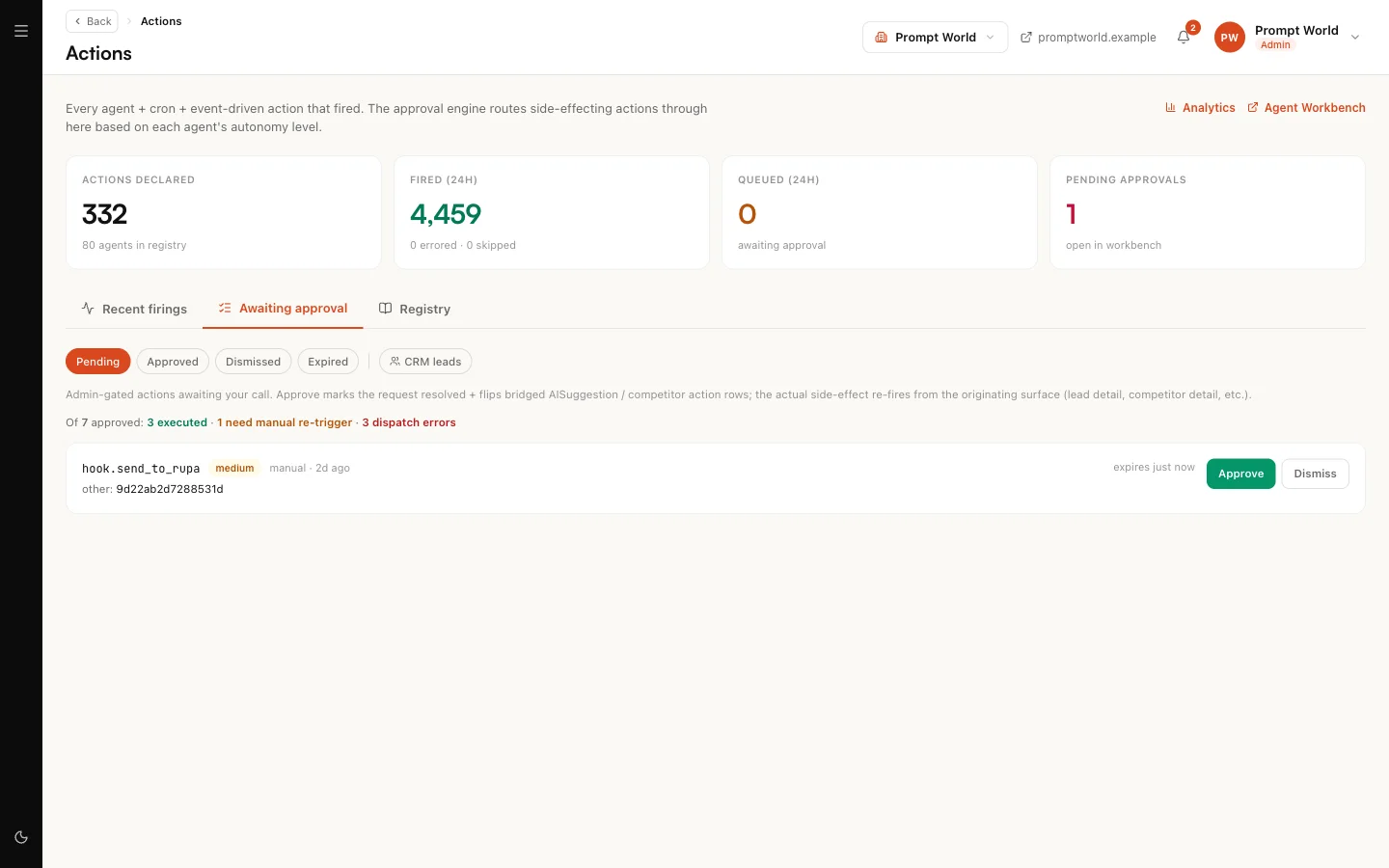
The lead approved it, and a week later almost all of the pages were back. That is enterprise governance without an implementation project. And where your plan includes it, a Nagent marketer joins the workspace and owns the number with you.
Breadth or depth
If your company has standardised on Salesforce, a suite is the natural home for agents. But if the real question is how soon someone will start moving your growth number, a working team on day one beats every part and a project to assemble them.
For a side by side view of the two products, see Nagent vs Salesforce Agentforce.
Salesforce product details are taken from Salesforce's public Agentforce Marketing page as it appeared in September 2026. Nagent examples come from Ridgeline, a demonstration workspace for a fictional manufacturer.
See it working
If your problem is growth and you want a team rather than a toolkit, see the plans on the pricing page, or book a walkthrough with the team. To put numbers on your own case, run the cost calculator in the Salesforce Agentforce guide.
Frequently asked questions
What is Salesforce Agentforce Marketing?
Salesforce's page introduces Agentforce Marketing, formerly Marketing Cloud, as its marketing solution for the agentic enterprise: AI agents that help marketers plan, create campaigns and content, optimise, and orchestrate customer experiences across every channel, built on what Salesforce calls the world's number one CDP, for B2B and B2C marketing.
Which products make up Salesforce's marketing platform?
On its marketing page, the platform divides into Marketing Cloud Next, a B2C agentic marketing platform, a B2B agentic marketing platform, a small business edition, a customer data platform called Data 360, and personalisation at scale. For inbound buyers, the page also presents Piper, an AI SDR agent from Qualified.
What is the assembly problem with enterprise marketing suites?
A suite gives you the parts of a growth organisation and assumes you, your admins and your implementation partner will assemble them into one. The assembly is where the months go and where most of the cost hides. Afterwards you still have to decide which agent owns which number, what each may do alone and who owns the result.
How soon does Nagent start doing growth work?
In the first week. Nagent ships the team already working: marketing, content, sales and customer experience teams made up of AI coworkers with clear jobs and your own people alongside them. Setup is a short conversation with MIRA, the AI chief of staff, and the workspace starts running before it is finished.
What controls does Nagent give a large company over its AI coworkers?
Every tool an AI coworker can use is switched on one permission at a time. A monthly budget cap stops anything from overspending. Every new AI coworker starts like a new hire, with everything it does waiting for a person, until it earns more freedom through a track record you approve. Important decisions arrive as one card with the risk and a rollback.
Should a company that has standardised on Salesforce choose Agentforce Marketing?
If your company has standardised on Salesforce, with the data, the admins and the partners to match, a suite is the natural home for agents. If the real question is how soon someone will start moving your growth number, a working team on day one beats every part and a project to assemble them.
Further reading
- Nagent vs Salesforce Agentforce: the sourced comparison guide, with dated screenshots
- Salesforce Agentforce alternatives: the other platforms in its category
- Salesforce Agentforce dossier: pricing, governance and evidence in one place
- The Earned Autonomy Ladder: How much an AI agent may do alone, decided by its record
- Anatomy of an Agent: A Configuration, Not a Program: The ten declared parts every Nagent agent is built from
- How to evaluate an agentic AI platform: Six criteria, three grades of evidence and one bounded pilot
- Autonomy is not a setting: Nagent vs NoimosAI
- Nagent vs Jasper: a hundred agents is not a team
- Nagent vs Okara: the founder is not a queue
Sources
Facts about Salesforce Agentforce Marketing are as its own pages and the reports below stated them, checked on 30 September 2026. Products change; the linked pages are the current word.
- Salesforce, Agentforce Marketing (formerly Marketing Cloud) https://www.salesforce.com/marketing/