
Nagent vs Typeface: content was never the bottleneck
Typeface runs a superb enterprise content supply chain. Nagent carries growth past the publish line, to search, pipeline, budget and customers.
Typeface suits a global brand producing thousands of on brand assets a month in dozens of markets, with brand trained agents and a loop that learns from campaign performance. Nagent suits a team whose number depends on what happens after the publish line: search, pipeline, budget and customers, run by AI coworkers and your people together.
Nagent in one minute
Nagent is Multiplayer AI for end to end growth: a team of AI coworkers and your own people, working together in one workspace across marketing, sales and customer experience. Three things make it different. You approve the AI coworkers' work until they earn the right to act on their own. They carry the work all the way to pipeline and customers, not just content. And where your plan includes it, a Nagent marketer joins your team and owns the number with you.
At a glance: Typeface and Nagent
| Typeface | Nagent | |
|---|---|---|
| Built around | The content supply chain | Your growth number |
| Who does the work | Brand trained agents from a marketplace | AI coworkers and your people, in one workspace |
| Who decides what AI can do alone | Brand rules and your reviewers | A track record each AI coworker earns, approved by you |
| How far the work reaches | Briefs, creative, localisation and campaign performance | Content, plus demand, sales and customer experience |
| Who owns the result | Your team | Your team, with a Nagent marketer where your plan includes it |
Overview
Somewhere in a global consumer company this morning, a green tick appeared on a screen: Campaign published.
It is a satisfying moment, and it took an astonishing amount of machinery to produce. The brief was written by an agent grounded in the brand's guidelines. The copy was drafted in the brand's voice for three audiences. The images were generated, checked against the style rules, resized for six channels and approved. Weeks of agency back and forth were compressed into days. A marketing leader who remembers how this worked five years ago would call it a miracle.
And then the tick disappears, and the work that actually decides whether the quarter is good begins somewhere else.
For most of the last three years, the enterprise AI conversation in marketing has been about the content supply chain: how to make more on brand assets, faster, with fewer people and less risk. It was the right problem to solve first. Content was slow, expensive and inconsistent, and generative AI was very good at exactly the things that made it so.
But content was never the bottleneck of growth. It was only the most visible one. Now that it has been cleared, the real constraint is easy to see. It sits just past the moment every content system is designed to reach, a moment we have started calling the publish line.
The finest content supply chain in the enterprise
Typeface is the most sophisticated example of the content supply chain we have seen, and it is worth understanding why. Its homepage describes agentic AI for enterprise marketing teams, a system that orchestrates people, agents and systems to run campaigns at scale, and lists customers such as Cognizant, JPMorgan Chase, Johnson Controls, Coca Cola and Google.
Its architecture, which it calls the Orchestration Engine, has four layers. Arc Graph holds the brand's guidelines, audiences, assets and campaign learnings as structured intelligence that agents can act on and enforce. Arc Fabric connects the systems. Arc Agents are bespoke agents built for the brand's workflows. And Arc Loop closes the circle: closed loop marketing that learns from past campaign performance and generates better campaigns with each rotation.
Around the engine sits a marketplace of reusable agents, built by Typeface and its partners, that teams can install into their workspace: a campaign brief builder, a product description localiser, a social repurposer, an ad variant generator, an SEO content refresher.
It is serious enterprise software, backed by serious investors, and for a global brand producing thousands of assets a month in dozens of markets, it solves a real and expensive problem.
But read the names on the marketplace shelf again. Brief builder. Localiser. Repurposer. Variant generator. Content refresher. Every agent makes, adapts or refreshes an asset. And look at what the loop learns from: campaign performance, the click through rate of one creative against another. The entire system, however intelligent, is organised around the asset and closes its loop at the asset's performance. It is a supply chain, and supply chains end at delivery.
What happens after the publish line
Cross the publish line and a different kind of work begins. It is less photogenic, and it is where revenue is made.
The campaign is live. Now a hundred business buyers visit the pricing page, and someone needs to research them and write to the right person at each. A product page that the campaign points to quietly disappears from Google after a website change nobody noticed. A distributor asks about delivery and waits a day for an answer. The paid campaign that is working sits at its budget cap because nobody can approve more after six in the evening.
None of this is content. All of it is growth. And none of it is reached by a system whose loop closes when the asset is published.
The same campaign, past the green tick
In Nagent, the green tick is where the team's work speeds up, not where it stops. Content is one team in the workspace, alongside marketing, sales and customer experience, with AI coworkers and your own people working together.
The morning after the campaign goes live, NORA, the AI coworker for outbound, has researched the hundred accounts that visited the pricing page and drafted first messages for the sales lead to read. The paid ads coworker has staged a budget increase for the campaign that is converting, waiting for a person to approve. And the AI coworker for search has spotted that the product pages had dropped out of Google, proposed a fix, and waited for approval before touching the website.
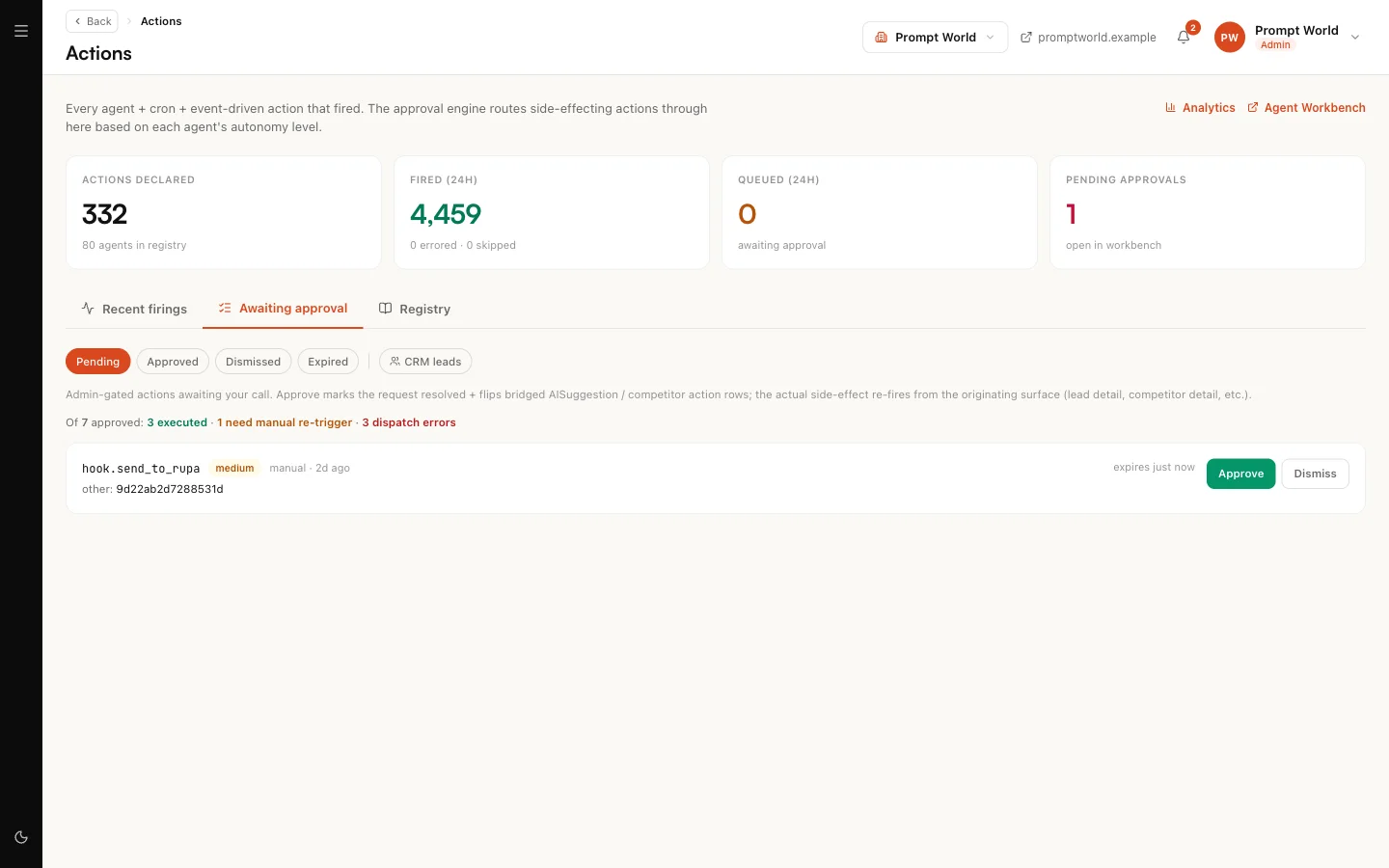
A week later, the AI coworker for search reports almost all of the missing pages back on Google, traffic up 18 percent, and no changes made without approval.
That is what a closed loop looks like after the publish line: not a better performing variant, but pages back on Google, buyers contacted, budget spent where it works. And every good result like this one becomes part of the AI coworker's record. Each one starts like a new hire with its work checked by a person, and earns more freedom as it proves itself, approved by you. The decisions that must always stay human stay human.
Where your plan includes it, a Nagent marketer joins the workspace and owns the number with you.
Past the green tick
The content supply chain was the right first chapter of AI in marketing. The next chapter is about everything after the publish line: the search results, the pipeline, the budget, the customer and the number at the end of the quarter.
For a side by side view of the two products, see Nagent vs Typeface.
Typeface product details are taken from typeface.ai as it appeared in September 2026. Nagent examples come from Ridgeline, a demonstration workspace for a fictional manufacturer.
See it working
If your problem is growth and you want a team rather than a toolkit, see the plans on the pricing page, or book a walkthrough with the team. To put numbers on your own case, run the cost calculator in the Typeface Arc guide.
Frequently asked questions
What does Typeface do for enterprise marketing teams?
Its homepage describes agentic AI for enterprise marketing teams, a system that orchestrates people, agents and systems to run campaigns at scale. For a global brand producing thousands of assets a month in dozens of markets, it solves a real and expensive problem: making more on brand content, faster, with fewer people and less risk.
What are the layers of Typeface's Orchestration Engine?
There are four. Arc Graph holds the brand's guidelines, audiences, assets and campaign learnings as structured intelligence agents can act on. Arc Fabric connects the systems. Arc Agents are bespoke agents built for the brand's workflows. Arc Loop is closed loop marketing that learns from past campaign performance and generates better campaigns with each rotation.
What kinds of agents are in Typeface's agent marketplace?
Reusable agents built by Typeface and its partners that teams install into their workspace, such as a campaign brief builder, a product description localiser, a social repurposer, an ad variant generator and an SEO content refresher. Every one of them makes, adapts or refreshes an asset.
What is the publish line in marketing?
It is the moment every content system is designed to reach: the green tick that says the campaign is published. Past it sits the work that decides the quarter, such as researching the buyers who visit the pricing page, fixing product pages that drop out of Google and moving budget to the campaign that is working.
What does Nagent do after a campaign goes live?
The morning after, NORA, the AI coworker for outbound, has researched the accounts that visited the pricing page and drafted first messages for the sales lead to read. The paid ads coworker has staged a budget increase for a person to approve, and the AI coworker for search has proposed a fix for pages that dropped out of Google.
How does an AI coworker in Nagent earn more freedom?
Every good result becomes part of the AI coworker's record. Each one starts like a new hire with its work checked by a person, and earns more freedom as it proves itself, approved by you. The decisions that must always stay human stay human.
Further reading
- Nagent vs Typeface Arc: the sourced comparison guide, with dated screenshots
- Typeface Arc alternatives: the other platforms in its category
- Typeface Arc dossier: pricing, governance and evidence in one place
- The Earned Autonomy Ladder: How much an AI agent may do alone, decided by its record
- Anatomy of an Agent: A Configuration, Not a Program: The ten declared parts every Nagent agent is built from
- How to evaluate an agentic AI platform: Six criteria, three grades of evidence and one bounded pilot
- Autonomy is not a setting: Nagent vs NoimosAI
- Nagent vs Jasper: a hundred agents is not a team
- Nagent vs Okara: the founder is not a queue
Sources
Facts about Typeface are as its own pages and the reports below stated them, checked on 30 September 2026. Products change; the linked pages are the current word.
- Typeface, website, Orchestration Engine and Agent Marketplace, September 2026 https://www.typeface.ai/