
Nagent vs Claude Tag: one colleague or a whole team
Claude Tag puts one shared Claude colleague in a Slack channel. Nagent gives your growth function a whole team of AI coworkers that earn trust.
Claude Tag suits a team that wants one excellent shared colleague in a Slack channel, tagged by anyone, remembering the channel's work and running long tasks. Nagent suits a growth function that needs a whole team: AI coworkers with their own jobs, trust each one earns through a record you approve, and work that reaches pipeline and customers.
Nagent in one minute
Nagent is Multiplayer AI for end to end growth: a team of AI coworkers and your own people, working together in one workspace across marketing, sales and customer experience. Three things make it different. You approve the AI coworkers' work until they earn the right to act on their own. They carry the work all the way to pipeline and customers, not just content. And where your plan includes it, a Nagent marketer joins your team and owns the number with you.
At a glance: Claude Tag and Nagent
| Claude Tag | Nagent | |
|---|---|---|
| Built around | One shared colleague in a Slack channel | Your growth number |
| Who does the work | One Claude identity for everyone in the channel | A growth team of AI coworkers, each with its own job, and your people, in one workspace |
| Who decides what AI can do alone | Settings for the whole channel | A track record each AI coworker earns, approved by you |
| How far the work reaches | Whatever the channel asks for | Marketing, sales and customer experience, with a CRM included |
| Who owns the result | Whoever asked | Your team, with a Nagent marketer where your plan includes it |
Overview
Published by Nagent, an official Anthropic partner.
The colleague in the channel
On 23 June 2026, Anthropic did something that sounds small and turned out not to be. It put Claude into Slack as a colleague.
Not as a bot you summon in a private window, which is what the old Claude in Slack app had been, but as a single shared identity that sits in a channel, that anyone in the channel can tag, and that remembers what the channel has been working on. You type @Claude, pull last week's signups and flag anything odd, close your laptop, and an hour later there is a thread with the numbers, two anomalies and a follow up question. Nobody opened a chat window. Nobody pasted context. The agent was already in the room.
Anthropic had been running it on itself first, and the numbers it shared were striking. Its own product team now gets about 65 percent of its code from Claude Tag. By late August, Anthropic's CI team was using it as first line on call for pipeline failures, producing situation reports in a median of around fourteen minutes and keeping a lessons file that it updates itself. When a model company tells you its own engineers delegate most of their work to a feature, it is worth paying attention.
Nagent and Claude Tag share a conviction: AI at work should be shared and in the open, not locked in one person's chat history. Where we differ is what happens next. Claude Tag gives a channel one excellent colleague. Nagent gives your growth function a whole team.
What Claude Tag built
The design is disciplined. In a configured channel, anyone with access can mention @Claude, hand it a task, and watch its plan and progress unfold in a thread. Everyone talks to the same Claude identity, so if one person starts a migration plan on Monday and is out on Tuesday, a colleague can open the thread and carry on. As Claude follows the channel it builds up context about the work, so people stop re explaining who the customer is or which repository they mean, and with an admin's permission it can pull facts from other channels it is allowed to read. Tasks can run for hours or days, and they can be scheduled.
The most distinctive feature is what Anthropic's documentation calls Claude's ambient presence, controlled per channel by a setting to respond automatically. With it switched on, Claude answers untagged messages it judges worth answering, surfaces relevant information from the channels and tools it can reach, and follows up on threads that have gone quiet without resolution. Leave it on in an incident channel and no thread dies; leave it on in a pipeline channel and a stalled deal gets a nudge.
The administrative controls are serious. Admins decide which tools and data Claude can reach through access bundles, which channels it works in, and how much it may spend, with token limits set both for the whole organisation and for individual channels. Work that would exceed a limit is declined rather than silently cut short. Memory is scoped to the channels an admin defines, so a Claude set up for sales work cannot see engineering channels, and admins can read a log of everything Claude has done and who asked for each task.
Claude Tag runs on Anthropic's Opus models. It is in beta for Claude Team and Enterprise customers, it needs a paid Slack plan and a Slack owner to set it up, and it replaced the old Claude in Slack app, which was retired on 3 August 2026. Today it lives only in Slack, though Anthropic has said it wants to reach the other places teams work.
The same week, in Nagent
In Nagent, the work goes to a team instead of one colleague. AI coworkers for search, paid ads, social, content, outbound and customer experience each own their job, with an AI chief of staff called MIRA planning the week. Your own people work alongside them. Each morning starts with what the team did overnight and the few decisions that need a person.
The quiet leads go to NORA, the AI coworker for outbound, who researches each one and drafts a follow up that waits for your sales lead before it is sent. The budget increase is staged by the paid ads coworker and waits in your inbox, because raising a budget always needs a person. And when the search coworker spotted that a website change was about to make thousands of product pages vanish from Google, it did not fix it alone. It raised it with the head of SEO.
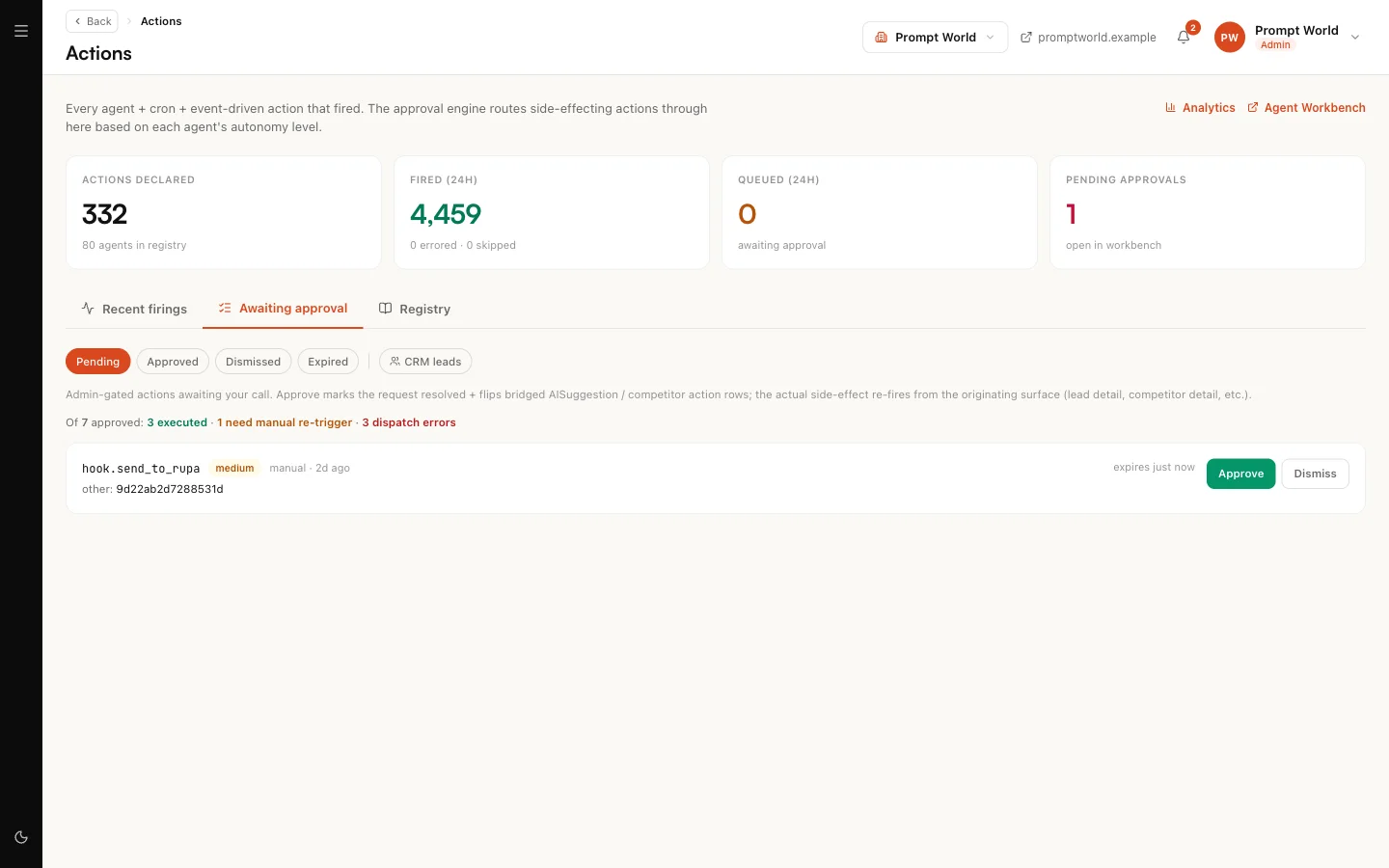
Each AI coworker earns its own trust. Every one starts like a new hire, with everything it does waiting for a person, and earns more freedom as it proves itself, approved by you. A promoted coworker needs you less; one that slips loses the freedom it had. And where your plan includes it, a Nagent marketer sits in the same workspace and owns the number with you.
A colleague and a team
One brilliant colleague is enough for a lot of work. Growth is different. Every action lands on a customer, a budget or a live page, so it needs roles that differ, trust that is earned, rules about what nobody does alone, and someone who answers for the result.
Claude Tag details come from Anthropic's announcement and coverage published between June and August 2026. Nagent examples come from Ridgeline, a demonstration workspace for a fictional manufacturer.
See it working
If your problem is growth and you want a team rather than a toolkit, see the plans on the pricing page, or book a walkthrough with the team. To see list prices at three team sizes, read the cost table in the Claude Tag guide.
Frequently asked questions
What is Claude Tag and how does it work in Slack?
Launched by Anthropic on 23 June 2026, Claude Tag puts Claude into Slack as a single shared identity that sits in a channel. Anyone in the channel can tag it, hand it a task and watch its plan and progress unfold in a thread. It builds up context about the channel's work, and tasks can run for hours or days and be scheduled.
What is Claude's ambient presence in Claude Tag?
It is a per channel setting to respond automatically. With it on, Claude answers untagged messages it judges worth answering, surfaces relevant information from the channels and tools it can reach, and follows up on threads that have gone quiet without resolution.
What controls do admins have over Claude Tag?
Admins decide which tools and data Claude can reach through access bundles, which channels it works in and how much it may spend, with token limits for the organisation and for individual channels. Memory is scoped to the channels an admin defines, and admins can read a log of everything Claude has done and who asked for each task.
Who can use Claude Tag today?
Claude Tag is in beta for Claude Team and Enterprise customers. It needs a paid Slack plan and a Slack owner to set it up, and it replaced the old Claude in Slack app, retired on 3 August 2026. Today it lives only in Slack, though Anthropic has said it wants to reach other places teams work.
How does Nagent decide what each AI coworker can do on its own?
Each AI coworker earns its own trust. Every one starts like a new hire, with everything it does waiting for a person, and earns more freedom as it proves itself, approved by you. A promoted coworker needs you less; one that slips loses the freedom it had. Raising a budget always needs a person.
How does Nagent handle quiet leads, budget changes and risky website edits?
Quiet leads go to NORA, the AI coworker for outbound, who researches each one and drafts a follow up that waits for your sales lead. A budget increase is staged by the paid ads coworker and waits for a person. A risky website change is raised with the head of SEO, with the reason and the risk on the card.
Further reading
- Nagent vs Claude Tag: the sourced comparison guide, with dated screenshots
- Claude Tag alternatives: the other platforms in its category
- Claude Tag dossier: pricing, governance and evidence in one place
- The Earned Autonomy Ladder: How much an AI agent may do alone, decided by its record
- Anatomy of an Agent: A Configuration, Not a Program: The ten declared parts every Nagent agent is built from
- How to evaluate an agentic AI platform: Six criteria, three grades of evidence and one bounded pilot
- Autonomy is not a setting: Nagent vs NoimosAI
- Nagent vs Jasper: a hundred agents is not a team
- Nagent vs Okara: the founder is not a queue
Sources
Facts about Claude Tag are as its own pages and the reports below stated them, checked on 26 September 2026. Products change; the linked pages are the current word.
- Anthropic, Introducing Claude Tag, 23 June 2026 https://www.anthropic.com/news/introducing-claude-tag
- TechRepublic, Anthropic launches Claude Tag, June 2026 https://www.techrepublic.com/article/news-anthropic-claude-tag-ai-agent-slack/
- DataCamp, Claude Tag: Anthropic's AI teammate for Slack, June 2026 https://www.datacamp.com/blog/claude-tag
- AI Builder Club, What is Claude Tag, updated August 2026 https://www.aibuilderclub.com/blog/what-is-claude-tag
- ofox, Claude Tag setup guide, June 2026 https://ofox.ai/blog/claude-tag-slack-setup-guide-2026/
- explainx, Claude Tag guide, updated August 2026 https://explainx.ai/blog/claude-tag-slack-team-ai-collaboration-guide-2026