
Nagent vs Zocket: the brand is not the bottleneck
Zocket builds a brand operating system for enterprise brands. Nagent builds a growth team of AI coworkers organised around your number.
Zocket suits an enterprise brand that wants to look consistent, fast and watched everywhere, with agents in six marketing modules running on a private brand graph. Nagent suits a company whose problem is the number: AI coworkers that earn trust through a track record you approve and carry the work to pipeline and customers.
Nagent in one minute
Nagent is Multiplayer AI for end to end growth: a team of AI coworkers and your own people, working together in one workspace across marketing, sales and customer experience. Three things make it different. You approve the AI coworkers' work until they earn the right to act on their own. They carry the work all the way to pipeline and customers, not just content. And where your plan includes it, a Nagent marketer joins your team and owns the number with you.
At a glance: Zocket and Nagent
| Zocket | Nagent | |
|---|---|---|
| Built around | The brand and its memory | Your growth number |
| Who does the work | Agents in six marketing modules | AI coworkers and your people, in one workspace |
| Who decides what AI can do alone | Rules an administrator sets | A track record each AI coworker earns, approved by you |
| How far the work reaches | Brand, creative, content, ads and reputation | Marketing, sales and customer experience |
| Who owns the result | Your team | Your team, with a Nagent marketer where your plan includes it |
Overview
It is 9:14 on a Monday, and the chief marketing officer of a fast growing consumer brand is looking at the best dashboard she has ever owned.
Share of voice is up six tenths of a point. Five festive concepts cleared approval over the weekend without a single edit. The reputation desk answered most of Saturday's complaints on its own, in eleven seconds on average. The overnight audit log reads like a clean bill of health: 214 autonomous actions, three escalations, nothing unresolved.
Revenue is flat for the third week running.
She does not need another dashboard to tell her the brand is in good shape. She knows it is. What she needs is an answer to a different question, the one her chief executive will ask at ten o'clock: who is moving the number?
That gap, between a brand that is well looked after and a number that refuses to move, is the most expensive blind spot in marketing today. And it is not an accident. It is the natural result of how marketing software has been organised for twenty years.
Every generation of marketing software has been built around a unit. The CRM era organised everything around the account. Marketing automation organised it around the campaign. The first wave of generative AI organised it around the asset: the ad, the post, the article, produced faster and cheaper than ever. Each generation made its unit extraordinarily efficient. None of them made anyone responsible for the outcome.
The agent era is now forcing that choice into the open. When software can do the work rather than assist with it, you have to decide what the work is for. You can organise agents around the brand, and they will make it consistent, fast and watched everywhere. Or you can organise them around the number, and they will try to move it.
This essay is about that choice. It uses one company, Zocket, as the clearest example of the first path, because Zocket has built the most complete version of it we have seen. And it explains why we built Nagent on the second.
The brand operating system
Zocket's story is worth telling, because it mirrors the market. It began as a tool that helped a small business make a Facebook ad in under thirty seconds. Today it calls itself the AI native brand operating system for enterprise brands, and its homepage describes a product that would have seemed like science fiction three years ago.
At its centre is the Brand Brain, a private graph of everything a brand knows, remembers and senses. Zocket shows it streaming from 44 sources, among them owned social, ratings and reviews, paid ads, stock exchange filings, category trends and the Play Store, into 16 layers holding almost one and a half million signals.
On top of the graph sit six modules: brand intelligence, creative, content, performance, reputation and competitor intelligence. Every agent runs what Zocket calls a loop. It reads the graph, plans its steps, acts with tools, clears the human gates and writes the outcome back, so the next run starts smarter than the last.
It is an impressive piece of engineering, and it is the logical end point of a decade of marketing technology built around the brand. The memory is the brand's. The loop improves the brand's playbook. The modules protect and project the brand. If your problem is that a large brand looks different in every market and nobody notices waste until the quarter closes, this is a very good answer.
But notice what the system is optimising. Share of voice. Voice match. Assets approved without edits. Complaints answered in eleven seconds. These are signs of a healthy brand. None of them is revenue, and none of them names who is responsible for it. A brand operating system is the best possible answer to the previous era's question. The agent era is asking a new one.
The approval tax
Look closely at Zocket's own product screen and you will find the most important number in the category. It is not the share of voice. It is the small grey line under the creative module: 25 in approvals.
Every system that puts agents to work on a brand has to decide what they may do alone. The brand operating system answers with gates and rules. Nothing ships past a gate a person did not open. A rules engine decides, by severity, channel and topic, what runs on its own and what escalates to a human. It is careful, auditable and exactly what an enterprise risk team wants to hear.
It also has a cost that compounds quietly, and we call it the approval tax. When autonomy is granted by category, every agent in that category is treated the same way, forever. The agent that has produced flawless work for six months waits at the same gate as the one switched on this morning. So one of two things happens. Either the gates stay closed and the humans become the bottleneck, reviewing an ever growing queue while the agents wait. Or someone widens the rules to clear the queue, and the category is suddenly trusted with more than any agent in it has earned.
The brand operating system has made memory compound. Every run writes back to the graph and the next run starts smarter. What it has not made compound is trust.
There is also a second blind spot. Zocket's six modules cover the brand: intelligence, creative, content, performance, reputation and competitors. They stop where marketing stops. There is no sales team in that list and no one looking after the customer once the order is placed. But for most companies, that is exactly where revenue is won or lost: the enquiry nobody follows up for three days, the first message that reads like a machine guessed at the business, the customer who waits a day to hear about delivery.
The same Monday, in Nagent
Go back to our chief marketing officer at 9:14, and give her a different workspace.
She does not open a brand dashboard. She opens her team. A team of AI coworkers has worked through the night across marketing, sales and customer experience. Most of what they did needed no one. Six things need her.
Six, not twenty five, because in Nagent trust is earned, not set by a rule. Every AI coworker starts like a new hire: everything it does waits for a person. As it proves itself, with good work approved without edits and risky calls correctly handed up, Nagent recommends a promotion and a person signs it off. A promoted coworker needs you less. One that slips loses the freedom it had. The things that must always stay human, like changing the website's structure or raising a budget, stay human at every level.
Then comes the question her chief executive will ask at ten. Last week's campaign brought forty business buyers to the pricing page. In Nagent, that does not end at a click. NORA, the AI coworker for outbound, has researched each account and drafted a first message to the right person. Her sales lead reads them before anything is sent, and nothing is written to the CRM until a person approves it.
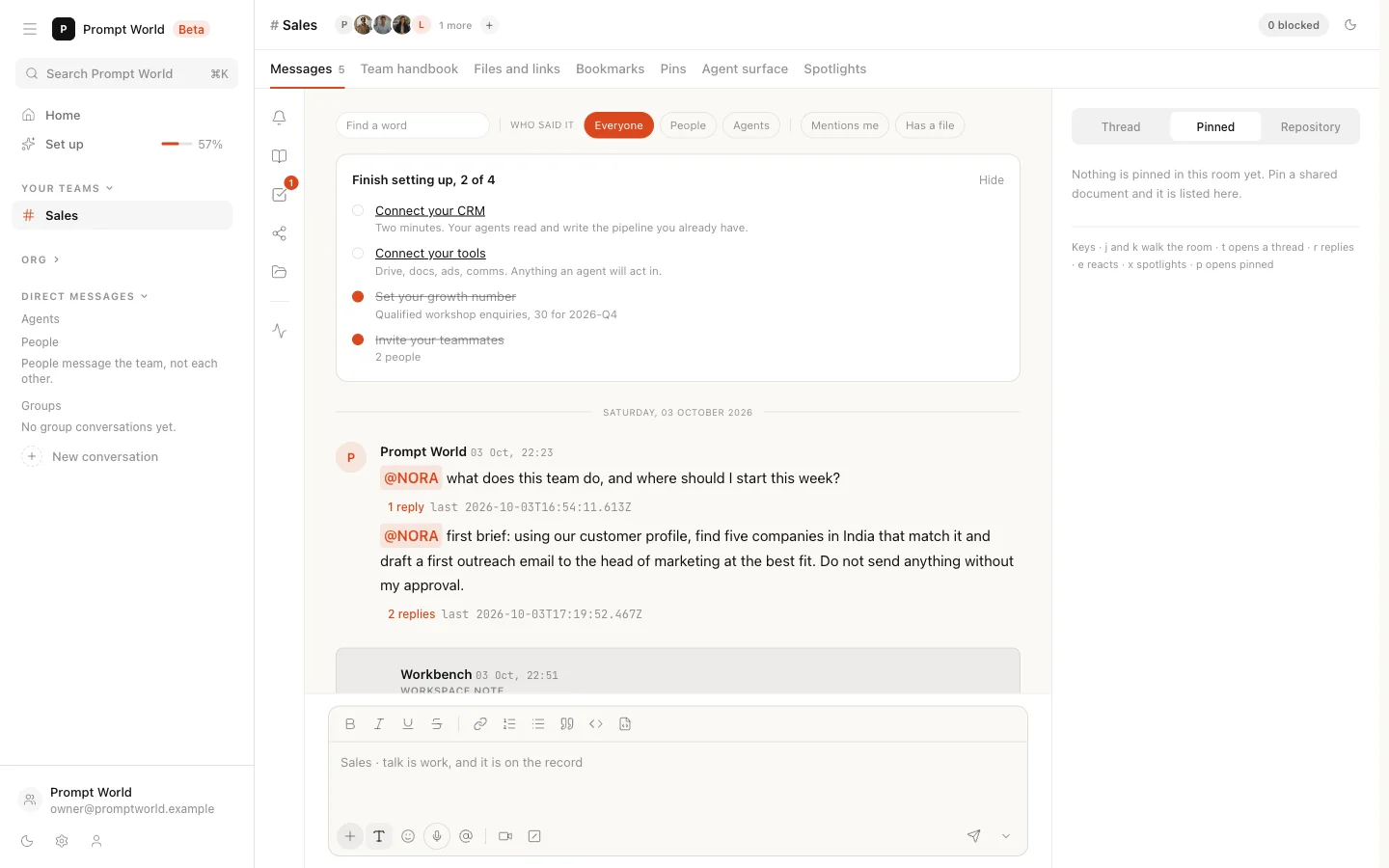
By ten o'clock she has an answer. Not a greener dashboard, but pipeline: who visited, who was contacted, who replied. And where her plan includes it, a Nagent marketer sits in the same workspace, owning that number with her.
The number test
When you choose where to put your agents this year, ask three questions. What is the system organised around: your brand, or your number? How does an agent earn the right to act alone: by a rule, or by a record? And when the number does not move, whose name is on it?
A brand operating system will make your brand better looked after. Nagent is built to move the number.
Zocket product details are taken from zocket.com as it appeared in September 2026. Nagent examples come from Ridgeline, a demonstration workspace for a fictional manufacturer.
See it working
If your problem is growth and you want a team rather than a toolkit, see the plans on the pricing page, or book a walkthrough with the team.
Frequently asked questions
What is Zocket's Brand Brain?
The Brand Brain is a private graph of everything a brand knows, remembers and senses. Zocket shows it streaming from 44 sources, among them owned social, ratings and reviews, paid ads, stock exchange filings, category trends and the Play Store, into 16 layers holding almost one and a half million signals.
What modules does Zocket's brand operating system include?
Six modules sit on top of the graph: brand intelligence, creative, content, performance, reputation and competitor intelligence. Every agent runs a loop: it reads the graph, plans its steps, acts with tools, clears the human gates and writes the outcome back, so the next run starts smarter than the last.
How does Zocket decide what its agents can do on their own?
With gates and rules. Nothing ships past a gate a person did not open, and a rules engine decides, by severity, channel and topic, what runs on its own and what escalates to a human. It is careful, auditable and exactly what an enterprise risk team wants to hear.
What is the approval tax?
When autonomy is granted by category, every agent in that category is treated the same way, forever. The agent with six months of flawless work waits at the same gate as one switched on this morning. Either the gates stay closed and people become the bottleneck, or the rules are widened and the category is trusted with more than any agent in it has earned.
How does Nagent decide what an AI coworker can do without a person?
Every AI coworker starts like a new hire, with everything it does waiting for a person. As it proves itself, Nagent recommends a promotion and a person signs it off. A promoted coworker needs you less; one that slips loses the freedom it had. Changing the website's structure or raising a budget stays human at every level.
What happens in Nagent when a campaign brings buyers to the pricing page?
NORA, the AI coworker for outbound, researches each account and drafts a first message to the right person. The sales lead reads them before anything is sent, and nothing is written to the CRM until a person approves it. The result is pipeline: who visited, who was contacted and who replied.
What should I ask before choosing where to put my AI agents?
Ask three questions. What is the system organised around: your brand, or your number? How does an agent earn the right to act alone: by a rule, or by a record? And when the number does not move, whose name is on it?
Further reading
- The comparison hub: Nagent beside the agent platforms buyers shortlist, sourced and dated
- The Earned Autonomy Ladder: How much an AI agent may do alone, decided by its record
- Anatomy of an Agent: A Configuration, Not a Program: The ten declared parts every Nagent agent is built from
- How to evaluate an agentic AI platform: Six criteria, three grades of evidence and one bounded pilot
- Autonomy is not a setting: Nagent vs NoimosAI
- Nagent vs Jasper: a hundred agents is not a team
- Nagent vs Okara: the founder is not a queue
Sources
Facts about Zocket are as its own pages and the reports below stated them, checked on 30 September 2026. Products change; the linked pages are the current word.
- Zocket, homepage https://zocket.com/