
Nagent vs Microsoft Copilot: the default and the specialist
Microsoft gives you the tools to build agents for everything. Nagent gives growth teams AI coworkers that arrive hired and earn trust.
Microsoft Copilot and Agent 365 are the strongest default for making, finding and governing agents across a whole company, and Nagent sits comfortably inside a Microsoft shop. For growth, Nagent is the specialist: a growth team of AI coworkers that arrives hired, earns its autonomy with your approval, and carries work through to pipeline and customers.
Nagent in one minute
Nagent is Multiplayer AI for end to end growth: a team of AI coworkers and your own people, working together in one workspace across marketing, sales and customer experience. Three things make it different. You approve the AI coworkers' work until they earn the right to act on their own. They carry the work all the way to pipeline and customers, not just content. And where your plan includes it, a Nagent marketer joins your team and owns the number with you.
At a glance: Microsoft Copilot and Nagent
| Microsoft Copilot | Nagent | |
|---|---|---|
| Built around | Every agent in the enterprise | Your growth number |
| Who does the work | Agents your teams build in Copilot, Copilot Studio or Foundry | A growth team of AI coworkers that arrives hired, with your people, in one workspace |
| Who decides what AI can do alone | Permissions IT grants | A track record each AI coworker earns, approved by you |
| How far the work reaches | Whatever agents your teams build | Marketing, sales and customer experience, with a CRM included |
| Who owns the result | Your team | Your team, with a Nagent marketer where your plan includes it |
Overview
In almost every enterprise conversation we have, the same question arrives somewhere in the first half hour. Someone from IT, usually polite and slightly tired, asks: we already have Microsoft, so why would we need you?
It is a fair question, and it deserves a better answer than most vendors give. Microsoft is not a competitor in the ordinary sense. It is the environment. Your people already write in Word, meet in Teams, file in SharePoint and sign in with Entra. Copilot is already in the ribbon of every application they open. When Microsoft decides that agents are part of work, they arrive in your company the way the weather does: everywhere at once, and without anyone having to buy anything new.
Over the past year Microsoft has made that decision emphatically. It has put agents into Copilot, built an Agent Store, given every new agent its own identity, and launched Agent 365, a control plane that lets IT see and govern every agent in the company from one place. Copilot has moved from one to one chats into group conversations in Teams. The stack that results is broad, deep and, for a CIO, deeply reassuring.
Nagent is a specialist. We do one thing, growth, and the honest answer to the IT question is simple: Microsoft gives you the tools to build agents for everything. Nagent gives you a growth team that is already built, and a reason to trust it.
What Microsoft built
The clearest way to understand Microsoft's approach is to follow an agent from birth to governance.
An agent can be born in three places. The simplest is Agent Builder inside Copilot, where anyone with a Copilot licence can describe an agent in natural language, start from a template, give it instructions and knowledge, and test it in a preview pane, with no separate licence. More serious agents are built in Copilot Studio, which connects to internal systems and business rules and is billed in Copilot Credits, at USD 200 a month for 25,000 credits or a cent a credit on pay as you go. The most technical are built in Microsoft Foundry.
Once built, agents are distributed through the Agent Store inside Copilot, which groups them into your own agents, agents built by Microsoft such as Researcher, Analyst and Visual Creator, and agents built by your organisation. Users pin the ones they want; admins can pin others for them.
Then governance takes over. In the Microsoft 365 admin centre, IT decides who may use agents at all, for everyone, no one, or specific users and groups, and which kinds of agents are allowed, such as those built by Microsoft or by external publishers.
Above that sits Agent 365, which became generally available on 1 May 2026. It is priced at USD 15 per user per month, or included in the new Microsoft 365 E7 suite at USD 99 per user per month, and one licence covers every agent a person owns, sponsors, manages or interacts with. Since July 2026, every new agent receives a Microsoft Entra Agent ID, with no opt out at environment level. A central registry lists the prebuilt Microsoft 365 and Teams agents, agents built in Copilot Studio or Foundry, and partner agents, and registry sync with Amazon Bedrock and Google Gemini Enterprise is arriving. At general availability Microsoft also began discovering agents running locally on Windows machines, starting with agents built on OpenClaw.
Around the whole stack sits Work IQ, Microsoft's intelligence layer, which grounds Copilot and its agents in Microsoft 365 content, connected line of business data and Copilot Memory. Microsoft has also brought the technology behind Anthropic's Claude Cowork into Microsoft 365 Copilot.
Some of the most ambitious pieces are still arriving. Autonomous agent identities, in which an agent gets its own mailbox, OneDrive and place in the org chart, remain in Microsoft's Frontier preview programme, and parts of the security layer, including runtime threat protection for agents, were still in public preview in June. But the direction is unmistakable. Microsoft intends to be the place where every agent in the enterprise is born, found, identified and governed.
The growth leader's Tuesday
Microsoft's governance answers the question a CIO asks first: what agents do we have, who owns them, and can we switch them off? That matters, and Nagent sits comfortably inside a company that governs everything else through Microsoft.
But the growth leader asks a different question on a Tuesday afternoon. A paid campaign is converting well and the budget runs out tonight. Can the agent raise it on its own? Has it earned that? And if not, who signs off before six o'clock? A registry can tell her the agent exists. It cannot answer those questions. And if her company runs growth on Microsoft, someone in IT still has to build the agents for search, paid ads, social, content and outbound, connect them to the right tools and decide what each may do. That usually means a backlog.
The same Tuesday, in Nagent
In Nagent, the growth team is already there. AI coworkers for search, paid ads, social, content, outbound and customer experience arrive hired, organised into teams with an AI chief of staff called MIRA, alongside the leader's own people. The CRM comes included.
So on Tuesday afternoon, NIA, the AI coworker for paid ads, has already spotted the converting campaign and staged a budget increase, with the numbers behind it, waiting in the leader's inbox. She approves it in one click before six. Raising a budget always needs a person in Nagent, however senior the AI coworker becomes.
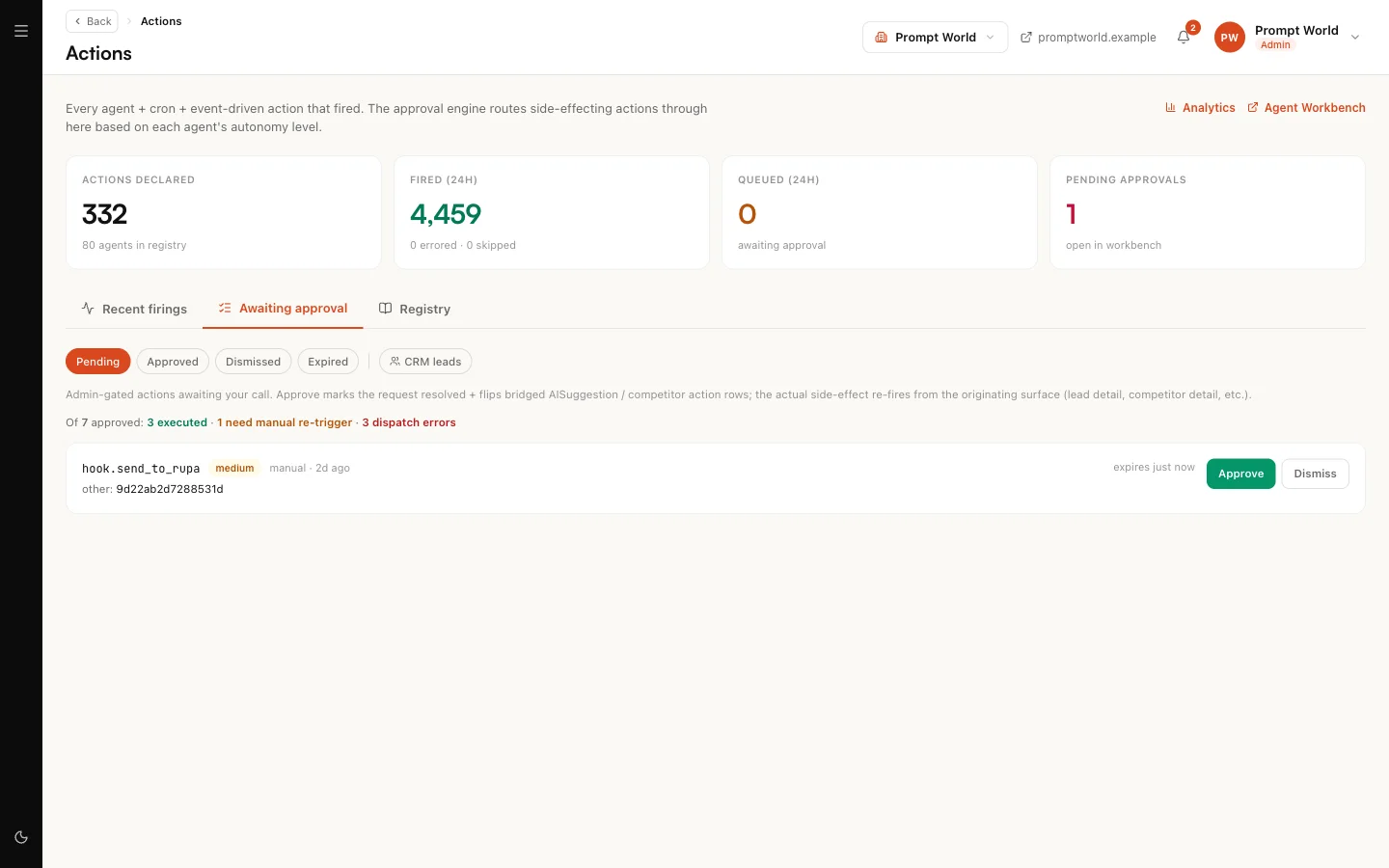
For everything else, trust is earned. Every AI coworker starts like a new hire, with everything it does waiting for a person. As it proves itself, Nagent recommends a promotion and a person signs it off. A promoted coworker needs you less. One that slips loses the freedom it had.
Microsoft governs agents as identities in a directory, with permissions IT grants. Nagent runs them as members of a team, with freedom they earn and can lose. And where your plan includes it, a Nagent marketer sits in the same workspace and owns the number with you.
The default and the specialist
Microsoft has built the most important default in the agent era, the place where agents are made, found and governed across the whole company. Growth is where a specialist earns its place: the work is specific, the stakes are high and the outcome is measurable. Keep Microsoft as your default, and let Nagent run growth.
Microsoft details come from Microsoft's pricing pages and documentation, and from licensing analysis published in 2026.
See it working
If your problem is growth and you want a team rather than a toolkit, see the plans on the pricing page, or book a walkthrough with the team.
Frequently asked questions
We already have Microsoft 365 Copilot, so why would we need Nagent for growth?
Microsoft gives you the tools to build agents for everything. Nagent gives you a growth team that is already built. If your company runs growth on Microsoft, someone in IT still has to build the agents for search, paid ads, social, content and outbound, connect them to the right tools and decide what each may do, which usually means a backlog. In Nagent those AI coworkers arrive hired.
What is Microsoft Agent 365 and what does it cost?
Agent 365 is Microsoft's control plane that lets IT see and govern every agent in the company from one place. It became generally available on 1 May 2026 at USD 15 per user per month, or included in the Microsoft 365 E7 suite at USD 99 per user per month, and one licence covers every agent a person owns, sponsors, manages or interacts with.
How is Copilot Studio priced for building more serious agents?
Copilot Studio, which connects agents to internal systems and business rules, is billed in Copilot Credits: USD 200 a month for 25,000 credits, or a cent a credit on pay as you go. Simpler agents can be built in Agent Builder inside Copilot by anyone with a Copilot licence, with no separate licence.
How does Nagent decide what an AI coworker may do on its own?
Trust is earned. Every AI coworker starts like a new hire, with everything it does waiting for a person. As it proves itself, Nagent recommends a promotion and a person signs it off. A promoted coworker needs you less, and one that slips loses the freedom it had. Microsoft governs agents as identities in a directory, with permissions IT grants.
Can a Nagent AI coworker raise an ad budget without a person approving it?
No. Raising a budget always needs a person in Nagent, however senior the AI coworker becomes. NIA, the AI coworker for paid ads, can spot a converting campaign and stage a budget increase with the numbers behind it, and the increase waits in the leader's inbox until she approves it in one click.
Does Nagent work inside a company that governs its agents through Microsoft?
Yes. Microsoft's governance answers the question a CIO asks first: what agents do we have, who owns them, and can we switch them off? Nagent sits comfortably inside a company that governs everything else through Microsoft. Keep Microsoft as your default, and let Nagent run growth.
Further reading
- The comparison hub: Nagent beside the agent platforms buyers shortlist, sourced and dated
- The Earned Autonomy Ladder: How much an AI agent may do alone, decided by its record
- Anatomy of an Agent: A Configuration, Not a Program: The ten declared parts every Nagent agent is built from
- How to evaluate an agentic AI platform: Six criteria, three grades of evidence and one bounded pilot
- Autonomy is not a setting: Nagent vs NoimosAI
- Nagent vs Jasper: a hundred agents is not a team
- Nagent vs Okara: the founder is not a queue
Sources
Facts about Microsoft Copilot are as its own pages and the reports below stated them, checked on 26 September 2026. Products change; the linked pages are the current word.
- Microsoft, Microsoft 365 Copilot plans and pricing https://www.microsoft.com/en-us/microsoft-365-copilot/pricing
- Microsoft, Copilot Studio plans and pricing https://www.microsoft.com/en-us/microsoft-365-copilot/pricing/copilot-studio
- Microsoft, Microsoft 365 documentation on GitHub https://github.com/MicrosoftDocs/microsoft-365-docs
- Winbuzzer, Microsoft Agent 365 hits general availability (May 2026) https://winbuzzer.com/2026/05/02/microsoft-agent-365-general-availability-local-ai-agents-xcxwbn/
- A Guide to Cloud and AI, Agent 365 pricing and licensing guide (2026) https://www.aguidetocloud.com/licensing/agent-365/
- SAMexpert, Agent 365 licensing (June 2026) https://samexpert.com/agent-365/
- Atlan, Microsoft Copilot Studio agents: build, cost and governance (August 2026) https://atlan.com/know/ai-agent/ai-agent-applications/what-are-microsoft-copilot-studio-agents/