
The record is not the team: Nagent vs HubSpot Agent Hub
CRM native agents see the customer. Growth needs agents that see the work. How HubSpot Agent Hub and Nagent differ for a growth team.
HubSpot Agent Hub is the most complete CRM native agent offering, and a natural next step for a company that already runs on HubSpot. Nagent suits a team that needs the team itself run: AI coworkers and people in one workspace, trust earned through a track record you approve, and a CRM included, so there is nothing to migrate.
Nagent in one minute
Nagent is Multiplayer AI for end to end growth: a team of AI coworkers and your own people, working together in one workspace across marketing, sales and customer experience. Three things make it different. You approve the AI coworkers' work until they earn the right to act on their own. They carry the work all the way to pipeline and customers, not just content. And where your plan includes it, a Nagent marketer joins your team and owns the number with you.
At a glance: HubSpot Agent Hub and Nagent
| HubSpot Agent Hub | Nagent | |
|---|---|---|
| Built around | The CRM record | Your growth number |
| Who does the work | Agents configured per task, on a dashboard | AI coworkers and your people, in one workspace |
| Who decides what AI can do alone | How each agent is configured | A track record each AI coworker earns, approved by you |
| How far the work reaches | Marketing, sales and service, inside HubSpot's CRM | Marketing, sales and customer experience, with its own CRM included |
| Who owns the result | Your team | Your team, with a Nagent marketer where your plan includes it |
Overview
For twenty years the CRM has been the closest thing a company has to a memory of its customers. Every email, every call, every deal stage and every support ticket ends up as a line on a record. So when agents arrived, the obvious move for a CRM company was to put them on top of that record. The agents would know the customer from the first day, because the customer was already there.
It is a powerful idea, and nobody has executed it more thoroughly than HubSpot.
It also contains an assumption worth examining. It assumes that the hardest thing about growth is knowing the customer. In our experience, the hardest thing about growth is running the team that serves them: deciding who does what, who is trusted with what, what happens when something goes wrong, and who answers for the number. A record knows the customer. It does not run the team.
Agents that live in the record
On its public Agent Hub page, HubSpot now presents its agents under one roof called Agent Hub, with a headline that states the ambition plainly: all of your AI agents, managed in one place. Build demand, win deals and serve your customers with a team of AI agents for marketing, sales and customer service. Built on your CRM data, the agents have the context they need to drive results. On the same page, HubSpot says 306,000 customers trust it worldwide.
The agents are organised by outcome along the customer journey: build, win, delight, scale. Content, campaign and nurture agents build demand. Prospecting, deal progression and revenue agents win deals. Customer and knowledge base agents delight customers. A data agent helps the business scale.
Inside the product, a dashboard lets a team run its AI by outcome. Each outcome shows its featured agents and a measure of what they have done: how many contacts a nurture agent has engaged, how a prospecting agent is performing, how much of the customer agent's work resolves on its own. Below it, a builder lets teams describe a custom agent in plain language, such as one that writes a pre call summary from CRM records.
HubSpot's page says Agent Hub is included in its Starter, Professional and Enterprise editions, and many agents run on HubSpot Credits, so companies pay as the agents work.
This is the most complete version of the CRM native agent idea on the market. For a company that already runs its business on HubSpot, it is a natural next step.
Record first
But look at the shape of it. The agents are listed under goals on a dashboard. They are configured, switched on and measured by the tasks they complete. They know the customer because they live in the record. What they do not have is a place in a team.
We call this design record first. It answers the question what does the agent know, and it answers it superbly. It leaves three other questions to the humans around it.
The first is who the agent works with. A record has no room in it. The people deciding this quarter's plan, the approvals waiting for a lead, the debate about which accounts to prioritise, all of that happens somewhere else, in email, in Slack, in meetings. The agents see the result of those conversations when it lands on the record, not the conversations themselves.
The second is how much the agent is trusted. As Agent Hub presents it, an agent is configured for a task and switched on. Nothing on the page describes an agent that earns more freedom as its record improves, or loses some after a mistake. It is trusted as much as its configuration says.
The third is who owns the outcome. A dashboard can report that a nurture agent engaged forty percent of contacts. It cannot tell you whose job it is to make next quarter's number, or what happens when the percentage falls.
And there is a practical limit hiding in plain sight. Record first agents are only as good as the record they live in. To use them, you run your business on that CRM. For a company already on HubSpot, that is a strength. For everyone else, it is a migration before the first agent can start.
A Monday pipeline review, two ways
Picture the Monday pipeline review at a fast growing software company. The CRM dashboard looks healthy. The nurture agent engaged forty percent of contacts last week. The prospecting agent flagged thirty accounts. And then the head of growth asks the question every pipeline review ends on: so who is following up on these, and who decided we could send that sequence without checking it?
Nobody in the room is quite sure. The agents did their tasks. The team running them is still the team it always was, coordinating in email, chat and meetings.
Now run the same Monday in Nagent. The head of growth opens a workspace where her people and her AI coworkers work as one team. The first screen is not a dashboard of agents. It is the team: what ran overnight, and the handful of decisions that need her.
The thirty accounts are not a list on a record. NORA, the AI coworker for outbound, has researched each one and drafted a first message, and the sales lead is reading them in the same room before anything is sent. The CRM comes with Nagent, so there is nothing to migrate before the team can start.
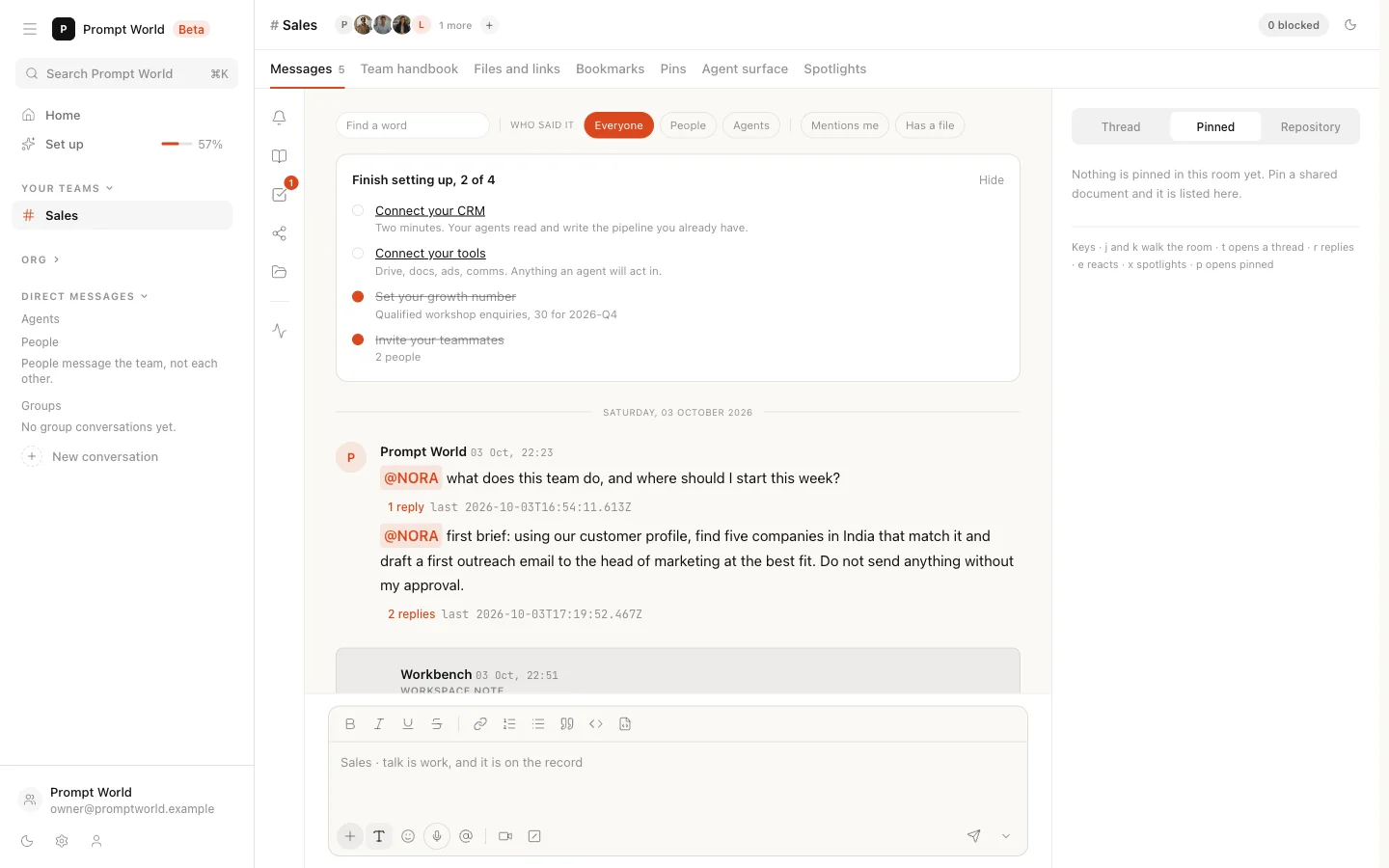
And the question of who decided what is answered by design. Every AI coworker starts like a new hire, with everything it does waiting for a person. As it proves itself, Nagent recommends a promotion and a person signs it off. A promoted coworker needs you less; one that slips loses the freedom it had. The decisions that must always stay human, like sending to a prospect or changing a budget, stay human at every level.
Where her plan includes it, a Nagent marketer sits in the same workspace too, owning the number with her.
The customer and the team
A CRM knows your customer. Someone still has to run the team that serves them: decide who does what, trust the AI coworkers that have earned it, stop the ones that have not, and answer for the quarter. That work happens in a room, not a record.
HubSpot product details are taken from HubSpot's public Agent Hub page as it appeared in September 2026. Nagent examples come from Ridgeline, a demonstration workspace for a fictional manufacturer.
See it working
If your problem is growth and you want a team rather than a toolkit, see the plans on the pricing page, or book a walkthrough with the team. To see list prices at three team sizes, read the cost table in the HubSpot Agent Hub guide.
Frequently asked questions
What is HubSpot Agent Hub, and what does it do?
On its public Agent Hub page, HubSpot presents all of its AI agents managed in one place, for marketing, sales and customer service, built on CRM data. The agents are organised by outcome along the customer journey: build demand, win deals, delight customers and scale, with a builder for describing custom agents in plain language.
What does record first mean when comparing AI agents?
Record first is a design that answers what the agent knows, because the agent lives in the CRM record. It answers that superbly, but leaves three questions to the humans around it: who the agent works with, how much it is trusted, and who owns the outcome.
Do I need to run my business on HubSpot to use Agent Hub?
Record first agents are only as good as the record they live in, so to use them you run your business on that CRM. For a company already on HubSpot, that is a strength. For everyone else, it is a migration before the first agent can start. Nagent comes with its own CRM, so there is nothing to migrate.
How does Nagent decide how much an AI coworker is trusted?
Every AI coworker starts like a new hire, with everything it does waiting for a person. As it proves itself, Nagent recommends a promotion and a person signs it off. A promoted coworker needs you less, and one that slips loses the freedom it had. Sending to a prospect or changing a budget stays human at every level.
How is HubSpot Agent Hub priced?
On its Agent Hub page, HubSpot says Agent Hub is included in its Starter, Professional and Enterprise editions, and many agents run on HubSpot Credits, so companies pay as the agents work. For Nagent, see the plans on the pricing page.
What does a Monday pipeline review look like in Nagent?
The head of growth opens a workspace where her people and AI coworkers work as one team, showing what ran overnight and the decisions that need her. NORA, the AI coworker for outbound, has researched each flagged account and drafted a first message, and the sales lead reads them in the same room before anything is sent.
Who owns the growth number with Nagent?
Your team owns the result. Where your plan includes it, a Nagent marketer sits in the same workspace and owns the number with you, so the question of whose job it is to make next quarter's number has an answer.
Further reading
- Nagent vs HubSpot Agent Hub: the sourced comparison guide, with dated screenshots
- HubSpot Agent Hub alternatives: the other platforms in its category
- HubSpot Agent Hub dossier: pricing, governance and evidence in one place
- The Earned Autonomy Ladder: How much an AI agent may do alone, decided by its record
- Anatomy of an Agent: A Configuration, Not a Program: The ten declared parts every Nagent agent is built from
- How to evaluate an agentic AI platform: Six criteria, three grades of evidence and one bounded pilot
- Autonomy is not a setting: Nagent vs NoimosAI
- Nagent vs Jasper: a hundred agents is not a team
- Nagent vs Okara: the founder is not a queue
Sources
Facts about HubSpot Agent Hub are as its own pages and the reports below stated them, checked on 30 September 2026. Products change; the linked pages are the current word.
- HubSpot (the essay draws on HubSpot's public Agent Hub page, September 2026) https://www.hubspot.com